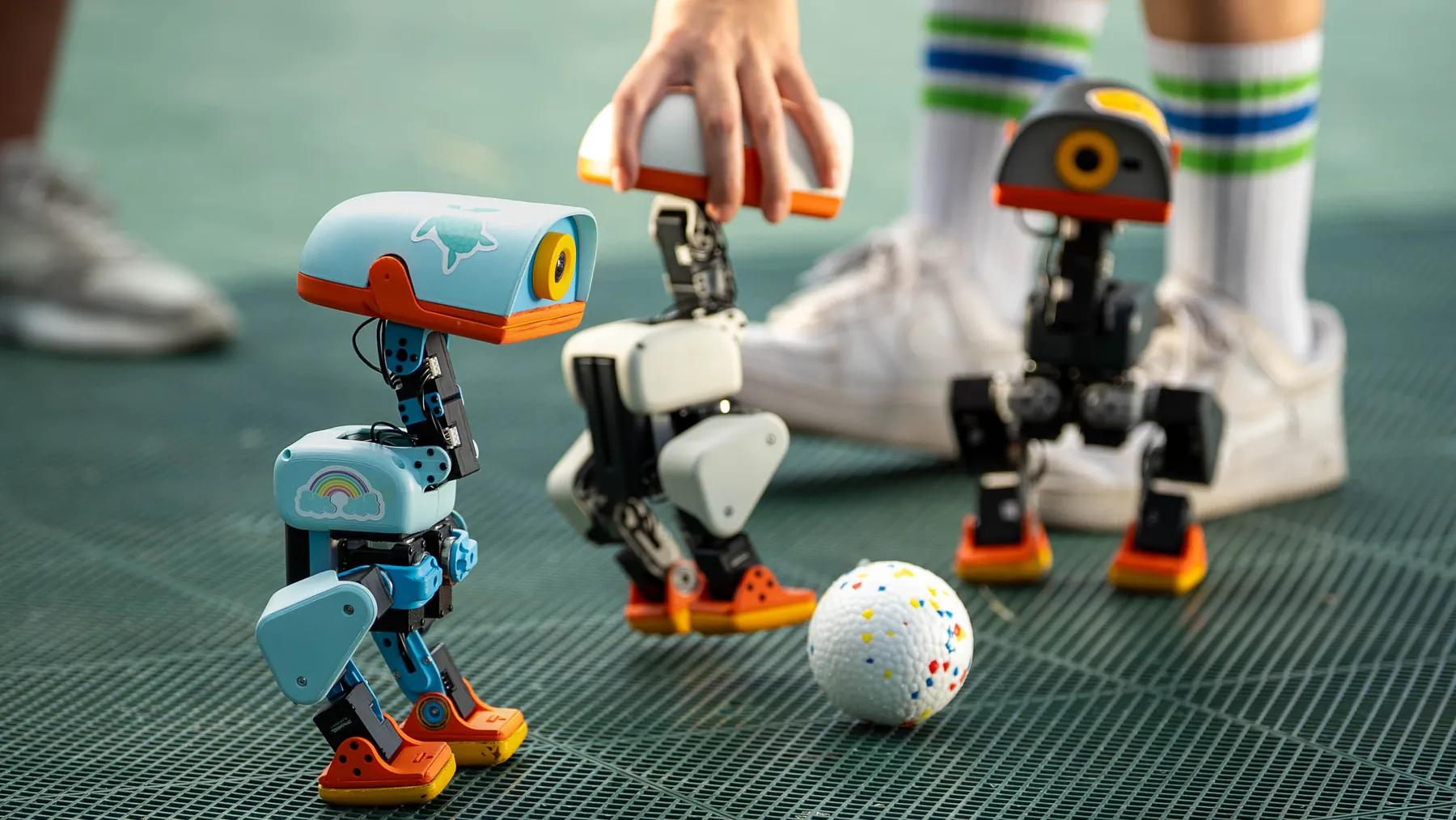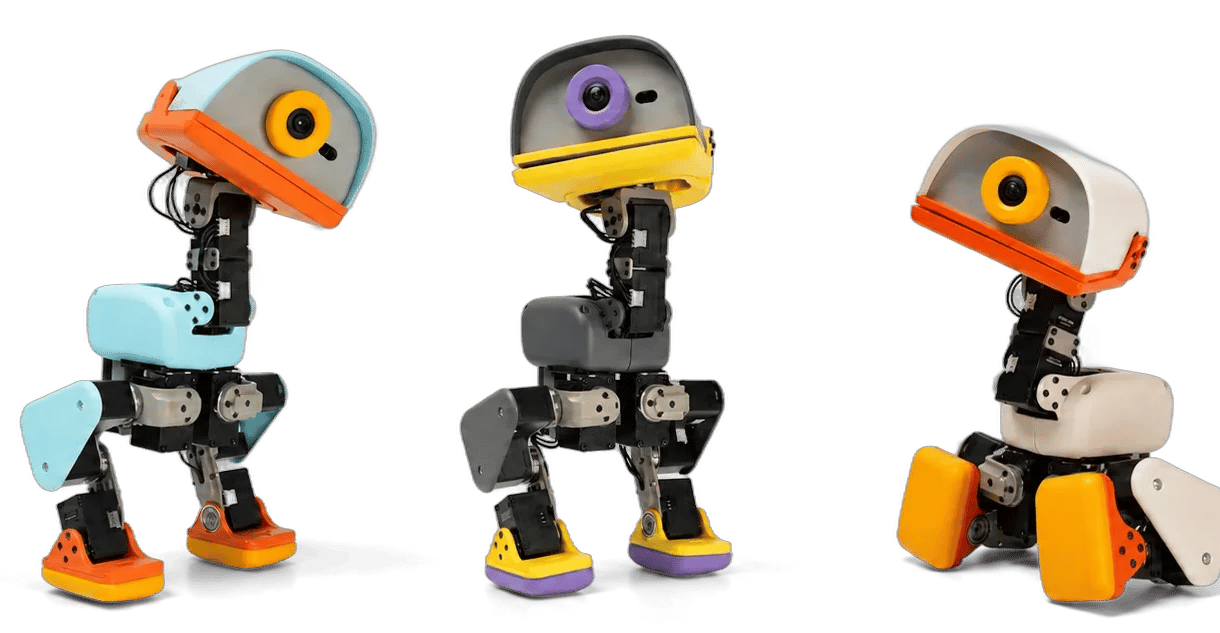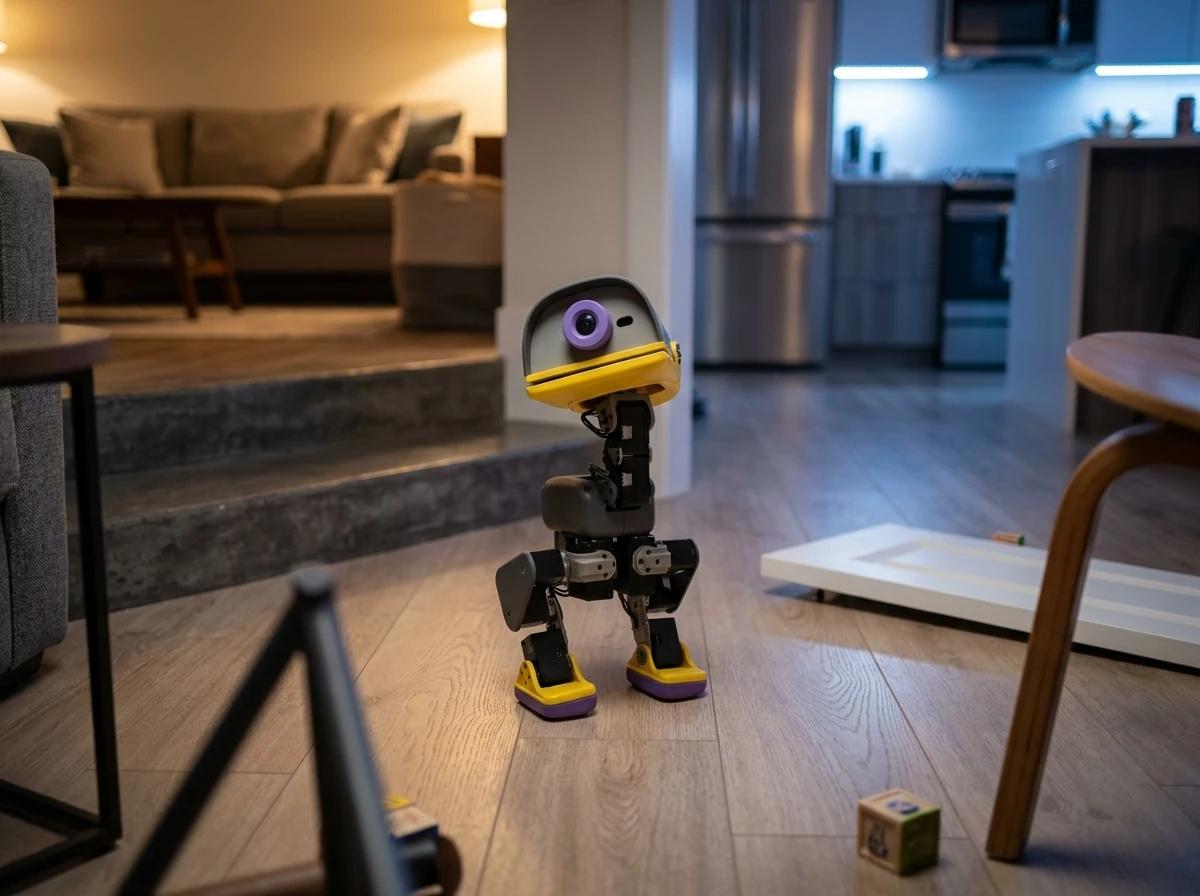
MicroDuck can walk. That doesn't mean it knows where to go.
This distinction is easy to miss when watching the launch videos.
You see a little robot walking across the floor, standing back up after a fall, rolling around on skates, and responding to commands. It has a camera, LiDAR, two IMUs, Wi-Fi and Bluetooth, and a software stack built around learned physical behaviors. (Pollen Robotics)
The natural next question is:
Could I just tell MicroDuck to go to another room?
Not today, at least not as a finished autonomous home-robot feature.
And I think that's actually one of the most interesting things about MicroDuck.
Because there's a huge difference between:
a robot that can walk
and:
a robot that can navigate.
And an even bigger difference between:
a robot that can navigate
and:
a robot that can operate on its own.
Walking is the easy part of the sentence
MicroDuck's core locomotion is already surprisingly capable for such a small machine.
Pollen says its learned behaviors include walking, sitting and standing, kicking, grabbing, roller skating, and getting back up after falling. The robot uses a 50 Hz control loop with fifteen servos driven by neural policies. (Pollen Robotics) (GitHub)
That's locomotion.
The robot knows, in a sense, how to make its body move.
But imagine giving it a much less specific instruction:
“Go to the kitchen.”
Now the robot needs to solve a completely different problem.
Where is the kitchen?
Where am I now?
Which direction should I go?
Is that chair blocking the path?
Did somebody move the chair?
Can I walk around it?
Did I actually arrive?
What if I fall halfway there?
What if the usual path is blocked?
That is no longer just locomotion.
That's navigation.
Pollen itself describes navigation as a future challenge
This isn't me inventing a roadmap for MicroDuck.
When a Pollen Robotics engineer introduced the project on Reddit, they described the robot's mobility capabilities as already “decent” but said the next major challenge was getting to autonomous behaviors.
They specifically named:
- natural language;
- SLAM;
- navigation;
- grasping;
as areas that would be interesting to explore on the platform.
For navigation, they described the problem in terms of mapping and localization, obstacle avoidance, and path planning, and suggested that an open-source navigation stack such as Nav2 could potentially be adapted to MicroDuck. (Reddit)
That tells us something important.
Autonomous navigation is not a finished MicroDuck feature. It is one of the problems the platform is designed to let people explore.
That's a much more honest way to look at it.
So what does navigation actually require?
The terminology can make this sound more complicated than it needs to be.
At a very high level, a navigating robot has to answer three questions:
Where am I?
That's localization.
Where is everything around me?
That's perception and mapping.
How do I get there?
That's planning.
Humans do this almost unconsciously.
You walk into a room and immediately know roughly where you are.
You see a chair and know you can't walk through it.
You decide to walk around it.
You recognize the kitchen.
You don't need to build an explicit map in your head before every step.
A robot has to turn those same abilities into software.
MicroDuck already has some of the hardware that makes the problem possible.
It has a camera.
It has LiDAR.
It has IMUs.
It has a body capable of moving around.
The missing part isn't simply “add a navigation button.”
The missing part is a system that can connect those inputs to reliable movement decisions.
LiDAR doesn't mean it can automatically navigate
This is another important distinction.
Seeing that MicroDuck has LiDAR can make it tempting to assume:
“Great. It can map my house.”
Not necessarily.
A sensor gives you information.
Software turns information into decisions.
A LiDAR sensor can tell the system about distances and surroundings.
A camera can provide visual information.
An IMU can provide information about the robot's movement and orientation.
None of those sensors, by themselves, answer:
“Where should I go next?”
They are inputs to the navigation problem.
And this is one of the reasons I think MicroDuck is an interesting platform rather than a finished autonomous robot.
It already has a lot of the ingredients.
Now people have to make them work together.
The simulator may be more important than it looks
This is where MicroDuck's sim-to-real design becomes relevant again.
Pollen built MicroDuck so that learned behaviors can be trained in simulation and then deployed to the real robot. The current software ecosystem includes the robot repository, simulation tools and reinforcement-learning tooling, with the stated goal of letting developers train and refine new physical behaviors before deploying them on hardware. (Pollen Robotics) (GitHub)
Navigation is exactly the kind of problem where that approach could become useful.
Imagine testing thousands of simulated situations:
chair in the middle of the room;
narrow passage;
obstacle appears;
robot starts facing the wrong direction;
robot loses its position;
robot falls;
route changes.
You can learn from those failures much faster in simulation than you can by physically crashing a robot into your furniture all day.
That doesn't mean simulation magically solves navigation.
Reality will always introduce problems the simulator didn't predict.
But it changes the economics of experimentation.
And that is one of the reasons the MicroDuck platform is interesting.
The community is already moving toward this layer
The GitHub repository is changing quickly.
The current public repository has active development around the robot software, and recent releases include work related to mapping and localization (maploc), remote camera, policy-space and other pieces of the system. The repository currently shows hundreds of forks, while new pull requests continue to appear around camera, policy and system capabilities. (GitHub) (GitHub)
I would not interpret a maploc development build as:
“MicroDuck now navigates your house.”
That would be overclaiming.
What it does show is something more modest and more useful:
the software stack is actively moving toward capabilities that could support more sophisticated autonomous behavior.
That's the direction I'd watch.
What would “home navigation” actually look like?
Let's make it concrete.
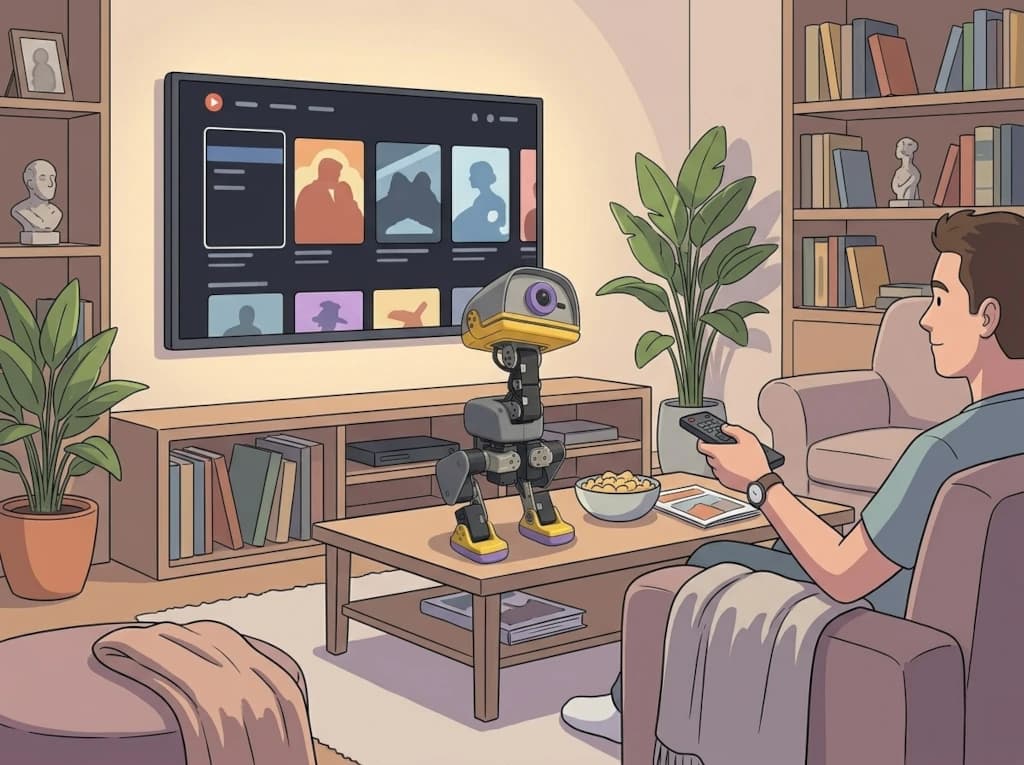
Suppose you put MicroDuck on the floor in your living room.
You say:
“Go to my desk.”
That sounds like a simple command, but it is very different from the kind of first-day demos and use cases people usually start with.
For that to work reliably, MicroDuck would need to understand at least:
Its current position
It needs some idea of where it is relative to the environment.
The destination
It needs to know what “my desk” means.
The environment
It needs to detect obstacles and relevant landmarks.
A route
It needs to choose a path.
Movement
It needs to execute that path with its physical body.
Recovery
It needs to handle unexpected changes.
And then there is the last part that is easy to overlook:
knowing that it actually succeeded.
A robot that walks toward your desk but stops halfway isn't autonomous.
A robot that arrives at your desk but doesn't know it arrived isn't particularly useful either.
Navigation is therefore not just:
map + motors.
It's a continuous loop:
perceive → locate → plan → move → check → adjust
And that loop has to keep running in the real world.
Then there is the problem of stairs
This is where small desktop robots run into a reality problem.
A robot can look surprisingly capable in a controlled environment.
But a normal home is not a robotics laboratory.
There are stairs.
Thresholds.
Carpets.
Cables.
Pets.
People.
Shoes.
Bags.
Chair legs.
Low tables.
Slippery surfaces.
Different lighting.
Things that move.
Things that are suddenly in the way.
MicroDuck is only about 25 cm tall.
That is part of its appeal.
It is also part of the problem.
The smaller the robot, the more its world changes scale.
A coffee table becomes enormous relative to it.
A small obstacle can become a serious navigation problem.
A route that looks trivial to a human may be surprisingly difficult for a tiny biped.
This is why I would be skeptical of any claim that treats:
“It walks.”
as evidence that:
“It can operate autonomously throughout your home.”
Those are very different achievements.
Navigation is also different from autonomy
This distinction matters even more.
Imagine MicroDuck can successfully build a map and navigate to your desk.
That's impressive.
But it still might need you to tell it what to do.
“Go to my desk.”
“Come back.”
“Look at the door.”
That's navigation.
Autonomy begins to look different.
The robot might decide:
“My battery is getting low. I should return to the charging station.”
Or:
“You called me, so I'll come over.”
Or:
“Something changed in the room, so I should investigate.”
Or:
“I finished the task. I should return to where I normally stay.”
Now you're not just asking the robot to follow a route.
You're giving it a reason to move.
That's a much harder problem.
This is where the previous LLM discussion comes back
This is where the previous LLM discussion comes back — and if you want the longer version, it's worth reading what happens when MicroDuck gets an LLM.
A language model can potentially help MicroDuck understand high-level instructions.
For example:
“Go check the kitchen.”
The LLM can interpret that as an intention.
But it doesn't replace the navigation system.
The robot still needs to figure out:
where the kitchen is;
where it is now;
how to get there;
what obstacles are in the way.
This is why the architecture matters.
Pollen's own engineer has pointed out that modern approaches to natural language, SLAM, navigation and other higher-level tasks can be too computationally heavy to run entirely inside the small robot, meaning a laptop or other external computer may be needed for some experiments. (Reddit)
So the future MicroDuck architecture may look less like:
everything happens inside the duck
and more like:
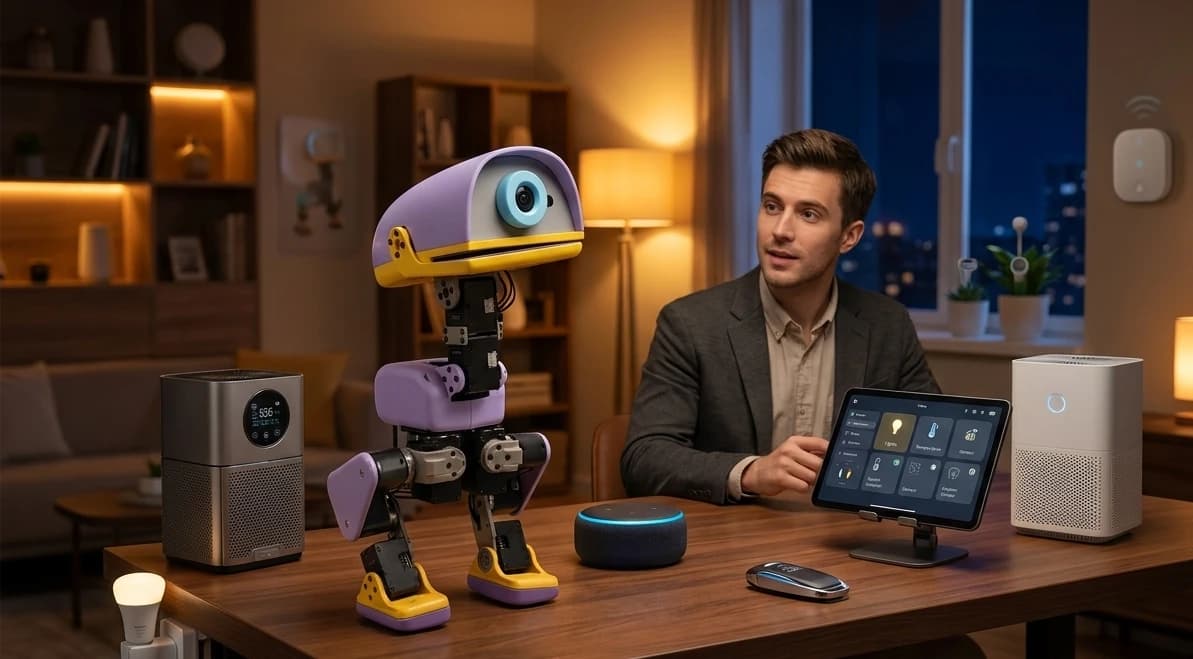
robot body + local control + external intelligence
That's not necessarily a weakness.
It's how many robotics systems are built — and it's also why the $399 price isn't the whole cost is worth thinking about.
I actually think this is better for MicroDuck
One of the most interesting things about MicroDuck is that it doesn't have to solve every problem itself.
The robot can provide:
- sensors;
- actuators;
- physical movement;
- low-level control.
A computer can provide:
- heavier models;
- mapping;
- planning;
- LLMs;
- external services.
The community can provide:
- new behaviors;
- integrations;
- experiments;
- software improvements.
That division could make the platform much more flexible.
And it fits the open-source philosophy we've already discussed.
The robot doesn't have to become the final answer.
It can become a platform that other people build the answers on top of.
But would I trust MicroDuck to roam around my home today?
No.
Not as a normal consumer product.
That's not an insult.
It's simply a consequence of where the project is right now.
Pollen describes autonomous navigation as an area for future exploration, not as a finished out-of-the-box MicroDuck feature. (Reddit)
And I think that's actually the correct expectation to have.
Today, MicroDuck is much more compelling as:
a small, mobile, open robot platform
than as:
an autonomous home robot.
That difference is important when deciding what you're actually getting for $399.
What would change my mind?
There are a few milestones I'd watch.
First: reliable localization
The robot needs to know where it is without constantly getting lost.
Second: obstacle avoidance
Not just detecting an obstacle, but reliably deciding how to get around it.
Third: repeatable destination navigation
Tell it to go somewhere and have it succeed repeatedly, not just once in a demo.
Fourth: recovery
A good autonomous robot needs to deal with mistakes.
Fifth: charging
Eventually, it should be able to manage its own battery rather than requiring you to intervene.
We've already discussed why I think self-charging is more important than it sounds. A robot that can navigate around your home but needs you to find it and plug it in every hour is only partially autonomous.
Sixth: useful behavior on arrival
Getting to your desk is not the goal.
Doing something useful once it gets there is.
That's where navigation starts connecting to the rest of the physical-AI stack.
And that's where things get genuinely interesting
Imagine:
“Go check whether I left the bedroom light on.”
Now MicroDuck needs more than navigation.
It needs:
navigation
Get there.
perception
See the light.
reasoning
Understand what you're asking.
action
Potentially interact with the environment.
communication
Come back and tell you what it found.
That is no longer a robot walking around.
That's an AI system acting in a physical environment.
And that is the version of MicroDuck that I think is really worth watching.
My take
I don't think the most interesting question about MicroDuck is:
“Can it walk around my house?”
The better question is:
“Can it eventually understand where it is, where it needs to go, why it should go there, and what to do when it arrives?”
Walking solves only one piece of that problem.
Navigation solves another.
Autonomy connects them into something much bigger.
MicroDuck already has a surprisingly capable physical foundation for its size, and Pollen has deliberately made the software stack open enough for the community to experiment with these higher-level behaviors. The company's own engineers have singled out SLAM, navigation and autonomous behaviors as important areas to explore next. (Pollen Robotics) (Reddit)
But I wouldn't pretend we're already there.
Today, MicroDuck can move.
The exciting question is whether the community can teach it where to go.
And eventually, whether it can figure out why it should go there in the first place.