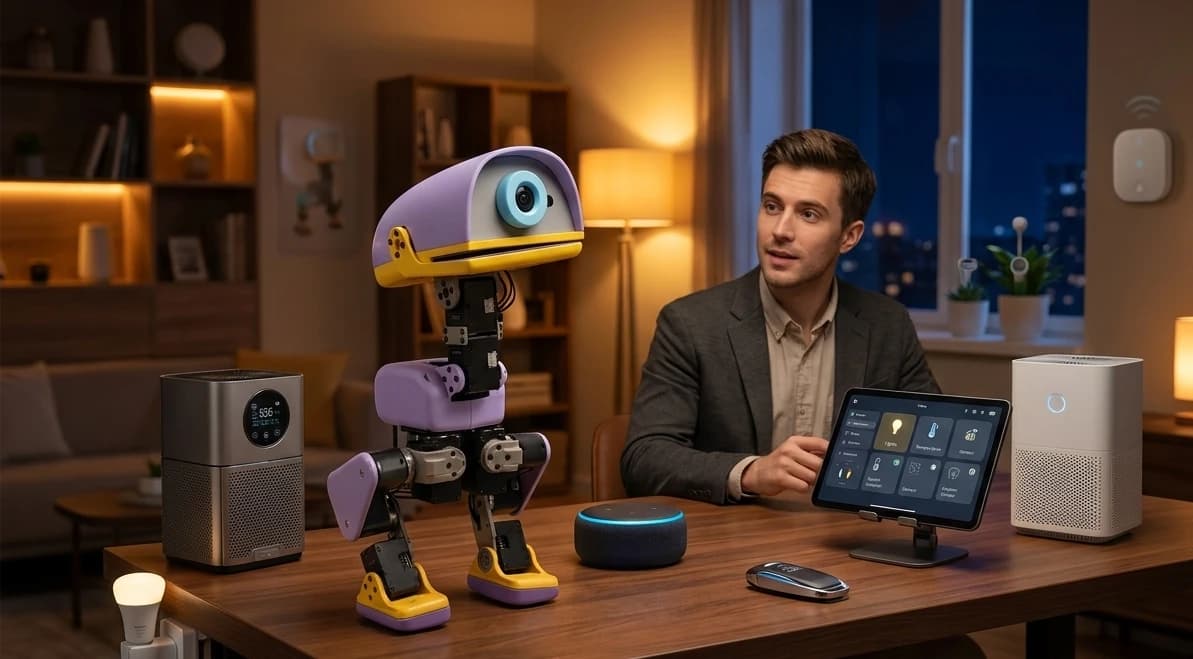
Turning on a light isn't the interesting part. Giving your smart home a physical presence is.
At first, connecting MicroDuck to a smart home sounds almost gimmicky.
Why would you need a small robot to control your lights when your phone, smart speaker, watch, and voice assistant can already do it?
That's a fair question.
And if all MicroDuck does is replace:
“Hey Google, turn on the lights”
with:
“MicroDuck, turn on the lights”
then I don't think the integration is particularly interesting.
But there is a more interesting possibility.
What if MicroDuck becomes a physical interface between AI and the environment around you?
That is a different proposition.
And people are already experimenting in that direction.
MicroDuck isn't a smart-home hub
Let's get this distinction out of the way first.
MicroDuck isn't being sold as a smart-home controller.
Pollen's current software architecture, however, is designed to let external programs communicate with the robot over its API and remote interfaces. The architecture explicitly discusses a server-side program, such as an LLM, observing and controlling the robot, and the same underlying robot API is intended to be accessible from different clients. (GitHub)
That matters because it means MicroDuck doesn't have to work alone.
It can potentially become one part of a larger system.
And that's where smart-home integration starts to make sense.
Someone is already trying this
This isn't just theoretical.
A recent community project called QuackSat is experimenting with turning MicroDuck into a voice satellite for Home Assistant.
The developer explained that they had preordered a MicroDuck but wouldn't receive it until December, so they started building the software before the physical robot arrived. Their prototype already uses real Home Assistant services and real LLMs calling robot tools through MCP, while the MicroDuck daemon runs in a simulated mode for development. (Reddit)
I find this more interesting than the headline “MicroDuck can control your smart home.”
Because the project changes the role of the robot.
It isn't simply another smart-home remote.
It's experimenting with the robot as a voice, AI and physical interface.
That distinction is important.
What would MicroDuck actually add?
Let's take a normal smart home.
You might already have:
- smart lights;
- plugs;
- thermostats;
- cameras;
- speakers;
- sensors;
- routines;
- voice assistants.
The digital infrastructure is already there.
So what does a robot add?
The obvious answer is:
another way to control it.
I don't think that's enough.
The more interesting answer is:
a device that can physically exist inside the same environment it is helping you control.
That changes the interaction.
A smart speaker sits somewhere and waits for you to speak.
A phone is something you pick up.
A robot can potentially move, look, react and speak.
That gives it a different kind of presence.
Imagine a simple example
Suppose it is evening.
Your smart home knows:
- the time;
- the room you're in;
- the lights that are on;
- the thermostat;
- maybe your music;
- perhaps other sensors around the house.
Normally, all of that information lives inside an app or automation system.
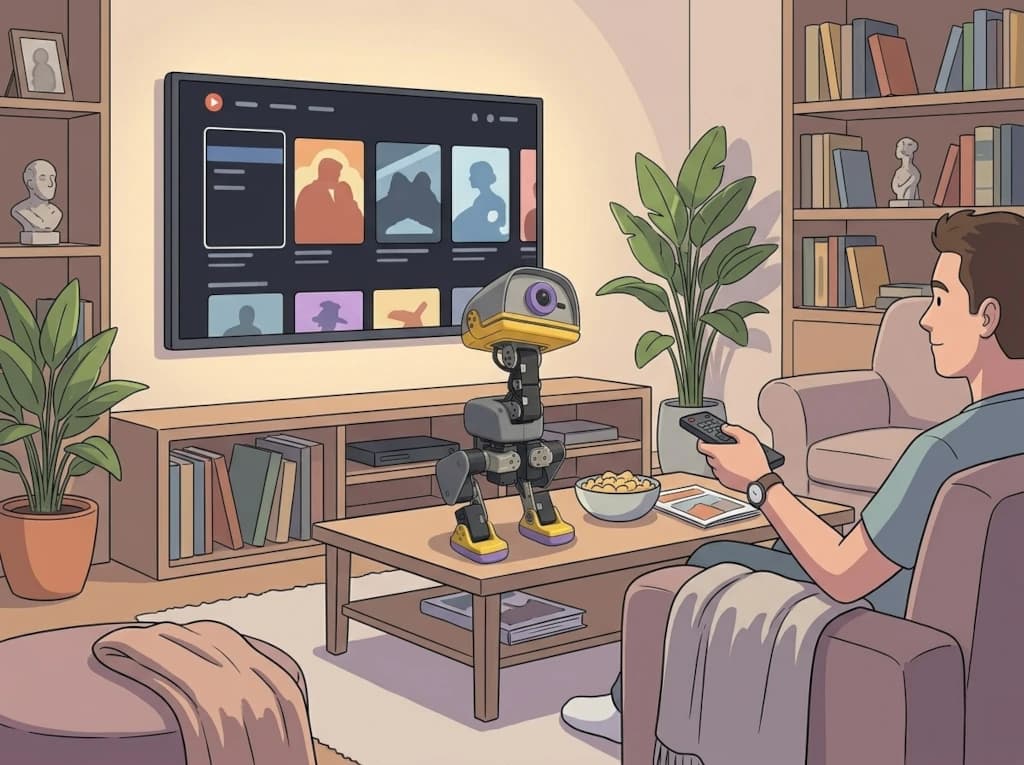
Now imagine MicroDuck sitting on your desk.
Instead of opening an app, you ask:
“It's getting dark. Can you sort the room out?”
The AI layer could interpret the request.
The smart-home system could handle the actual devices.
MicroDuck could respond and physically react.
Maybe it turns toward you.
Maybe it says what it changed.
Maybe it performs a little behavior afterward.
The important part isn't that it turned on a light.
Your existing smart-home system could already do that.
The interesting part is that the action now has a physical agent attached to it.
That's a much more interesting interface.
The robot becomes a bridge
This is probably the best mental model.
Don't think:
MicroDuck controls my smart home.
Think:
MicroDuck can become a physical endpoint for my digital environment.
Your home contains information and tools.
The LLM can understand what you want.
MicroDuck can provide perception, speech and physical action.
The smart-home system provides access to the devices.
So you get something like:
You → AI → tools → smart home
while MicroDuck sits inside the loop as the physical interface.
That's much more powerful than a robot merely having a few smart-home commands.
This is where MCP becomes interesting
The community project mentioned above uses MCP to let the LLM call robot-related tools through a larger Home Assistant setup. (Reddit)
You don't need to understand MCP to see the interesting part.
MCP isn't what makes the idea valuable.
The important thing is that the AI is no longer trapped inside the robot.
It can potentially have access to other tools.
That changes what the robot can do.
Instead of:
“MicroDuck can turn on the lights.”
you can imagine:
“MicroDuck can help me interact with the things in my environment.”
Those are very different ideas.
But I don't think robots should replace smart speakers
At least not yet.
A smart speaker has some major advantages.
It's cheap.
It doesn't need to walk.
It doesn't fall over.
It doesn't need to navigate.
It can stay plugged in.
And it doesn't need a battery.
So if your only goal is:
turn lights on and off,
a robot is a ridiculous solution.
That's not a criticism.
It's just the wrong job.
A robot becomes interesting when the physical body adds something the stationary device cannot.
That could mean:
- moving toward you;
- looking at you;
- physically changing its position;
- reacting with body language;
- showing status through movement;
- perceiving the environment;
- eventually taking physical actions.
The more of those things become reliable, the more valuable the robot becomes as a smart-home interface.
The real opportunity is context
This is where I think the combination gets much more interesting.
A smart home has enormous amounts of context.
Your phone knows where you are.
Your lights know when they are on.
Your thermostat knows the temperature.
Your door sensor knows whether something is open.
Your camera may know whether someone is present.
The problem is that all of this information is fragmented across systems.
An AI layer can potentially reason across those systems.
And MicroDuck gives that reasoning a physical presence.
Imagine:
“Why is it so warm in here?”
The AI checks the thermostat.
Or:
“Did I leave the bedroom light on?”
It checks the light state.
Or:
“Someone rang the doorbell.”
The robot could potentially tell you.
Again, the robot itself does not need to perform all of these actions.
It can be the interface through which the AI interacts with your home.
That is the part I find interesting.
But a smart home connection doesn't automatically make a robot useful
This is where I would push back on the excitement.
You can connect almost anything to a smart-home system.
That doesn't mean the connection is useful.
If MicroDuck sits on your desk and all it does is:
“The bedroom light is on.”
you haven't solved a meaningful problem.
You have added a robot to something that already worked.
The integration has to exploit something the robot does unusually well.
For me, those things are:
Presence
It is physically there.
Interaction
It can respond as an object, not just a notification.
Movement
It can potentially move to you.
Perception
It has cameras, LiDAR and other sensors.
Personality
It can communicate through movement and behavior instead of only text or sound.
That's where the robot starts to differentiate itself.
The robot could eventually become the thing you interact with
This is a subtle but important change.
Right now, our smart homes are mostly invisible.
We interact with:
- apps;
- dashboards;
- switches;
- voice assistants.
The underlying systems disappear.
A robot is different.
You can see it.
It can react to you.
It can move.
That creates something closer to a relationship.
You don't necessarily think:
“I am querying my smart-home API.”
You think:
“Ask the duck.”
That sounds silly.
But that is actually one of the more interesting properties of physical interfaces.
A good interface makes complex systems feel simple.
The best one might make you forget the complexity is there.
There is also a privacy question
This is where I think smart-home integration becomes more serious.
MicroDuck has a camera and microphones.
A smart home can contain an extraordinary amount of information about your daily life.
Pollen's architecture documentation explicitly recognizes that privacy is an issue because the robot can carry a camera and microphone in someone's home. (GitHub)
Once you combine:
robot + microphone + camera + AI + smart home
you have a system that knows much more about your environment than a normal toy.
That's powerful.
It is also something I would take seriously.
Who processes the audio?
Where does the camera data go?
Which commands are executed locally?
Which services are cloud-based?
What happens when the robot is remotely accessible?
These aren't reasons to reject the concept.
They're part of the product.
The more useful the robot becomes, the more important these questions become.
A robot that can control your home also needs boundaries
There's another problem that is easy to ignore.
A language model can misunderstand a request.
A normal chatbot misunderstanding you is usually harmless.
A smart-home-connected robot can actually trigger things.
Turn something on.
Turn something off.
Open something.
Start something.
Move around your home.
That's why Pollen's architecture separates high-level control from the local safety-critical robot loop. The robot's local control system remains authoritative over safety, while remote clients send higher-level intents rather than directly writing motor commands. (GitHub)
I think the same principle should apply to the smart home.
The AI should be able to ask for an action.
The system should still decide whether that action is safe and allowed.
That's much more sensible than simply giving a language model unrestricted control over everything.
The most interesting future isn't “robot remote control”
It is robot awareness.
Controlling devices is easy compared with understanding a situation.
Imagine MicroDuck eventually being able to combine:
what it sees
with:
what your smart home knows
with:
what you tell it
with:
what it remembers
Then the robot has a richer model of the environment.
For example:
It sees you sitting at your desk.
The smart-home system knows the room is getting dark.
The time is late.
You usually turn off the desk lights around now.
Instead of waiting for:
“Turn off the lights.”
the system could potentially make a suggestion.
Or do nothing.
Or ask.
That introduces a concept I think is much more interesting than automation:
initiative.
But initiative should be earned
I don't want a robot constantly making decisions for me.
That would get annoying very quickly.
A smart system needs to learn the difference between:
“This is useful.”
and:
“This is just noise.”
If MicroDuck tells me something every five minutes, I've gained nothing.
If it occasionally understands context and saves me an interaction, that's different.
This is where personality, memory and automation start to overlap.
And it's another reason why simply adding an LLM isn't enough.
The system needs judgment.
So, could MicroDuck become part of your smart home?
Technically, the direction is already visible.
Pollen's architecture is designed to let external software observe and control the robot, including server-side programs such as LLMs. (GitHub)
Community developers are already experimenting with MicroDuck, Home Assistant, LLMs and MCP before their physical robots arrive. (Reddit)
So the idea is not far-fetched.
But I would separate three levels.
Level 1: Remote control
You say something.
The system turns a light on.
Useful, but not revolutionary.
Level 2: AI interface
You speak naturally.
The AI understands what you want and chooses the appropriate smart-home tools.
Much more interesting.
Level 3: Physical AI
The robot can perceive the environment, understand context, remember relevant information, decide when to act, and use both its physical capabilities and your smart-home infrastructure.
That's the level that gets genuinely interesting.
And that's also the level we shouldn't pretend MicroDuck has reached today.
My take
I don't think MicroDuck needs smart-home integration to be a good robot.
But I think smart-home integration could become one of the things that turns it from an interesting desk gadget into something much harder to replace.
The reason isn't convenience.
It's context.
Your smart home already knows things.
An AI can potentially reason about those things.
MicroDuck gives that intelligence a body, a voice and a physical presence.
That's a very different interface from another app on your phone.
But I would not buy MicroDuck today because you expect all of this to work out of the box.
The ecosystem is still being built.
The community experiments are promising, but they're experiments.
The interesting question is not:
“Can MicroDuck turn on my lights?”
Of course it can potentially be connected to systems that do that.
The more important question is:
“Can a robot become the way I interact with the intelligent environment around me?”
I think that is a much bigger opportunity.
And MicroDuck is an unusually interesting platform on which to see whether that idea actually works.