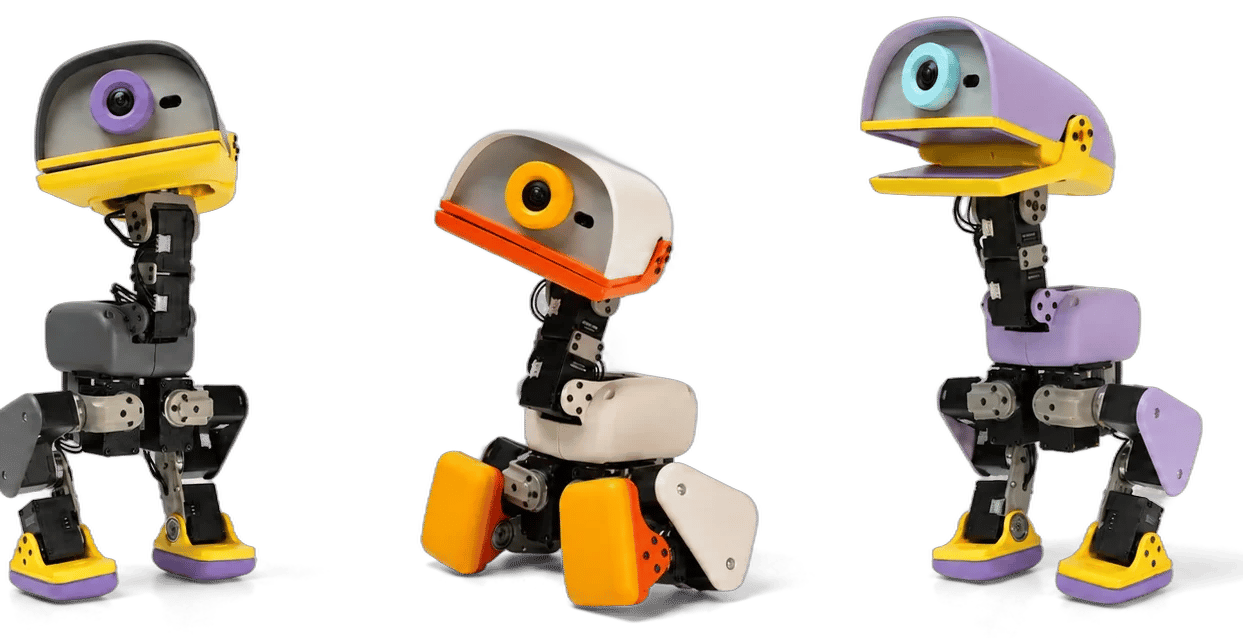
"$399 robot" sounds simple.
You might picture a small plastic robot that walks around your desk and does a few tricks.
That description is technically true.
It is also missing most of the interesting part.
MicroDuck's current preorder price is $399 before taxes and shipping. For that price, the base package gives you the robot, a battery, a USB-C cable, and a game controller. Pollen positions the robot as a playable physical AI platform rather than simply a finished consumer toy.
So what are you actually paying for?
Let's take it apart.
The $399 Package
The base MicroDuck package includes:
- the MicroDuck robot
- one battery
- a USB-C cable
- a game controller
That is it.
You do not need to buy an additional development kit just to start using the robot.
Pollen specifically describes the base robot as everything you need on day one, while the optional packs add spare parts, charging capacity, and accessories.
That is important because the advertised $399 price is not a deliberately incomplete "starter" product.
The robot is intended to be playable on its own.
The Robot Itself
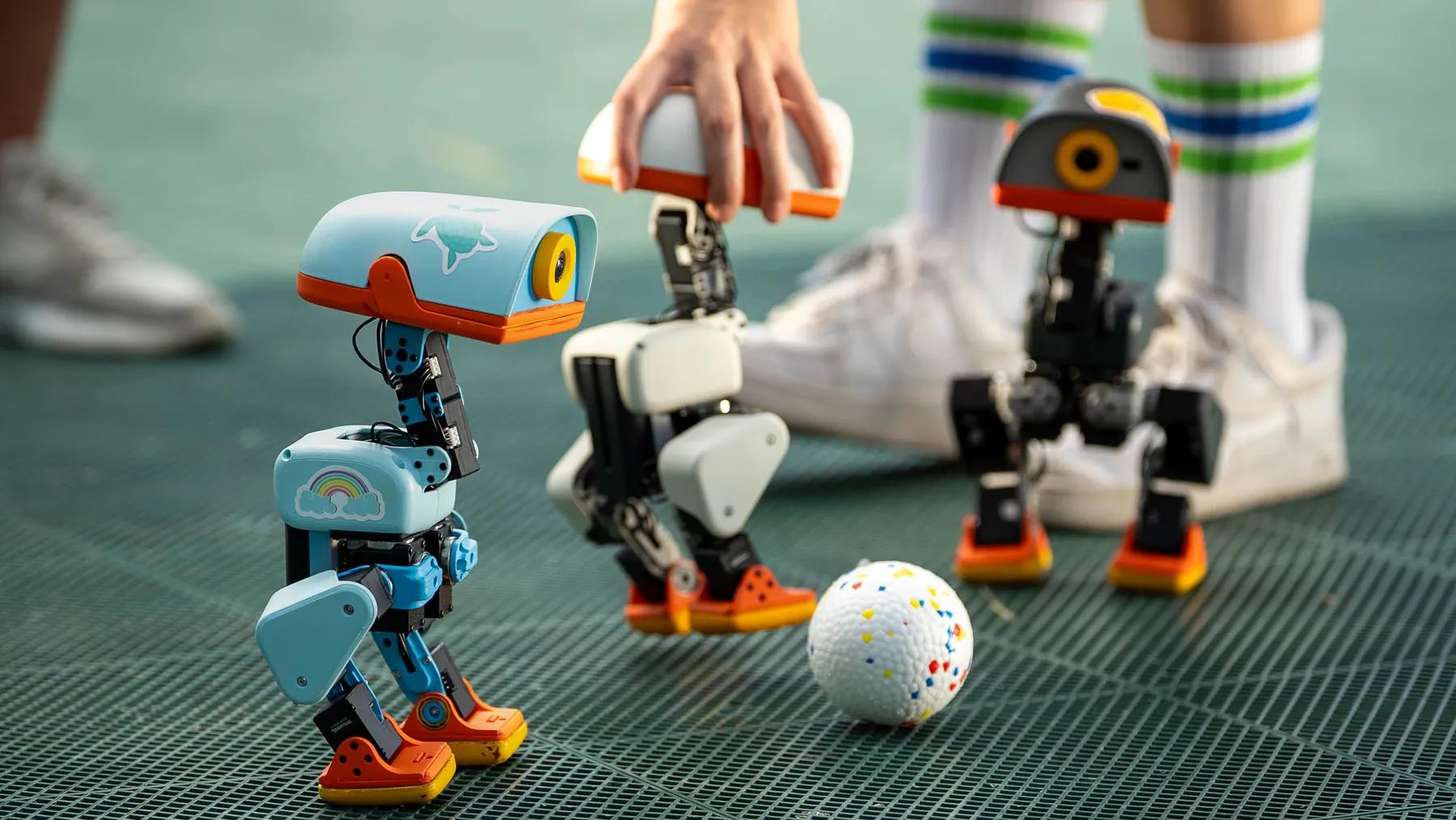
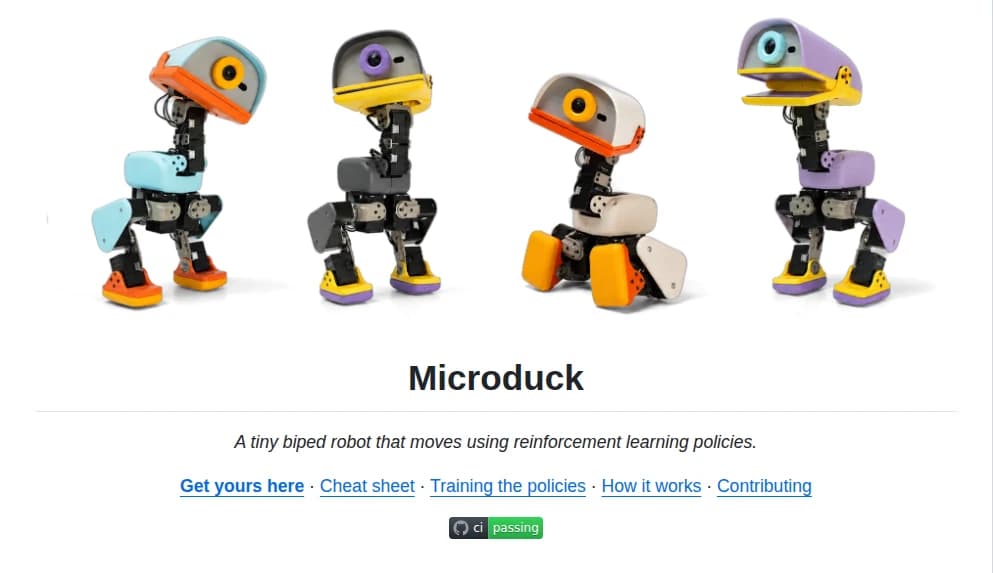
MicroDuck is a compact biped.
Pollen lists it at around 25 cm tall and about 780 g, with four available colorways.
Its physical size is one of the reasons the product is interesting.
This is not a room-scale humanoid.
It does not need a dedicated space in your home.
It is small enough to sit on a desk while still having enough physical hardware to demonstrate real robotic movement.
That puts it in an unusual middle ground.
It is more physically capable than a stationary smart speaker.
But it is far smaller and cheaper than most serious humanoid or research-oriented robots.
15 Motors
Inside the little body are 15 motors.
That number matters because a motor is not simply a specification on a box.
It determines how much physical movement the robot can express.
A simple wheeled device can get surprisingly far with only a few actuators.
A small biped needs much more coordinated movement.
MicroDuck's motors control the robot's body as it walks, changes posture, manipulates objects, and performs its trained behaviors.
That is part of what you are paying for at $399.
You are not buying a screen with a robot-shaped enclosure.
You are buying a small machine with a real body that has to physically coordinate itself.
The Camera
MicroDuck has a wide-angle front camera.
This gives the robot visual information about the environment in front of it.
A camera is also one of the pieces that makes a future software layer interesting.
Once a machine can perceive something, software can potentially turn that perception into a decision.
That could mean:
"There is an object here."
or eventually:
"That is the object I am supposed to interact with."
The distinction matters.
The camera itself does not magically give MicroDuck sophisticated visual intelligence.
It provides information.
The software determines what the robot does with that information.
LiDAR and Two IMUs
The camera is not the only sensor.
Pollen lists a compact 8×8 ToF LiDAR and two built-in IMUs.
These give the robot additional information about its physical state and surroundings.
The IMUs are especially relevant to a biped.
A robot with two legs constantly has to care about its orientation and movement.
The combination of sensors and motors is what allows the software to control a physical machine rather than simply generate an animation.
Again, the important distinction is:
hardware provides the physical interface.
software turns that interface into behavior.
That distinction becomes increasingly important as AI moves from screens into physical products.
A Grasping Beak
MicroDuck's beak is not just decorative.
It is articulated and designed to grasp objects.
That gives the robot a way to interact with things outside its own body.
This is one of the features that separates a moving character from a physical robot.
A character can move around.
A robot can potentially change something in its environment.
The current behavior is still limited.
You should not interpret "can grasp objects" as "can manipulate arbitrary household objects."
But even simple physical interaction opens up a much larger set of possible experiences.
Microphones and Speaker
Pollen's current hardware listing also includes microphones and a speaker.
This is easy to overlook because walking and grasping are more visually impressive.
But audio is potentially just as important for the future of an AI device.
A physical AI system needs ways to:
- receive information
- produce feedback
- communicate with people
- react to its environment
The speaker provides output.
The microphones provide input.
Neither one automatically makes MicroDuck an AI companion.
They are components that can be used by software to create those experiences.
That distinction will become important as the desktop-robot category evolves.
NFC
MicroDuck also includes two NFC antennas, positioned in the head and beak.
That might sound less impressive than a camera or LiDAR.
In practice, it is a useful example of how a small physical robot can have more interaction mechanisms than a traditional computer.
The accessory pack adds NFC tags that can be used to create custom interactions, triggers, and behaviors.
That creates a simple bridge between physical objects and software behavior.
Tap something.
Detect it.
Trigger an action.
That is a very different interaction model from clicking an icon on a screen.
Onboard Compute
MicroDuck uses a Rockchip RK3566 with an AI accelerator, alongside 1 GB of RAM and 32 GB of storage.
This is another area where it is important not to confuse hardware capability with product capability.
An AI accelerator is not the same thing as having an advanced AI model running locally.
The useful question is what the complete software stack does with the available compute.
And that is where MicroDuck's design becomes more interesting.
The hardware is relatively fixed.
The software can change.
Wi-Fi and Bluetooth
MicroDuck includes Wi-Fi and Bluetooth connectivity.
For a physical AI platform, connectivity matters because increasingly useful behavior does not necessarily have to live entirely inside the robot.
A robot can potentially communicate with another computer.
It can connect to services.
It can receive software updates.
It can participate in a broader application.
That creates another important distinction:
the robot does not have to contain the entire AI stack to be an AI product.
The physical robot can become the body while other computing resources provide additional intelligence.
That model will likely become increasingly common across physical AI products.
About One Hour of Battery Life
Pollen's current product listing gives the removable battery an approximate one-hour battery life.
That is worth knowing before buying.
A robot that moves continuously is fundamentally different from a phone or laptop.
Motors consume substantial power.
The more physically active the robot is, the more quickly battery capacity becomes an issue.
This is one reason the optional Charger Pack exists.
But the important point for the base purchase is simple:
you get one battery.
Additional batteries and a dual charger are separate purchases.
Seven Trained Behaviors
The base robot comes with seven trained moves.
Pollen lists behaviors including walking, sitting and standing, and other physical interactions such as kicking, grasping, roller skating, and recovering from a fall.
Seven might not sound like much.
But these are not seven animations.
They are learned physical policies controlling a machine with motors and sensors.
That distinction is why the software stack matters.
The shipped behaviors are not supposed to be the final state of the robot.
Pollen says the seven policies are published and retrainable, and its training workflow is designed around simulation, deployment to the physical robot, refinement, and sharing.
So the actual proposition is closer to:
seven behaviors today + a platform for creating more
rather than:
seven tricks and nothing else.
The Software Is Part of What You Are Buying
This may actually be the most important part of the $399 package.
Pollen makes the SDK, simulation environment, and full reinforcement-learning training stack available on GitHub.
The software stack is licensed under Apache-2.0, and Pollen says the robot's behaviors can be read, forked, retrained, and redeployed.
That changes the product category.
A closed robot is mostly:
hardware + manufacturer's software
An open physical AI platform can become:
hardware + manufacturer's software + community software + your own software
That extra layer is potentially much more valuable than another built-in feature.
Because once the physical hardware is in your hands, software can change what the hardware means.
What You Are Not Getting for $399
This is just as important.
You are not getting:
- every optional accessory
- multiple spare batteries
- the Dev Pack
- the Accessory Pack
- a finished general-purpose household robot
- unlimited autonomous behavior
- a guarantee of future community-developed capabilities
The base package is deliberately simple.
The additional packs are there for people who want more.
Pollen currently lists:
Charger Pack — $39
with a dual battery charger and two additional batteries.
Dev Pack — $119
with spare motors, motor cables, additional batteries, charger, NFC tags, tools, screws, and Hugging Face credit.
Accessory Pack — $39
with rollers, a laser, NFC accessories, tags, and a ball.
The key point is that these are extensions of the base product.
You do not need every pack to understand what MicroDuck is.
So What Does the $399 Actually Buy?
I would break it into four layers.
1. A physical body
15 motors.
A bipedal structure.
A grasping mechanism.
A camera.
LiDAR.
IMUs.
Microphones and speaker.
Battery-powered movement.
That is the physical machine.
2. A ready-to-use experience
A controller.
Seven trained behaviors.
A robot you can interact with without immediately entering a development environment.
That is the consumer layer.
3. An open development platform
SDK.
Simulation.
Reinforcement-learning training stack.
Retrainable policies.
That is the developer layer.
4. A possible software ecosystem
This is the part you are not literally buying.
But you are buying into the possibility of it.
Pollen is explicitly encouraging people to train, modify, and share new behaviors through a community around the robot.
That ecosystem does not have a fixed dollar value.
It has to be built.
And whether it becomes genuinely valuable will depend on what people create after the robots are in their hands.
The Interesting Part Is the Separation Between Body and Brain
This is where I think MicroDuck becomes more interesting than a simple product comparison.
Look at the robot again.
The physical body has:
- motors
- sensors
- battery
- speaker
- microphones
- camera
- LiDAR
- gripper
That hardware is specific.
But the intelligence controlling it is much more flexible.
A behavior policy can change.
A perception system can change.
A language model can change.
A memory system can change.
An application can change.
The same physical machine can therefore become a different product depending on the software running on top of it.
That is a much broader idea than:
"This is a duck robot."
It is:
"This is one physical interface for software-defined AI."
And that idea extends well beyond MicroDuck.
The same pattern can appear in desktop robots, robot toys, expressive companions, wearable AI devices, and other physical interfaces.
The body changes.
The AI system changes.
The interaction model changes.
But the basic separation between physical interface and software intelligence remains.
Is $399 Good Value?
I would not answer this by comparing the number of features to the price.
A $399 product with twenty shallow features can be less interesting than a $399 platform with five good capabilities and an excellent software layer.
For someone who simply wants another gadget:
$399 may be expensive.
For someone who wants a small physical robot:
$399 is a relatively accessible entry point.
For someone who wants to experiment with physical AI and reinforcement learning:
the open software stack may be more important than the robot's initial feature count.
That is why the value proposition depends heavily on who is buying it.
My Take
For $399 before taxes and shipping, the base MicroDuck package gives you much more than a cute shell around a few animations.
You get a compact physical machine with 15 motors, camera and depth sensing, IMUs, audio hardware, NFC, onboard computing, wireless connectivity, a removable battery, a controller, and seven trained behaviors.
But the more unusual part is what sits underneath those specifications.
The SDK, simulator, reinforcement-learning stack, and retrainable policies mean the product is designed to change through software.
That is the part I would pay the most attention to.
Because the long-term value of physical AI may not come from building a robot with every possible capability into the original hardware.
It may come from building a physical platform where the capabilities can keep changing.
MicroDuck is a particularly interesting example of that approach.
And at $399, the question is not simply:
"Is this a cheap robot?"
It is:
"Is this an affordable entry point into software-defined physical AI?"
For the right buyer, that is a much more interesting proposition.