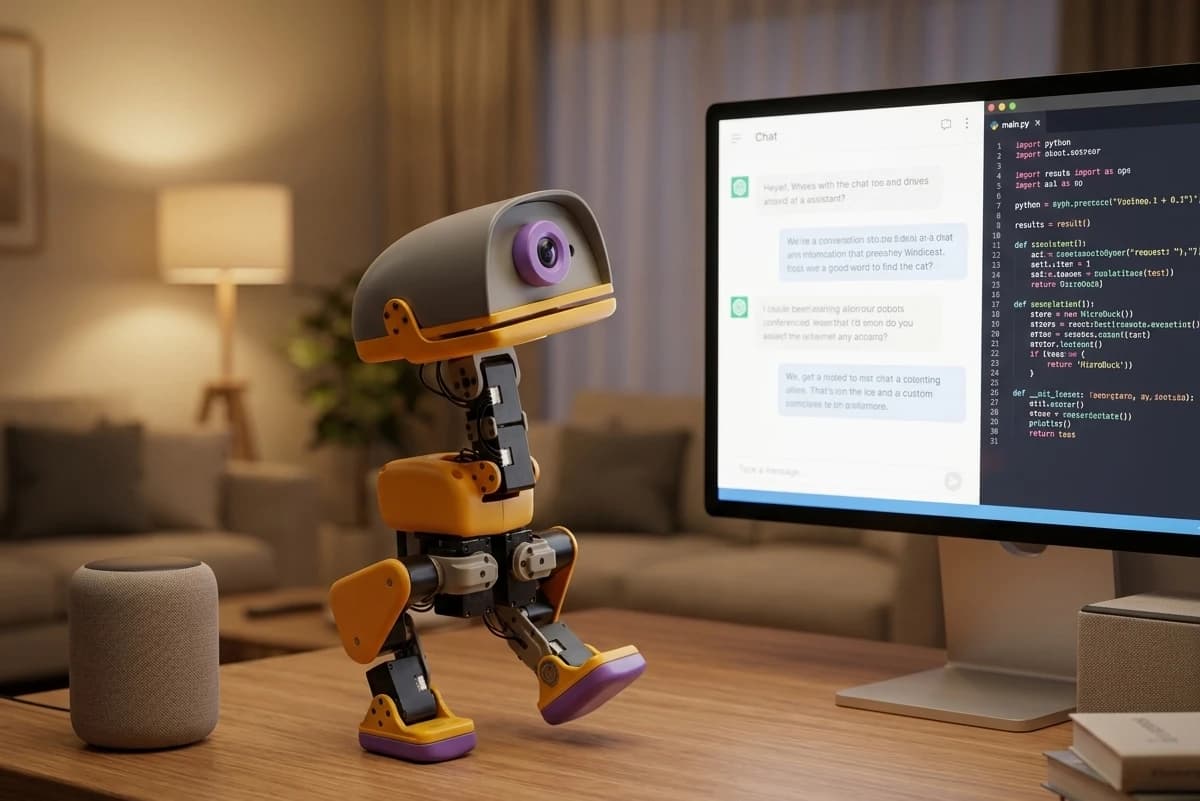
The interesting part isn't making MicroDuck talk. It's giving an AI model a body.
MicroDuck already has a body.
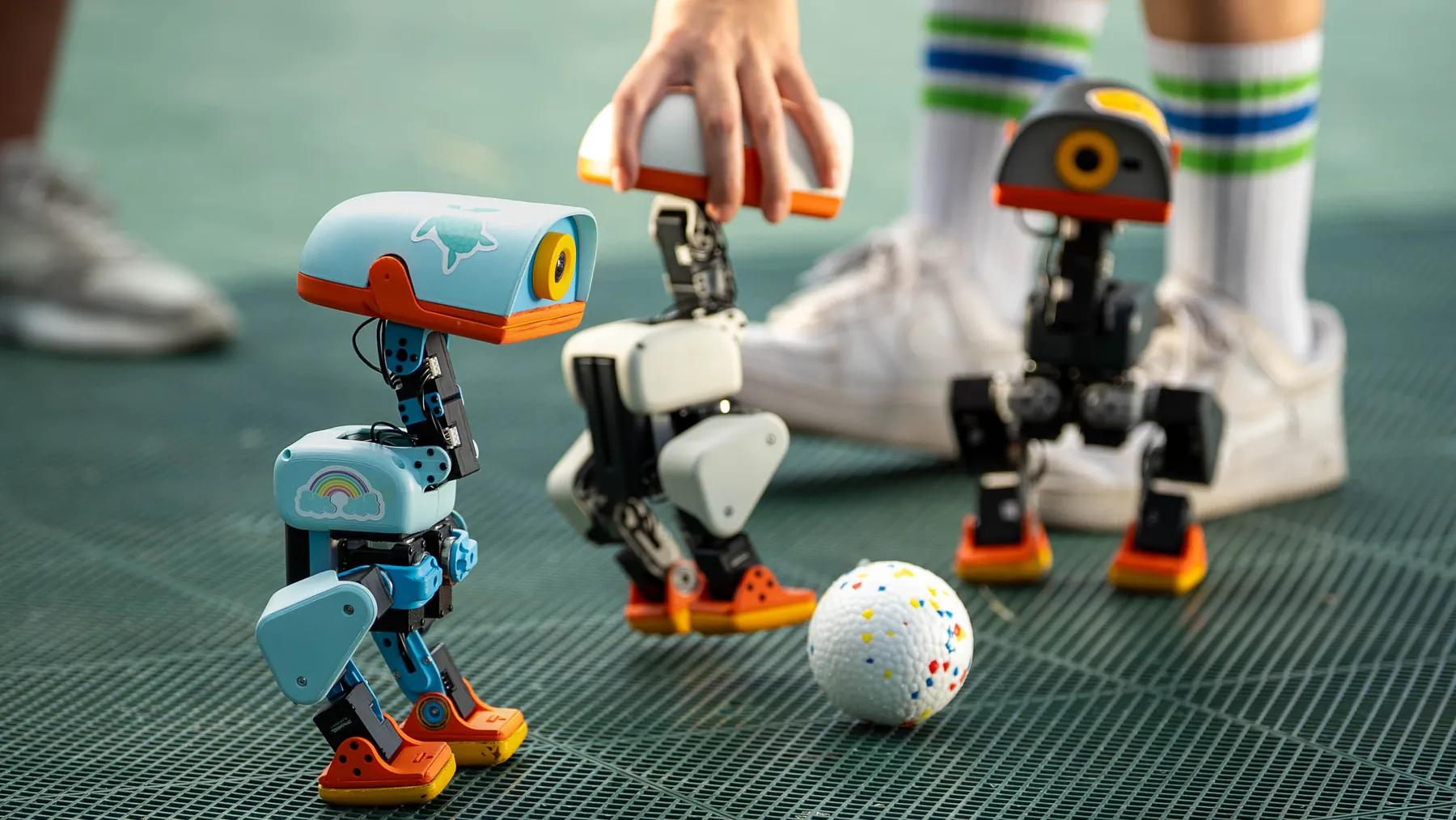
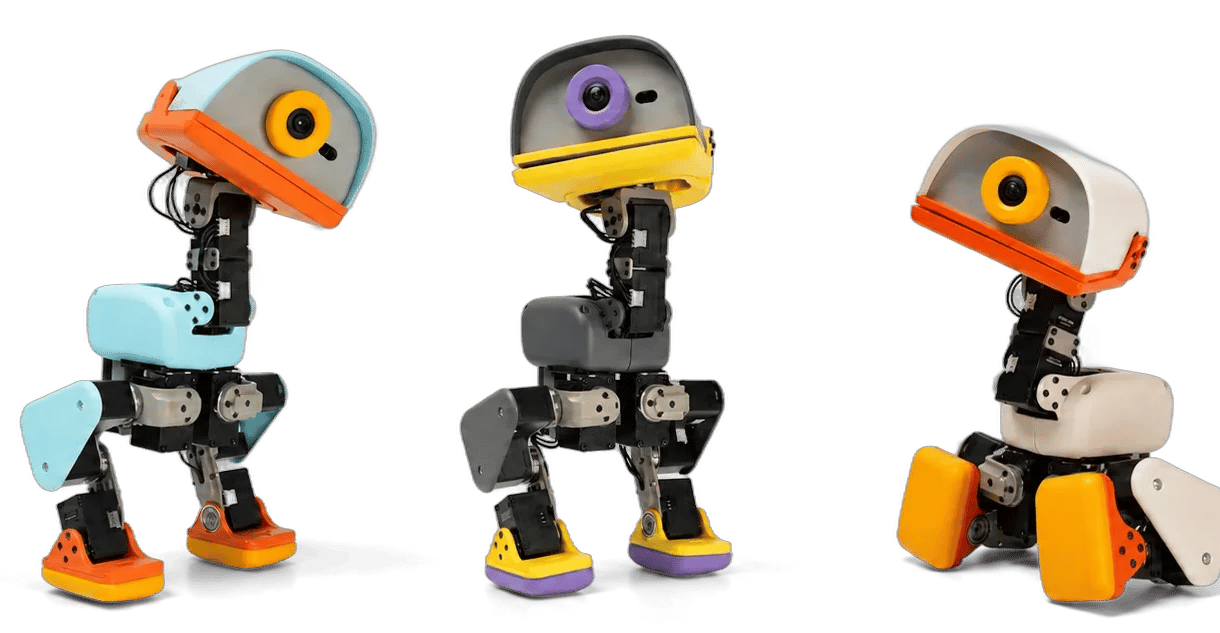
It can walk, sit, crouch, kick, grab objects with its beak, roll on skates, and recover from many common falls. It also has a camera, LiDAR, microphones, a speaker, Wi-Fi and Bluetooth. Its software stack is open, and its architecture is designed around the idea that other software can observe and control the robot. (Pollen Robotics)
So naturally, one of the first questions people have is:
What happens if you connect an LLM to it?
At first, the answer sounds almost trivial.
The LLM talks.
The robot listens.
Then the robot responds.
But that undersells what could actually happen.
A chatbot already has language.
MicroDuck already has a body.
The interesting thing is what happens when those two things are connected.
An LLM inside a robot is not automatically a smarter robot
This distinction is important.
If you connect a language model to MicroDuck and all you get is:
“Hello, how are you?”
followed by a duck noise, you haven't really created a new kind of robot.
You've just put a chatbot behind a speaker.
The physical body doesn't add much value.
The interesting version is different.
The model can receive information about the robot's environment.
It can understand a request.
It can decide what kind of action should happen next.
The robot can then physically act.
Pollen's own architecture documentation is unusually explicit about this direction. The team describes a server-side program such as an LLM observing and controlling the robot, with the robot's camera, audio and control interfaces exposed to external software. Their design even separates the high-level role of an LLM from the low-level control loop that needs to react quickly and safely. (GitHub)
That last part matters.
The LLM isn't supposed to directly control every motor.
It is more like a high-level brain.
The robot's own control system still handles the fast, physical part.
That is a much more sensible architecture.
Think of the difference this way
ChatGPT can say:
“I think you should move the object.”
MicroDuck can potentially move the object.
That's the transition I'm interested in.
A language model normally produces information.
A robot can turn information into physical action.
So the basic loop becomes:
See → understand → decide → act → observe again
That loop is fundamentally different from a normal AI assistant.
And it is why physical AI is becoming interesting.
MicroDuck already has the body needed for this experiment
The hardware is not just a shell with motors.
Pollen's current product materials list a camera, LiDAR, two IMUs, microphones and a speaker alongside the robot's actuators. The GitHub repository also exposes the software components responsible for camera streaming, audio, depth sensing, control and robot state. (Pollen Robotics) (GitHub)
This gives an LLM more to work with than text.
It could potentially receive:
- a camera frame;
- robot state;
- audio;
- a user request;
- information from external services.
And it could potentially respond by:
- moving;
- looking;
- speaking;
- triggering a behavior;
- calling an external tool;
- interacting with something else.
The exact capability depends on the software built around it.
But the architecture is there for this kind of experiment.
And people are already trying it
This isn't just something I would put on a future roadmap.
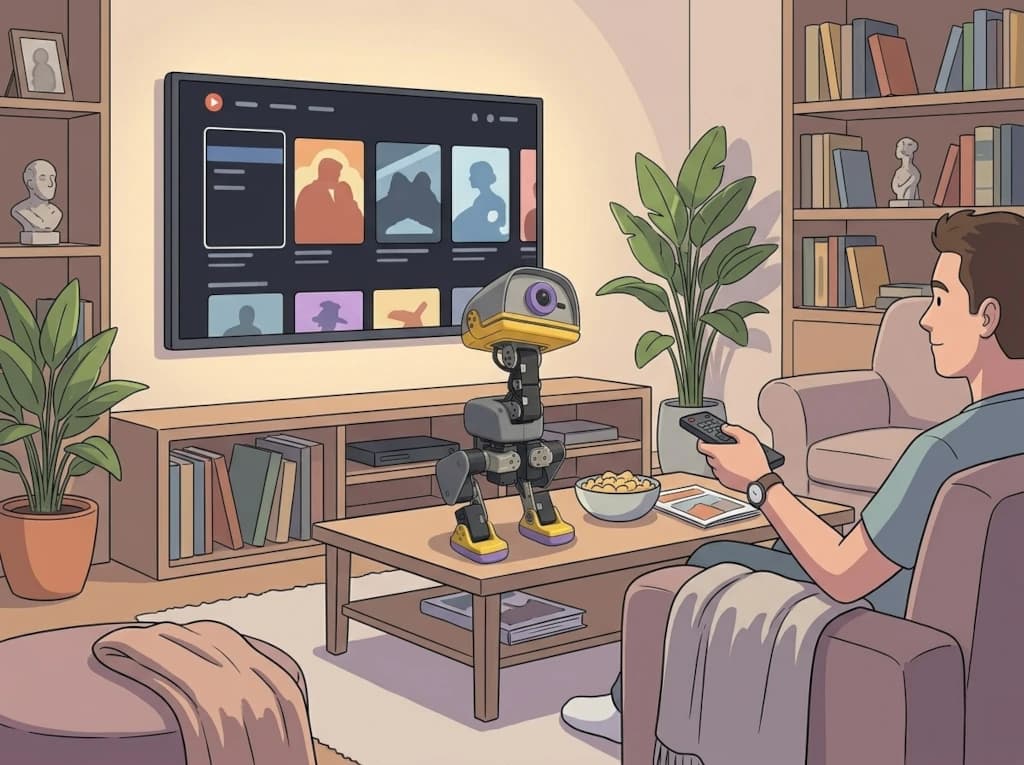
A recent community project is already connecting MicroDuck with Home Assistant, real LLM services and MCP.
The developer had preordered a MicroDuck but wouldn't receive it until December, so they built and tested the software against a simulated robot instead. Their goal is to use MicroDuck as a voice satellite, allowing the robot to interact with Home Assistant while an LLM handles higher-level tool use. (Reddit)
That project is interesting for a very specific reason.
The developer isn't treating the robot as:
“a thing that has AI.”
They're treating it as:
a physical interface for AI.
That's a much more interesting way to think about it.
Suddenly the robot can have tools
This is where the idea gets more useful.
Imagine asking:
“What's the weather like?”
A chatbot can answer.
Now imagine the same AI connected to a physical robot.
The robot could answer verbally.
But it could also become part of a bigger system.
For example:
“Turn off the lights.”
The LLM determines that this is a smart-home action.
A tool handles the Home Assistant request.
MicroDuck speaks the result.
Or:
“Remind me to check the oven in ten minutes.”
The system could interact with a timer.
Or:
“What did I ask you about yesterday?”
A system with memory could potentially retrieve the relevant information.
The robot does not have to personally perform every task.
Its value can come from being the physical interface through which the AI interacts with the world.
That's an important distinction.
This is where MicroDuck becomes more interesting than a talking toy
A talking robot is easy to understand.
It says things.
You say things back.
That's fun.
But a robot connected to a capable AI system can potentially do something else:
it can have context.
Not human-level context.
Not unlimited autonomy.
Just more context than a disconnected gadget.
It can know:
where it is;
what it can see;
what devices it can access;
what actions it is capable of;
what happened recently.
And the more systems you connect to it, the more meaningful that context can become.
This is one reason I think software matters more than hardware in MicroDuck's long-term future.
The physical robot gives the AI a presence.
The software determines what that presence is actually useful for.
But there is a trap here
People sometimes talk about “LLM + robot” as though adding an LLM automatically solves intelligence.
It doesn't.
An LLM is very good at handling language and reasoning over information.
A robot lives in the physical world.
The physical world is messy.
Objects move.
Lighting changes.
People interrupt.
The robot falls.
Sensors are noisy.
Actions take time.
A language model can confidently produce an answer that makes perfect sense in text and is completely useless as a physical action.
For example:
“Go pick up the cup.”
Sounds easy.
But the robot needs to know:
Where is the cup?
Can it reach it?
Can it grip it?
Is the object actually the cup?
Is the route clear?
What happens if it falls?
What happens if the cup moves?
This is why I like the architecture Pollen is describing.
The LLM can make high-level decisions.
The low-level robot system handles fast physical control.
Pollen's architecture explicitly notes that an LLM operates at a much slower timescale than the robot's reactive control loop, so the model should issue higher-level intentions while local control remains responsible for fast responses. (GitHub)
That is a much more realistic model of how physical AI should work.
The robot doesn't need to become “ChatGPT with legs”
I actually think that's the wrong goal.
If MicroDuck simply becomes a portable ChatGPT terminal with legs, I'm not sure that's particularly interesting.
My phone already does that.
My computer does that much better.
The reason to put AI into a robot is to exploit capabilities software does not have.
Presence.
Movement.
Physical interaction.
Environmental awareness.
Embodied behavior.
Imagine two systems.
System A
You ask:
“Did someone come into the room?”
It answers:
“I don't know.”
System B
A robot has a camera.
It can move.
It can observe the room.
It can respond.
The second system has access to a type of information and action that the first one simply doesn't have.
That is the real promise.
Not better conversation.
Better interaction with the physical world.
There is another reason this could be valuable: initiative
This is where things become much more interesting.
Right now, most AI assistants are reactive.
You ask.
They answer.
You issue a command.
They execute.
A physical robot could eventually do more.
Imagine MicroDuck noticing:
“My battery is low.”
and deciding it needs to return to its charger.
Or noticing:
“The person who normally sits here just arrived.”
and responding in some contextually appropriate way.
Or recognizing:
“The room is empty.”
and changing what it is doing.
That's a different level of interaction.
The robot is no longer simply responding to language.
It is responding to situations.
Of course, we're not there yet.
And I would not describe today's MicroDuck as an autonomous AI assistant.
But this is the direction that makes the combination of robot + LLM interesting.
Memory could make this even more important
A chatbot can remember information.
A robot can potentially use that memory in the physical world.
Imagine telling it once:
“I usually work in the afternoon. Don't bother me unless it's important.”
Then later:
the robot sees you at your desk.
A useful system might change its behavior based on that history.
Or:
“I like the blue light in the evening.”
Now the robot isn't simply answering questions.
It is operating with a model of the person it interacts with.
Again, this doesn't mean MicroDuck can do this today.
I'm describing the direction that becomes possible when an open robot platform is combined with modern AI systems.
And this is exactly why I think software ecosystem matters more than the hardware alone.
The community may be the part that makes this useful
This is the biggest reason I'm paying attention to projects like the Home Assistant integration.
The manufacturer does not have to invent every use case.
One person can build the voice layer.
Another can build smart-home integration.
Someone else can build memory.
Another person might build a new navigation behavior.
Someone else might connect an entirely different model.
This is what an open software ecosystem can do.
Pollen's current MicroDuck repositories are explicitly designed around this kind of extensibility. The main repository contains the robot control software and interfaces, while the reinforcement-learning repository handles the training side. Pollen also says new physical behaviors can be trained in simulation and shared with the community. (GitHub) (Pollen Robotics)
That means a useful MicroDuck in the future does not necessarily have to come entirely from Pollen.
It could be the result of many different people building on the same platform.
But this is also the biggest uncertainty
I don't want to turn this into a “MicroDuck + LLM = future solved” story.
There are at least three major problems.
Latency
LLMs are not instant.
A robot cannot wait several seconds every time it needs to react to something physically dangerous.
That's why low-level control needs to remain local. Pollen's own architecture acknowledges this distinction. (GitHub)
Reliability
An LLM can make mistakes.
A conversational mistake is annoying.
A physical mistake can knock something over.
The more real-world control you give to a model, the more important guardrails become.
Cost
A capable cloud model costs money.
Running models locally requires compute.
A robot that depends on expensive cloud inference may be impressive but not necessarily pleasant to use every day.
So even if “LLM-controlled MicroDuck” works technically, there is still a product question:
Would you actually want to live with it?
That question is much harder.
I think the most exciting use case isn't conversation
This is probably my strongest opinion on this topic.
If the first thing people do with an LLM-enabled MicroDuck is make it talk like ChatGPT, I won't be particularly impressed.
That's a demo.
The really interesting part starts when the LLM gives the robot agency.
Not unlimited agency.
Useful agency.
The ability to understand a goal and decide which physical actions, software tools or behaviors it should use to achieve it.
That's where a robot stops being:
AI that talks
and starts becoming:
AI that acts.
That distinction is huge.
What would make this genuinely useful?
For me, I would watch five things.
1. Perception
Can the robot understand enough about its environment to make useful decisions?
2. Memory
Can it remember information that actually improves future interactions?
3. Tools
Can it interact with other software and devices?
4. Actions
Can it translate high-level instructions into reliable physical behavior?
5. Initiative
Can it decide when to do something without needing a command every time?
Put those together and something interesting starts to emerge:
an AI system with a body.
That is much more compelling than:
a chatbot with a face.
What I would want from MicroDuck
I don't think MicroDuck needs to become a humanoid assistant.
That would miss what makes it interesting.
Its small size, distinctive movement and slightly strange personality are part of its appeal.
I'd rather see a robot that feels like a small presence in your environment.
Something that can:
see;
remember;
react;
move;
help;
surprise you;
and occasionally do something you didn't explicitly ask it to do.
Not because it is pretending to be human.
But because it behaves like something with a little bit of agency.
That's much more interesting to me.
And that's why the software ecosystem matters so much
This brings me back to the point I've made in the previous MicroDuck articles.
The hardware is the starting point.
The software is what determines how far it goes.
Pollen has already built a robot with a surprisingly capable physical foundation and an open software stack. The community is already experimenting with LLMs, Home Assistant and other integrations before many owners have even received their robots. (Pollen Robotics) (Reddit)
That's encouraging.
But it is still early.
We don't know whether those experiments will become polished tools.
We don't know how easy they will be for ordinary users.
And we don't know whether the ecosystem will keep producing new capabilities six months from now.
That's the part I'll be watching.
My take
I don't think putting an LLM in MicroDuck automatically makes it a better robot.
It could easily become a more complicated robot that talks more.
That's not particularly exciting.
The interesting possibility is much bigger:
MicroDuck could become a physical interface for AI.
The LLM provides reasoning and language.
The robot provides perception and action.
External tools provide access to the digital world.
The community provides new capabilities.
And memory can connect all of it across time.
That's when the pieces start to fit together.
The first version of MicroDuck is already interesting because it can move.
The next question is whether it can understand why it should move.
And eventually, perhaps more importantly:
whether it can decide what to do next.
That's the point where I'd stop thinking of MicroDuck as just a clever little robot and start thinking of it as an early experiment in what a personal AI with a body could actually be.