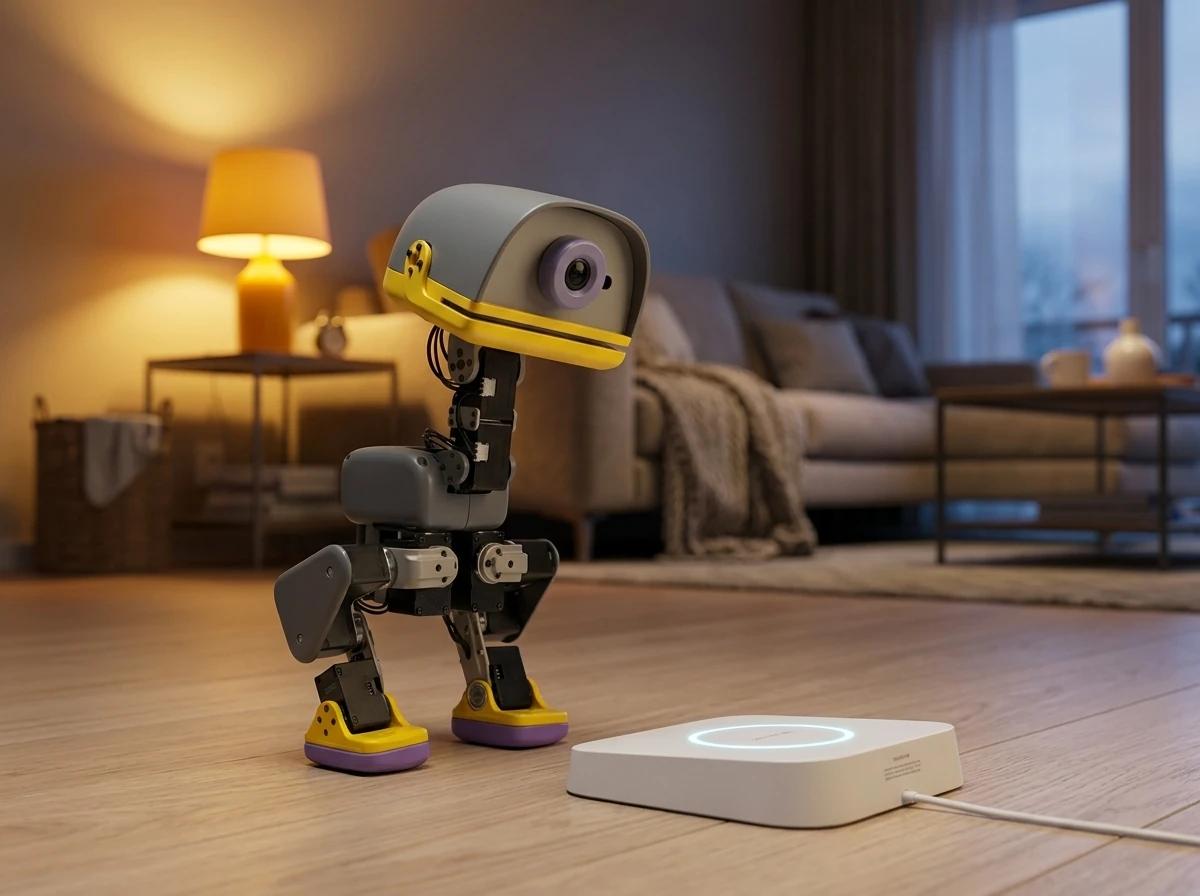
A robot that can walk around your home but still needs you to plug it in is interesting. A robot that can find its own charger is something else.
This is one of those questions that sounds trivial until you think about it for a few minutes.
Can MicroDuck charge itself?
Right now, the answer is no.
Pollen lists a removable NP-F550 2600 mAh battery with around one hour of runtime, depending on how the robot is used. The standard MicroDuck comes with one battery and a USB-C cable, while the optional Charger Pack adds two more batteries and a dual-battery charger. (Pollen Robotics) (Pollen Robotics)
And people are already asking about it.
A recent discussion in the Home Assistant community asked directly whether MicroDuck could auto-charge itself. The responses quickly focused on the practical problem: the robot currently needs to be connected to power, while an autonomous dock would require the robot to navigate to it and reliably make contact.
At first glance, this sounds like a minor convenience feature.
I don't think it is.
Self-charging is one of the features that separates a robot you interact with from a robot that can actually live alongside you.
MicroDuck already has the part people usually think is difficult
This is what makes the charging question interesting.
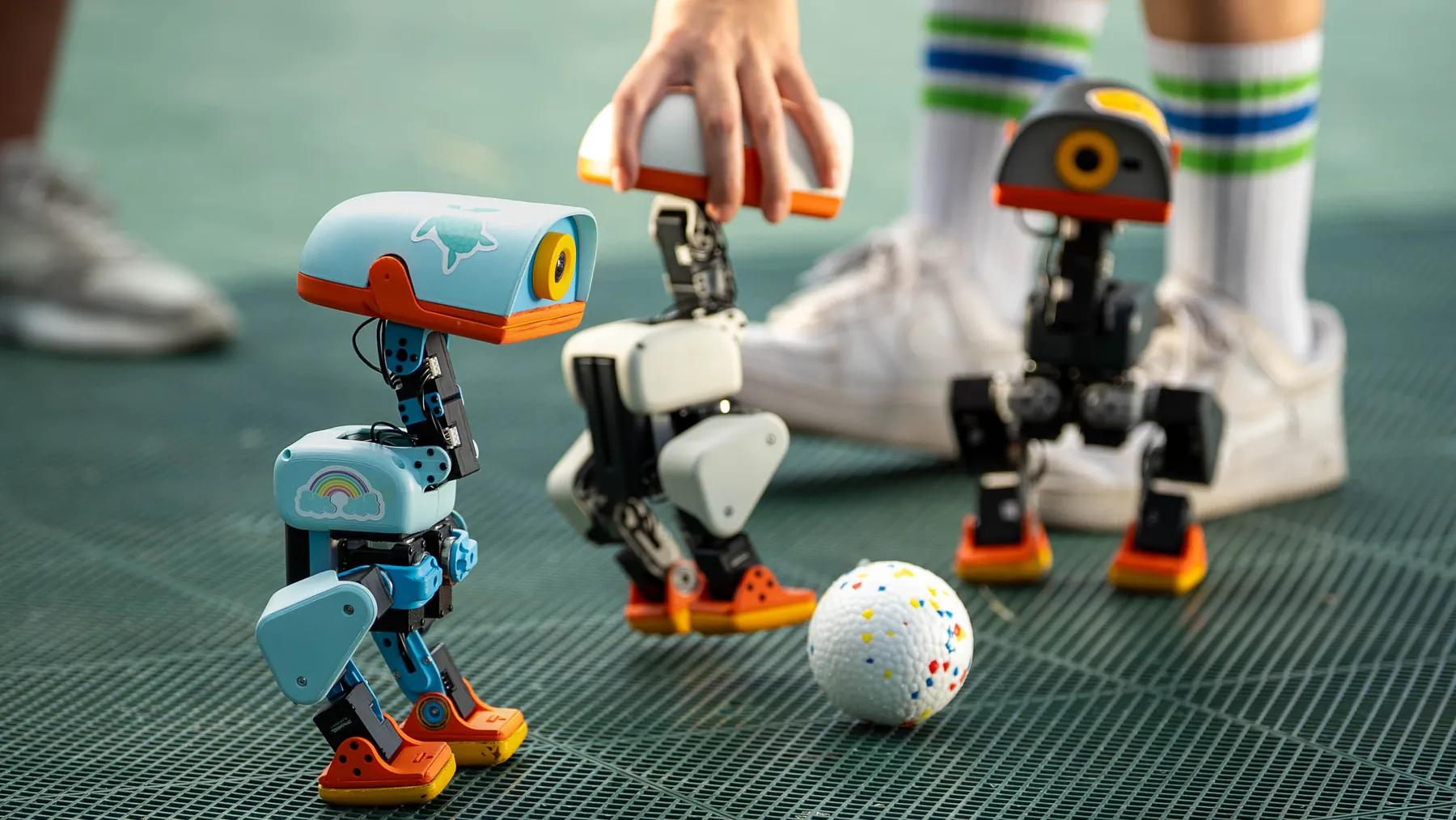
MicroDuck can walk.
It can sit and crouch.
It can recover from many falls.
It can roller-skate.
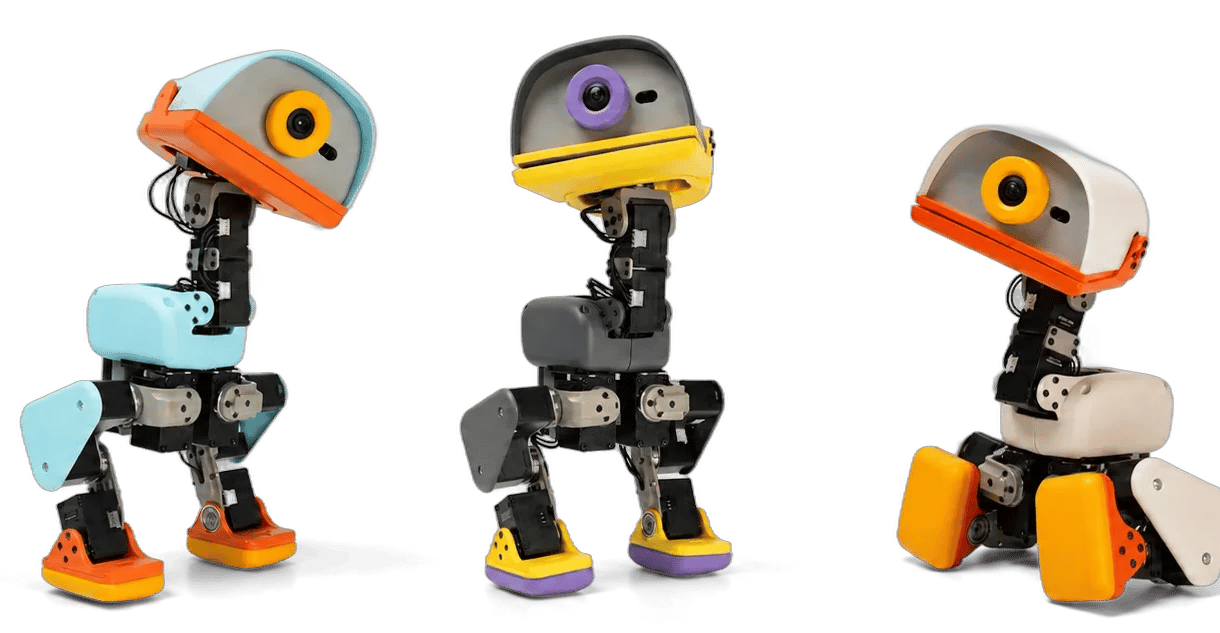
It can pick up objects with its articulated beak.
It has a camera, LiDAR, two IMUs, Wi-Fi and Bluetooth, and Pollen is building the software stack around learned behaviors and sim-to-real training. (Pollen Robotics)
In other words, the robot already has many of the ingredients you'd expect from a mobile robot.
So it is natural for someone to look at it and think:
Why can't it just walk back to a charging dock?
The annoying part is that “just walk back to a dock” isn't really one problem.
It is several problems stacked together.
The robot needs to know where the dock is.
It needs to know where it is.
It needs to navigate there.
It needs to approach the dock accurately.
It needs to recognize that it has reached the right position.
It needs to physically connect to the charging system.
And it needs to do all of that reliably enough that you don't discover a dead robot on the floor the next morning.
That last part is the real problem.
Walking somewhere is not the same as doing something reliably
This is an important distinction with robots.
A robot successfully walking from point A to point B in a demonstration doesn't necessarily mean it can perform that trip 100 times a day without supervision.
A demo can tolerate a failure.
A household robot can't.
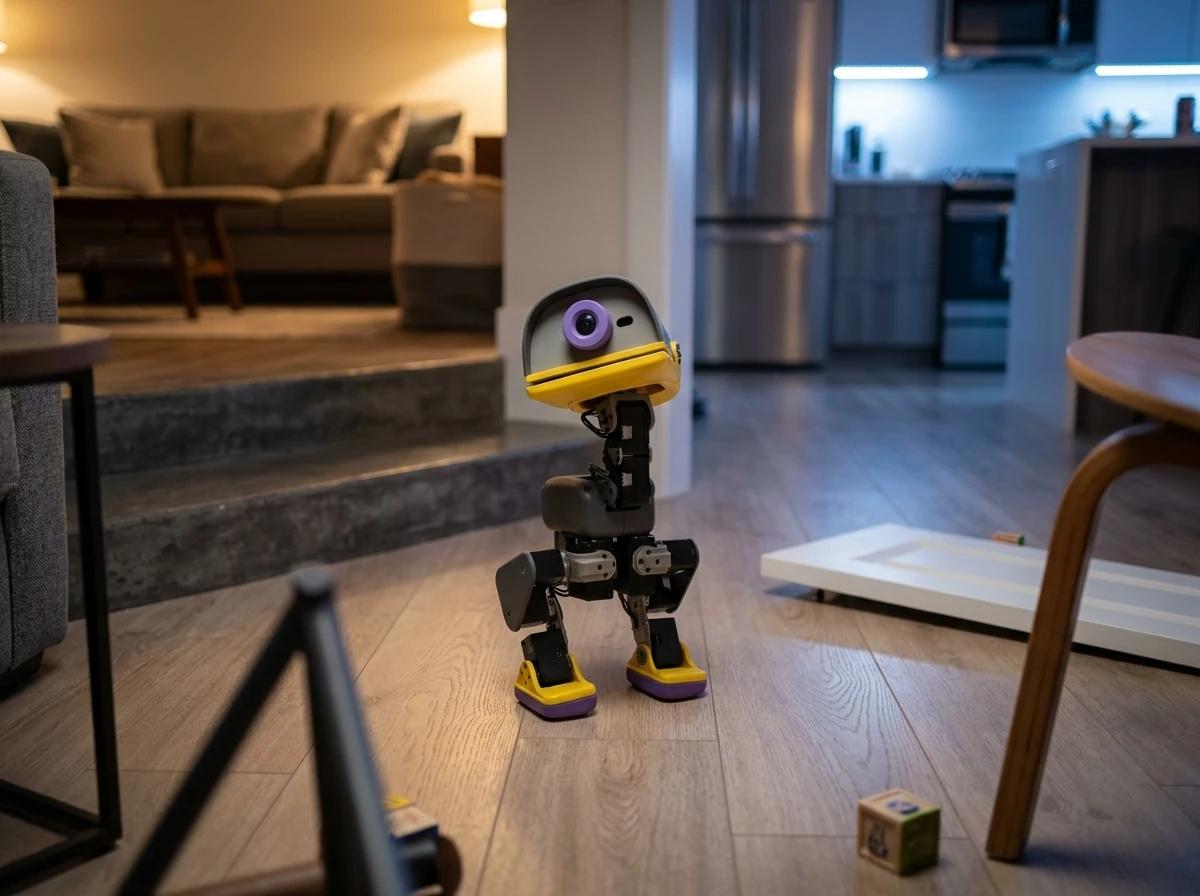
Imagine MicroDuck getting confused by a chair leg.
Or stopping two centimeters too far from the dock.
Or approaching from the wrong angle.
Or falling in front of the charger.
Or reaching the dock but failing to make electrical contact.
Or successfully charging once and then failing the next twenty times because the lighting, floor position or starting orientation is different.
None of these problems sound impressive in a video.
All of them matter if you want the robot to be something you leave running in your home.
That's why I don't think autonomous charging should be treated as a simple “nice feature.”
It is a reliability problem.
And reliability is much harder than a successful demo.
The battery makes this question more important
Pollen currently specifies around one hour of runtime, depending on usage, with a removable NP-F550 2600 mAh battery. (Pollen Robotics)
That is perfectly reasonable for a small experimental robot.
But it changes how you think about ownership.
If you're sitting at your desk playing with MicroDuck, battery management isn't a huge deal.
The robot gets low.
You plug it in.
You come back later.
No problem.
But now imagine a different kind of MicroDuck.
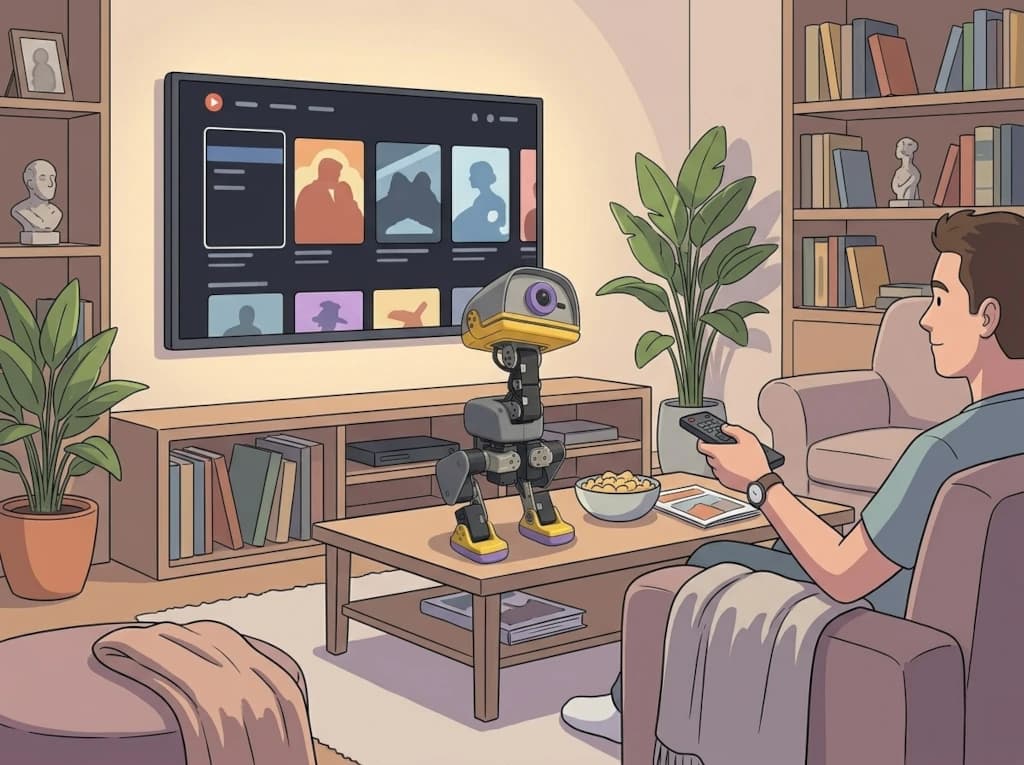
It sits on your desk during the day.
It notices something.
It moves around.
It talks to you.
It interacts with your smart home.
It performs a little task.
It wanders somewhere else.
Then its battery gets low.
At that point, telling the owner:
“Please pick me up and plug me in.”
breaks part of the illusion.
The robot is autonomous until it isn't.
That may sound like a small distinction.
I think it's actually fundamental.
A personal robot should eventually take care of itself
This is where I think the charging problem becomes much bigger than MicroDuck.
When we imagine a useful personal robot, we tend to focus on what it can do for us.
Talk.
See.
Move.
Remember.
Understand.
Carry something.
Control devices.
But there is another category of behavior that gets much less attention:
taking care of itself.
A useful robot should eventually be able to:
- manage its battery;
- return to a safe place;
- recover from ordinary mistakes;
- know when it needs attention;
- maintain its own operating state.
These aren't glamorous abilities.
They are infrastructure.
And infrastructure is what makes autonomy usable.
A robot that can perform ten impressive behaviors but needs constant human intervention can feel surprisingly primitive.
A robot with fewer impressive abilities but good self-management can feel much more autonomous.
That's why I find the charging question so revealing.
Could MicroDuck technically learn to do this?
Potentially, yes.
And this is where MicroDuck's design becomes interesting.
Pollen has built the robot around an open software stack, simulation and reinforcement learning. The company says the system is intended to let developers train new physical behaviors in simulation and then transfer those behaviors to the physical robot. (Pollen Robotics)
Pollen engineers have also described autonomous behaviors, navigation, SLAM and grasping as areas they want the community to explore on the platform.
A charging routine fits naturally into that broader problem.
But I would be careful with the wording.
There is a difference between:
“MicroDuck could eventually learn to charge itself.”
and:
“MicroDuck is going to get self-charging.”
The first is a plausible development direction.
The second would be a claim about a future product feature that hasn't been announced.
I haven't seen Pollen announce an autonomous charging feature for the current MicroDuck.
So for now, I would treat self-charging as an interesting possibility, not a promised capability.
The dock might actually be harder than the robot
This is the part I find most interesting.
We tend to imagine that the robot is the complicated part.
Maybe the dock is.
A good autonomous charging system could need:
A known physical location
The robot needs a reliable destination.
A reliable way to find it
The robot needs localization or some other way to identify the charging area.
A forgiving physical connection
The robot shouldn't need millimeter-perfect alignment every time.
A way to confirm charging
The robot needs to know that the connection actually worked.
A recovery strategy
What happens if it misses?
A good robot shouldn't simply say:
“I tried.”
It should try again.
That sounds obvious.
But this is exactly the kind of engineering detail that separates a cool robotics experiment from an appliance you can actually live with.
There are already multiple ways this could work
Self-charging doesn't necessarily mean one particular design.
Pollen could eventually support something as simple as a dedicated charging station that MicroDuck navigates toward.
Or a magnetic connection.
Or a dock with a large contact area.
Or some other approach.
The community is already imagining these possibilities. In the recent discussion around MicroDuck and Home Assistant, people immediately started suggesting ideas such as a dock or wireless charging, while noting that the current robot uses USB-C for charging.
I wouldn't take any of these community suggestions as evidence that Pollen is building them.
But they reveal something useful:
People aren't just asking whether MicroDuck can perform tricks anymore. They're asking how it could function as a persistent device in their environment.
That is a much more interesting question.
And this is where software becomes more important than hardware again
We've already argued that MicroDuck's open-source software stack could be more important to its long-term value than the initial set of behaviors.
Autonomous charging is another example.
The physical hardware may not need to change dramatically for the robot to become better at managing itself.
The intelligence layer could evolve.
A future software stack could potentially combine:
perception + localization + navigation + behavior planning + charging state
into something that makes the robot much more independent.
That's the same pattern we've been seeing around other MicroDuck experiments.
People are already exploring voice interaction, LLM integration and Home Assistant connectivity before many physical robots have even shipped. One developer is building a voice satellite for MicroDuck that uses real LLM services, Home Assistant and MCP, while developing against a simulated robot because their physical unit has not yet arrived.
That tells me something important.
The community isn't only interested in making MicroDuck do more things.
They're starting to think about making it fit into a larger environment.
Self-charging is part of that same transition.
The difference between a gadget and a robot
This is probably the biggest reason I care about the question.
A gadget expects you to use it.
A robot eventually needs to manage itself.
That's a subtle difference.
Your headphones don't need to walk back to their charging case because they don't move around your house.
Your smart speaker doesn't need to find an outlet because it stays in one place.
A robot is different.
The moment you expect it to move freely through your environment, power becomes part of its autonomy.
That's why I wouldn't consider self-charging just an accessory feature.
It's closer to an autonomy milestone.
Not the biggest one.
But a meaningful one.
I also think this changes how we should judge MicroDuck
This is where my view is slightly different from the usual “what features does MicroDuck have?” discussion.
I don't think the right question is:
“Can MicroDuck do X?”
I think we should increasingly ask:
“Can MicroDuck take care of the conditions required to keep doing X?”
Can it manage its battery?
Can it recover?
Can it navigate?
Can it understand its environment?
Can it decide when to act?
Can it return to where it belongs?
Can it maintain a relationship with its owner?
That is a different standard.
And it is much closer to the idea of a personal robot.
Would autonomous charging change my view of MicroDuck?
Yes.
Quite a lot.
If MicroDuck eventually becomes capable of:
wandering around → noticing low battery → finding its dock → charging → returning to what it was doing
I would see it differently.
Not because self-charging is particularly exciting by itself.
But because it would demonstrate something much bigger:
the robot is beginning to manage its own existence.
That is a meaningful step from:
“This is a device that can move.”
toward:
“This is an autonomous machine that can operate in an environment.”
Those are very different things.
My take
I don't think the lack of self-charging is a reason to avoid MicroDuck today.
It is an experimental platform, and Pollen has never presented the current robot as a fully autonomous home robot. In fact, the company explicitly frames MicroDuck as a way to make physical AI and learned behaviors more approachable, with autonomous navigation and similar capabilities described as areas for future exploration.
For the product that exists today, manually managing the battery is not a dealbreaker.
For the product MicroDuck could eventually become, I think it matters a lot.
Because there is a fundamental difference between:
a robot that can move around
and
a robot that can live in your environment without constantly needing you to manage it.
Self-charging doesn't create that second kind of robot by itself.
But it is one of the things that gets you closer.
And that's why I think the question is worth asking now.
MicroDuck doesn't need to charge itself to be interesting today.
But if the community and Pollen eventually figure out how to make it do so reliably, I would take that as a much bigger signal than simply adding another cool behavior.
It would mean the robot isn't just learning how to move.
It's learning how to exist.