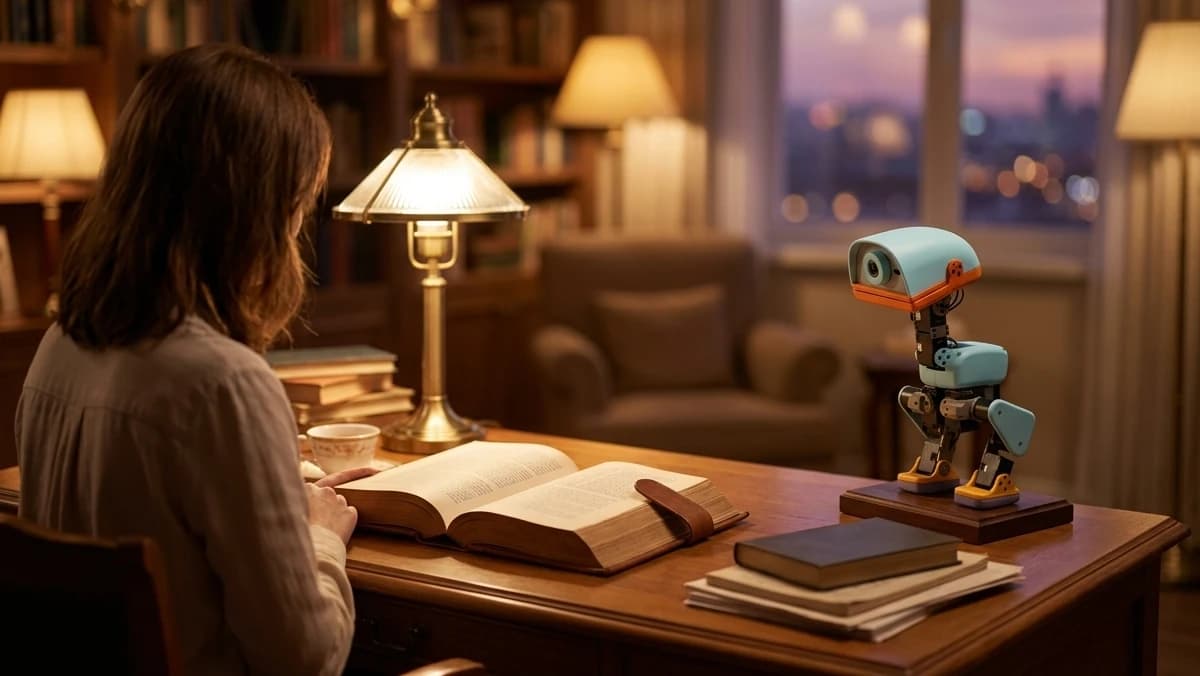
MicroDuck already has a body. What it doesn't fully have yet is a reason to use it.
This is the question I've been coming back to as I've looked deeper into MicroDuck.
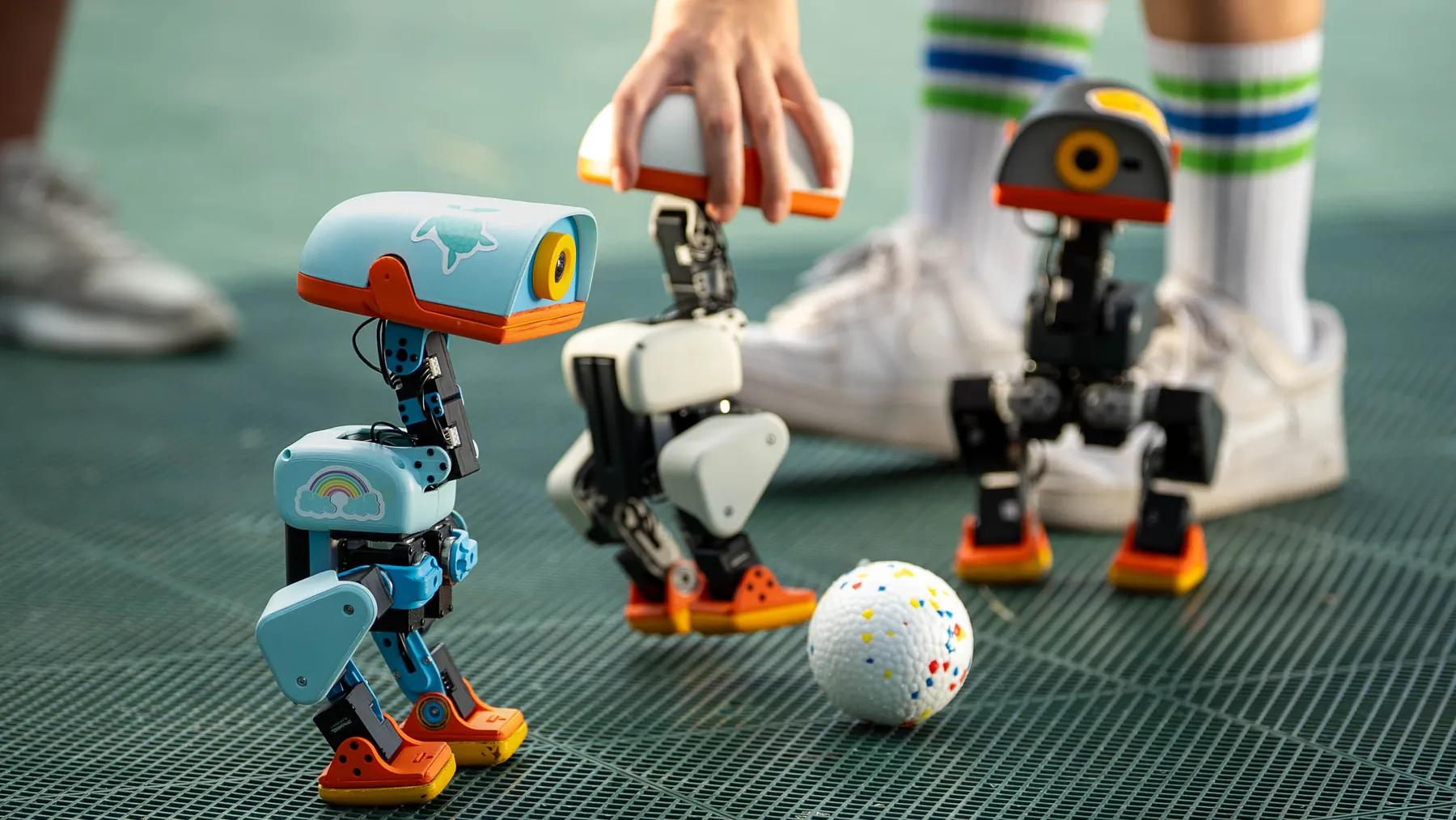
It can walk.
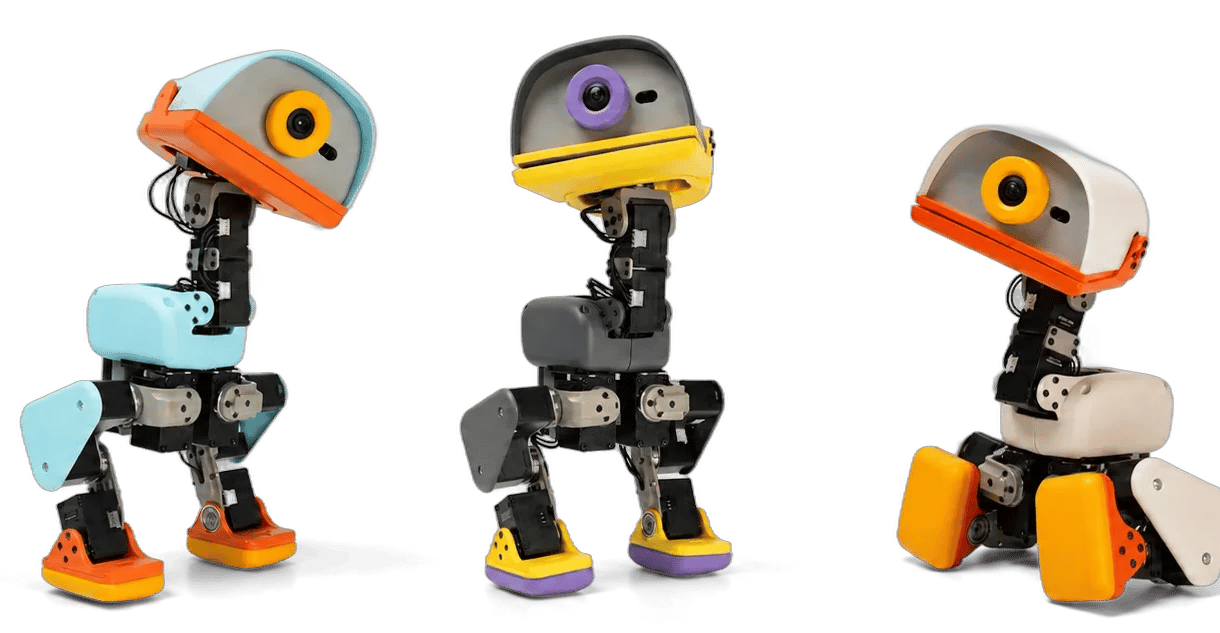
It can sit and stand.
It can kick.
It can grab things.
It can roller-skate.
It can recover after falling.
It has a camera, LiDAR, two IMUs, microphones, a speaker, Wi-Fi and Bluetooth.
Its software is open.
Its behaviors are learned policies that can be retrained.
And Pollen has built the project around simulation, reinforcement learning and sim-to-real deployment. (Pollen Robotics)
That is already enough to make MicroDuck a very interesting little robot.
But I don't think those things, by themselves, make it a personal robot.
Not yet.
The missing piece is subtle.
MicroDuck needs to move from:
“Here are things I can do.”
to:
“Here is what I should do right now.”
That is a much harder problem.
A library of behaviors isn't a personality
Imagine you own a MicroDuck.
You can make it walk.
You can make it kick a ball.
You can make it grab something.
You can make it skate.
You can make it get back up after falling.
Those behaviors are useful building blocks.
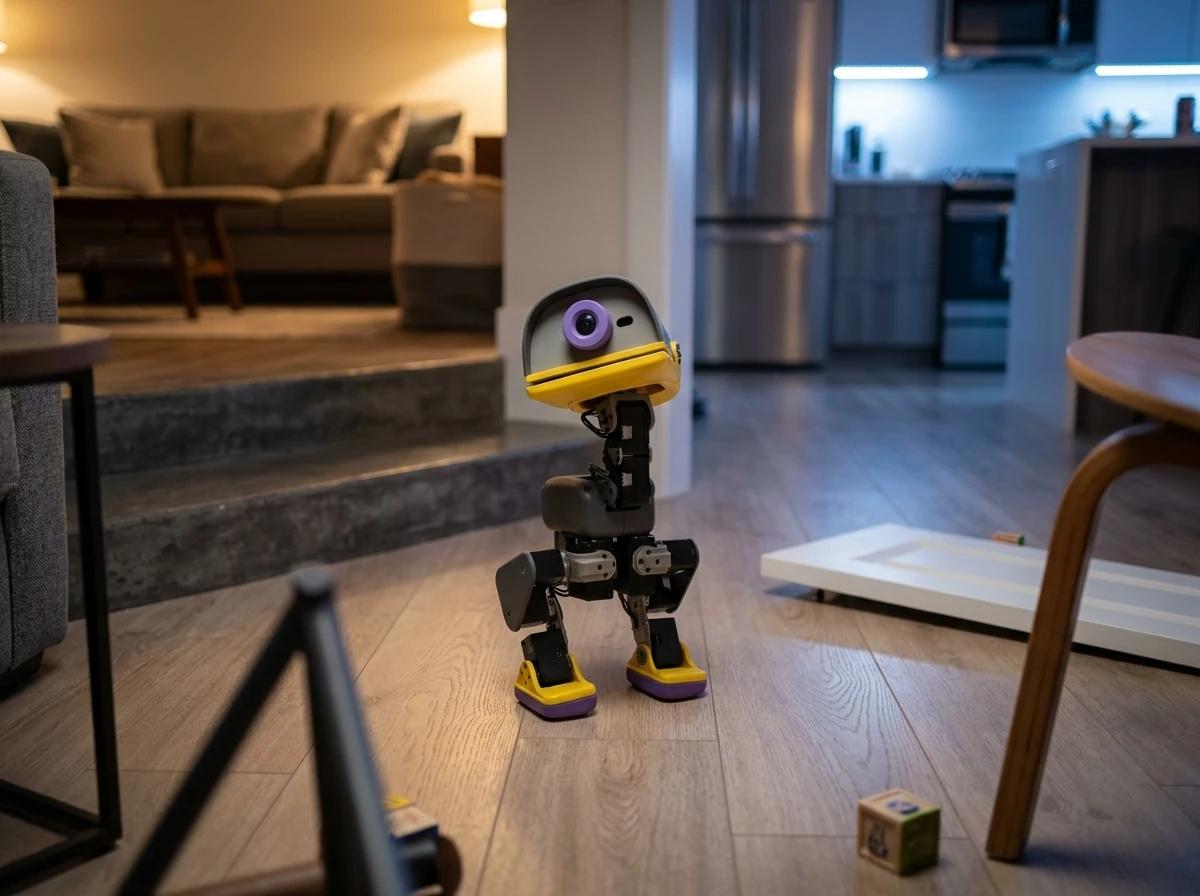
But imagine leaving the robot alone on a table.
What does it do?
Probably nothing unless you tell it to.
And that's where the distinction becomes important.
A personal robot isn't valuable simply because it has many capabilities.
It's valuable because it can decide when those capabilities should be used.
A human doesn't need you to say:
“Stand up now.”
“Look at me now.”
“Move toward me now.”
“Stop moving because I am working.”
A pet doesn't need a command list either.
It has some internal state.
It notices things.
It reacts.
It develops habits.
It has a reason to do things.
That's much closer to what we intuitively mean when we say something feels alive.
And interestingly, Pollen's own development roadmap seems to recognize this problem.
Pollen has already identified the missing layer
The most revealing document in the current MicroDuck repository might not be the product page.
It's the public roadmap.
Pollen's roadmap includes a milestone called:
M9 — The autonomous brain
And the description is unusually revealing.
The document says the biggest remaining gap is that the autonomous behavior layer doesn't yet exist in the daemon. It describes a planned system involving energy and mood, novelty-based exploration, obstacle avoidance, startle responses, sound reactions, ball play, a nap cycle and petting. It says the desired shape is a single brain where presence, mood and a shared beat become inputs to one system rather than isolated modes. (GitHub)
That is a very different idea from adding another behavior.
It's a system that answers:
What should the robot do when nobody tells it what to do?
That's the question I think matters most.
This is the difference between capability and agency
The word “agency” can sound philosophical.
It doesn't have to be.
Consider two robots.
Robot A
You give it commands.
It executes them.
Robot B
You leave it alone.
It notices something.
It chooses a behavior.
It acts.
Then it reassesses the situation.
Robot B doesn't necessarily have human-level intelligence.
It simply has a behavior loop that isn't completely dependent on the user.
That's an important difference.
MicroDuck already has many of the pieces required to build that kind of system.
The current software exposes sensor streams, robot state, movement control, audio and other interfaces. The architecture is built so different components can communicate through a common control layer. (GitHub)
But having all those inputs and outputs available isn't the same thing as having one system deciding what to do with them.
That's the missing layer.
The roadmap gives us a surprisingly concrete picture
The proposed autonomous brain isn't just:
“Add AI.”
It's much more specific.
The roadmap talks about:
Presence
The robot should have some understanding of whether it is active and what is happening around it.
Mood
Its behavior should vary depending on an internal state.
Novelty
It should have some reason to explore or react to things that are new.
Sound reactions
Ambient sounds can influence behavior.
Petting
Physical interaction can become part of the robot's behavior model.
Nap cycle
The robot can have periods of lower activity rather than constantly waiting for commands.
(GitHub)
I find this much more interesting than simply adding another “dance” policy.
Because these aren't individual tricks.
They're pieces of a continuous behavior system.
Why “doing nothing” is actually part of being a robot
This sounds strange, but I think it's important.
Most consumer electronics are designed around commands.
You press a button.
Something happens.
Then it waits.
A robot is different because it occupies physical space.
It doesn't have to be doing something every second.
It can be:
looking around;
resting;
making a sound;
noticing movement;
reacting to somebody walking past;
returning to a familiar place;
getting curious;
deciding not to interrupt you.
That idle state can become part of the experience.
And that's why the autonomous brain matters.
Without it, the robot is fundamentally:
a collection of behaviors waiting for instructions.
With it, the robot can potentially become:
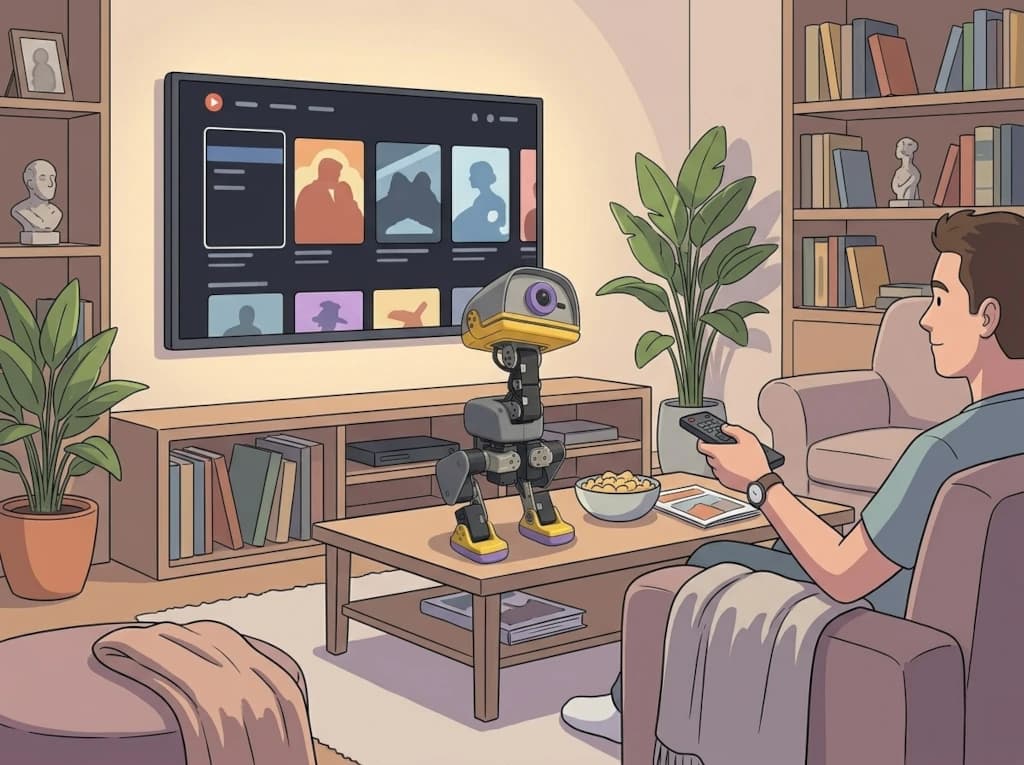
a thing that exists in your environment.
That's a meaningful difference.
This also explains why an LLM isn't enough
We've already looked at what an LLM could do for MicroDuck.
An LLM can provide language understanding.
It can potentially reason over context.
It can choose tools.
It can help interpret high-level goals.
But an LLM alone doesn't solve the autonomous behavior problem.
Suppose you leave MicroDuck in your room.
What should it do?
There may be no user message.
No explicit command.
No question.
Nothing to answer.
The robot still needs some kind of internal loop:
observe → evaluate → choose → act → observe again
That's not simply a chatbot problem.
It's a behavior problem.
And that's why I think Pollen calling its future milestone an autonomous brain is more meaningful than simply saying “we'll add more AI.”
The interesting part is that Pollen already has many of the ingredients
This is what makes MicroDuck different from a blank robotics platform.
It already has:
- physical movement;
- vision;
- depth sensing;
- audio;
- learned policies;
- a control loop;
- software interfaces;
- simulation;
- reinforcement learning;
- a community that can add new policies.
Pollen's public GitHub repository describes MicroDuck as a set of daemons around a 50 Hz control loop, with the robot's camera, sensor, control, update and communication systems already exposed through software interfaces.
So the challenge isn't:
“Can MicroDuck sense anything?”
or:
“Can MicroDuck move?”
It can.
The challenge is:
How do you combine all of those capabilities into one coherent behavior?
That's a much more interesting software problem.
And it may be harder than adding another skill
Suppose someone trains a new walking policy.
That's a relatively self-contained capability.
The robot can load it.
It can execute it.
It can stop it.
You know roughly what you're getting.
An autonomous brain is different.
It has to arbitrate between multiple possible behaviors.
Imagine MicroDuck:
hears a sound;
sees an object;
has low battery;
notices a person;
is currently playing;
receives a command;
detects an obstacle.
Which thing matters most?
What should it do?
Should it continue playing?
Should it react to the sound?
Should it come to the person?
Should it conserve battery?
Should it stop because somebody is nearby?
The architecture document explicitly lists authority priority when the app, a remote peer and autonomous behavior disagree as an unresolved design question. (GitHub)
That's a small line in a technical document.
I think it's actually a huge product problem.
Because the moment a robot can act by itself, it needs to know when not to act.
That's where personality becomes more than sound
Pollen says each MicroDuck gets its own audio identity when it first wakes up, and that voice stays with that individual robot. The current repository also includes sound generation and per-robot voice personality. (Pollen Robotics) (GitHub)
That's a nice touch.
But I don't think a unique voice is enough to create personality.
Personality comes from behavior.
Two robots can use the same voice and still feel completely different if:
- one is curious;
- one is cautious;
- one likes approaching people;
- one tends to stay nearby;
- one gets bored quickly;
- one reacts strongly to sounds.
That's why I find the roadmap's references to mood, presence, novelty and habits more important than simply giving the robot more sounds.
Personality is what happens when behavior becomes consistent over time.
The repository already acknowledges persistent personality and habits
This is another interesting detail.
Pollen's updater design explicitly reserves persistent state for things such as:
maps, personality, habits
and says that this robot-specific state should survive software updates and even rollback. User preferences such as the robot name are also designed to persist. (GitHub)
That doesn't mean MicroDuck already has a sophisticated personality system.
It doesn't.
But it shows that the software architecture is being designed with a future in which the robot has state that belongs to the individual robot.
That's important.
A robot with no persistent state is easy to update.
A robot with personality and habits needs continuity.
If you reset it every time the software changes, you lose part of what makes it feel like the same robot.
That is a very different design problem.
This is also where memory becomes useful
Imagine MicroDuck remembers:
where it usually sits;
what it likes to interact with;
how you usually engage with it;
your preferences;
what it has learned about its surroundings.
Now compare that with a robot that forgets everything after every update.
The hardware could be identical.
The learned movement policies could be identical.
The experience would be very different.
Memory is what allows behavior to accumulate.
And accumulated behavior is what can eventually create something that feels less like a gadget and more like a persistent companion.
Again, I'm not saying current MicroDuck already delivers that.
The point is that the architecture seems to be moving toward the infrastructure such a system would require. (GitHub)
So what is MicroDuck today?
This is how I would describe it.
It is already a physical AI platform.
It has a real body, sensors, learned behaviors and an open software stack.
It is already more than a static toy.
The behaviors can be retrained, policies can be updated, and the community can build on the platform. That's also why I keep coming back to whether MicroDuck actually learns or is just programmed.
But it is not yet a fully autonomous personal robot.
The higher-level behavior layer that decides what the robot should do on its own is still being designed.
That's not me being negative.
It's simply where the project is.
And honestly, I think that makes MicroDuck more interesting, not less.
Because the missing piece is exactly the interesting piece
If MicroDuck shipped today with:
perfect autonomy;
memory;
personality;
navigation;
self-charging;
useful physical tasks;
natural language;
smart-home integration;
it would be a very different product.
But we wouldn't get to watch how the ecosystem gets there.
MicroDuck is interesting partly because the pieces are arriving separately.
First:
movement.
Then:
learned behavior.
Then:
community policies.
Then:
external AI.
Then:
Then:
autonomous behavior.
The question is whether these pieces eventually become one coherent system.
That's the experiment.
I don't think the goal should be “make MicroDuck smarter”
This is where my own view differs from the way AI products are usually discussed.
A smarter model does not necessarily make a better robot, which is why I've argued before that a cute robot needs more than AI.
If MicroDuck can answer every question in the world but still sits there waiting for you to press a button, I'm not sure we've solved the most important problem.
I'd rather see a robot with slightly less impressive intelligence that has:
good timing;
useful initiative;
memory;
consistent personality;
reliable behavior;
and a sense of when to leave you alone.
That's much closer to something I would actually want on my desk.
Intelligence is not the same thing as agency.
And agency is not the same thing as usefulness.
A personal robot needs some combination of all three.
What would make me call MicroDuck a personal robot?
For me, the threshold is fairly simple.
I would want MicroDuck to be able to:
Notice something without being told to look.
Remember something that changes future behavior.
Choose an appropriate behavior without needing a command every time.
Move through its environment reliably.
Use external tools when they actually help.
Take care of basic needs such as charging.
Know when not to interrupt me.
And most importantly:
still feel like the same robot tomorrow.
That last one is easy to underestimate.
A personal robot isn't just a machine with capabilities.
It is a machine with continuity.
My take
I don't think MicroDuck is fully ready to be called a personal robot yet.
I think it's closer to:
a physical AI platform that could become a personal robot.
That distinction matters.
The hardware gives it a body.
The learned policies give it skills.
The open software gives other people the ability to expand those skills.
LLMs can potentially give it higher-level reasoning.
Navigation can give it freedom of movement.
Smart-home integrations can connect it to the environment.
But the autonomous brain is what could turn those pieces into one persistent system.
And Pollen's own roadmap makes it clear that this layer is still ahead. The planned autonomous brain is intended to combine presence, mood, novelty, sensing and behavior into a coherent loop rather than a collection of isolated commands.
That is the part I'm most interested in.
Not another trick.
Not another demo.
Not another benchmark.
I want to see what the duck does when nobody tells it what to do.
Because that is the point where a robot stops being a list of capabilities.
And starts becoming something that actually lives in your environment.