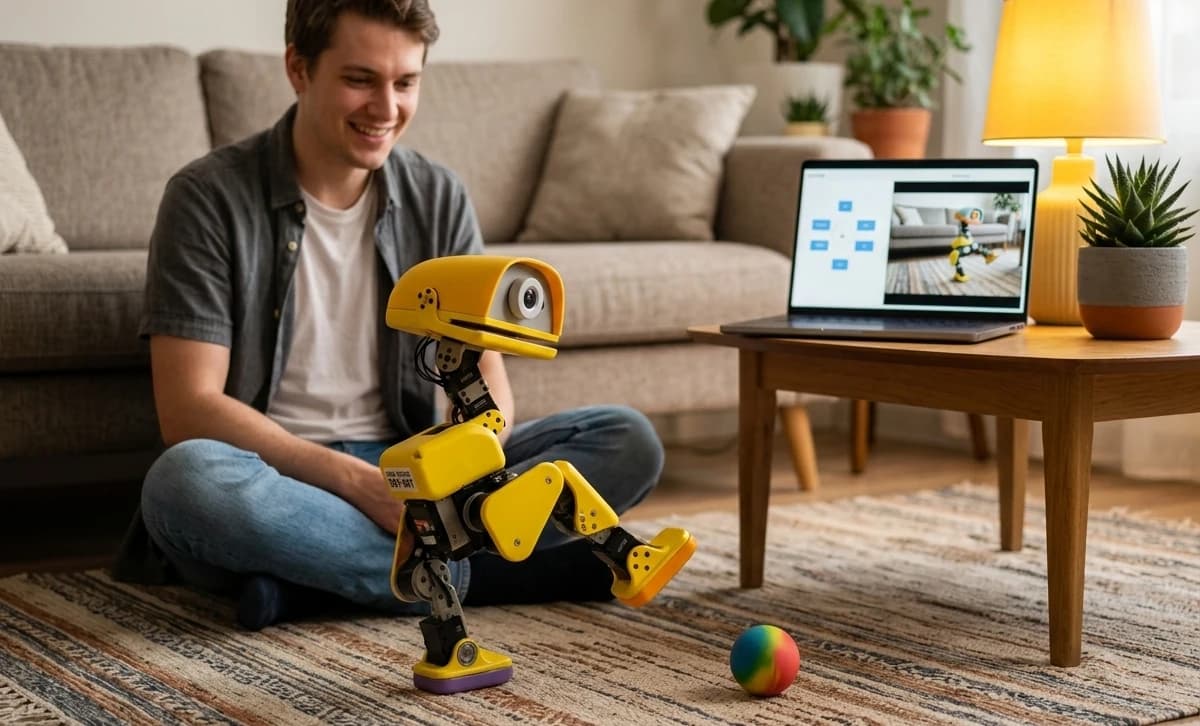
You don't need to code to benefit from open source. But someone does need to build something.
One of the first things you'll notice when you look at MicroDuck is how much of the project is built in the open.
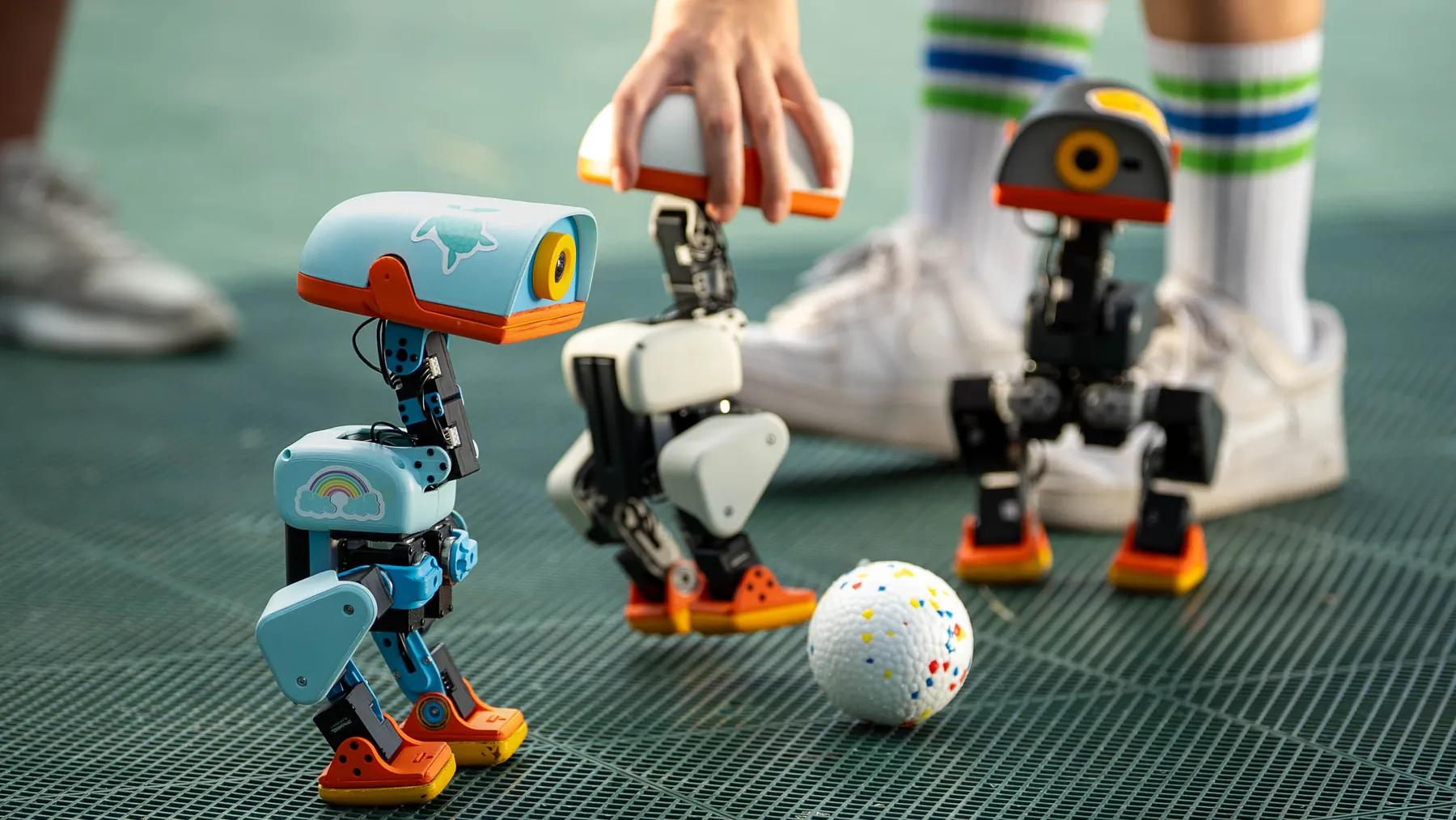
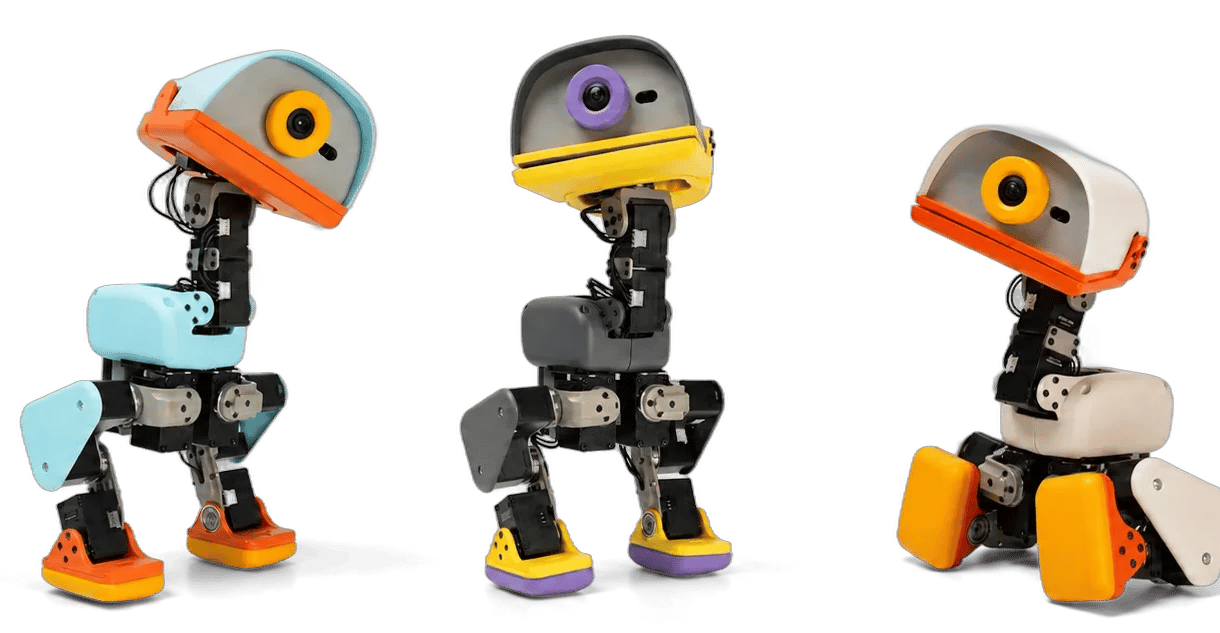
Pollen describes MicroDuck as an open-source biped robot. Its SDK, simulation environment, and reinforcement-learning training stack are published on GitHub, and the company says the software the robot runs is something you can read, fork, and retrain. (Pollen Robotics)
For developers, that's an obvious selling point.
But what about everyone else?
Most people who might want a small robot on their desk are not going to train reinforcement-learning policies after work.
They don't want to read a GitHub repository.
They don't want to configure a robot from a terminal.
They just want the robot to do interesting things.
So a reasonable question is:
If I don't code, why should I care that MicroDuck is open source?
I think the answer is:
You should care about what the openness enables, not about the source code itself.
And that's an important distinction.
Open source doesn't mean you have to become a developer
Let's start with the obvious misunderstanding.
Buying an open-source robot doesn't mean you have to become part of its developer community.
This is the point I explored in Does MicroDuck need coding?: you don't need to train your own walking policy.
You don't need to understand PPO.
You don't need to learn MuJoCo.
You don't need to know what an ONNX model is.
You can simply use the things that other people build.
This is already beginning to happen around MicroDuck.
Pollen's current software supports a policy system where policies can come from the official Pollen repository, from community repositories, or from a local file. The public documentation describes robotctl policy search, load, update, and reset, and shows an example of loading a policy published by another MicroDuck developer. (GitHub)
That is a big part of how open MicroDuck really is, but for an ordinary owner, the part to care about is simpler.
You don't necessarily need to know how the behavior was created.
You just need to eventually be able to say:
“Someone made this. I want to try it.”
That's the consumer value of an open ecosystem.
Think about your phone
You probably don't care that your phone's operating system contains millions of lines of code.
What matters is what exists because developers can build on the platform.
You install an app.
Someone else built it.
You use it.
You don't need to know how it works internally.
An open robot can eventually work in a similar way.
Someone trains a new behavior.
Someone creates a voice interface.
Someone connects the robot to another service.
Someone creates a new game.
Someone builds a better companion experience.
You download it or enable it.
That's the dream.
But there's one important difference.
A smartphone ecosystem already has billions of users.
A new robot doesn't.
And that is why MicroDuck's openness is both exciting and uncertain.
The software is open. The ecosystem is still young.
This distinction is probably the most important thing to understand.
MicroDuck has a public software stack.
That is a fact.
But having public code and having a mature ecosystem are two different things.
Right now, the project is very young.
Pollen only launched MicroDuck on August 27, 2026, and many owners are still waiting for their hardware. The community is already publishing experiments and policies, but the ecosystem is obviously nowhere near the maturity of something like an app store. (Pollen Robotics)
An independent community-maintained MicroDuck directory currently describes the project as still being in a pre-hardware phase for most users, with simulation and software projects already active but many hardware-facing projects not yet validated on physical units. (GitHub)
That is exactly what I would expect this early.
And it changes how I would evaluate the open-source promise.
I wouldn't ask:
“How many things can I download today?”
I'd ask:
“Are enough people building that this could become much more valuable six months from now?”
That's a much better question.
The first thing open source can give you is more behaviors
This is probably the easiest benefit to understand.
MicroDuck currently ships with seven trained moves, including walking, sitting and standing, kicking, grabbing, roller skating, and getting back up after a fall. Pollen says every behavior is a policy that can be retrained. (Pollen Robotics)
That's already a solid starting point for what MicroDuck can actually do, and it's pretty fun.
But eventually, seven behaviors become seven behaviors.
You can repeat them.
You can combine them.
You can show them to someone.
Then you've seen them.
The more interesting possibility is that new policies keep appearing.
Pollen's current policy-channel design explicitly supports community policies alongside official ones. Community policies can be loaded onto a robot separately from the main robot software, while an owner can reset a slot back to the official version. (GitHub)
For a developer, that's a technical feature.
For a normal owner, it could eventually mean something much simpler:
Your MicroDuck can gain new things to do without waiting for Pollen to release an entirely new robot.
That's a meaningful difference.
The second benefit is that someone else can solve the difficult parts for you
This might be even more important.
Suppose you want MicroDuck to talk naturally. That's exactly the kind of gap an LLM could fill, but you aren't interested in learning speech recognition.
You don't care about APIs.
You don't want to build a voice pipeline.
But someone else does.
They build it.
You use it.
Or maybe you want MicroDuck to interact with your smart home.
Someone creates an integration.
You install it.
Or perhaps someone develops a better way for the robot to remember preferences.
Again, you don't need to build it.
This is how an ecosystem becomes useful to non-technical people.
Developers absorb complexity so users don't have to.
That's the part of open source that is easy to overlook.
We've already seen a glimpse of this with MicroDuck
The community hasn't been sitting completely still while waiting for hardware.
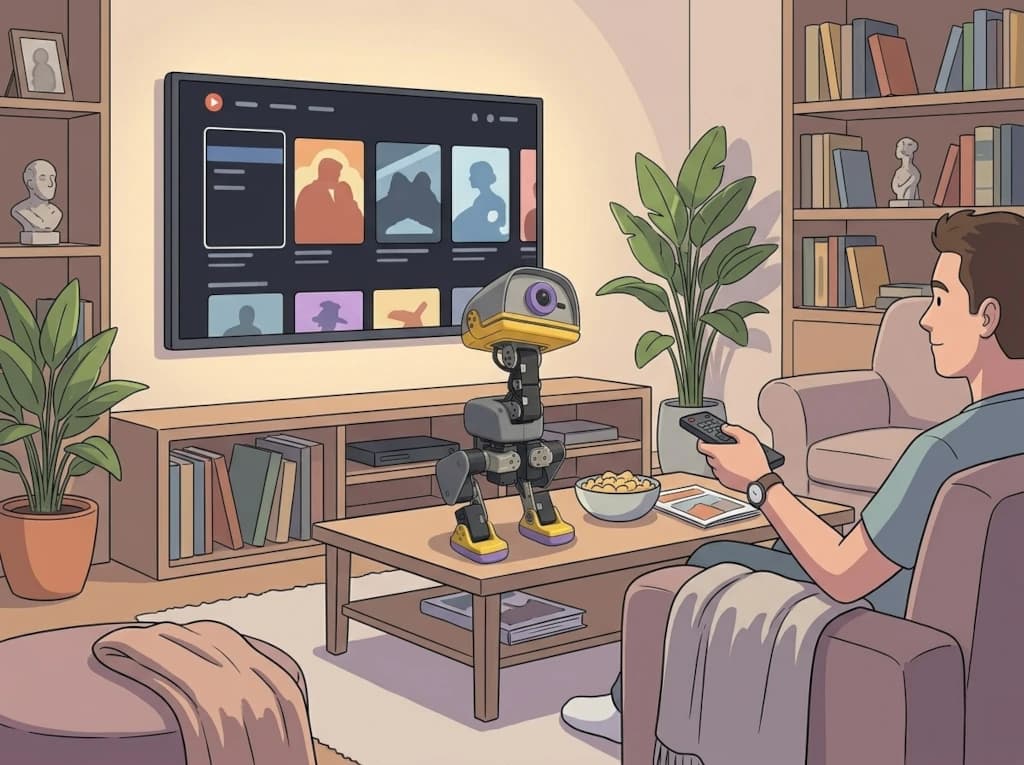
A developer has been working on a project that turns MicroDuck into a voice satellite for Home Assistant, using real LLM services and MCP tools. It's an early example of how the robot could become part of your smart home. Because their physical MicroDuck had not yet arrived, the project was being developed against a simulated robot. (Reddit)
You don't have to care about Home Assistant.
You don't have to care about MCP.
The interesting part is what this demonstrates.
Someone is taking the raw capabilities of the platform and trying to turn them into something that looks much more like a consumer experience.
That's exactly the bridge an open platform needs.
The developer sees:
SDK + robot + APIs + LLM + Home Assistant.
A normal user should eventually see:
“I can talk to my robot and it can interact with my home.”
The first one is infrastructure.
The second one is a product.
But this only works if the community keeps building
This is where I would be cautious.
Open source is not a magic spell.
Publishing code doesn't automatically create developers.
And developers don't automatically create useful consumer products.
There is a whole chain between the two.
It looks something like:
Open source
↓
Developers experiment
↓
Projects appear
↓
Projects become reliable
↓
Other people discover them
↓
Normal users can install them
↓
The robot becomes more useful
Any weak link can break the chain.
You can have thousands of GitHub stars and still have very little that an ordinary person can use.
Conversely, one developer can sometimes create an incredibly useful project that makes an entire platform much more attractive.
That's why I wouldn't judge MicroDuck's ecosystem by GitHub stars alone.
I'd watch for things that ordinary owners actually want.
The best outcome isn't more code
This might sound strange coming from an AI software developer, but I don't think the goal should be:
more code.
The goal should be:
less work for the owner.
That's a better way to evaluate the ecosystem.
Suppose someone creates a brilliant robotics project that requires:
- Linux;
- Python;
- CUDA;
- a specific GPU;
- five repositories;
- twenty installation commands;
- manual configuration;
- constant troubleshooting.
Developers might love it.
Most consumers won't.
Now suppose another developer takes the same underlying capability and turns it into:
Install → choose behavior → try it.
That's the project I'd care about more.
Because it crosses the line from:
developer experiment
to:
consumer feature.
This is why open source could actually matter more to non-technical users over time
There is a paradox here.
The more successful the MicroDuck developer ecosystem becomes, the less technical knowledge an ordinary owner may need.
That sounds backwards.
But think about it.
In the beginning:
Open source → you have to build things yourself.
Later:
Open source → other people have already built things.
Eventually:
Open source → you simply choose what you want.
That's what a mature ecosystem looks like.
The user doesn't see the complexity anymore.
They see the result.
This is the same reason app stores work.
You don't build the application.
You use it.
The developer platform underneath is what makes that possible.
The community could become MicroDuck's second product
This is probably the biggest reason I'm paying attention to MicroDuck.
Pollen is making the physical robot.
The community can potentially build the software layer around it.
Those two things reinforce each other.
More useful software makes the hardware more attractive.
More hardware creates more potential users.
More users attract more developers.
More developers create more software.
That creates a loop:
more owners → more developers → more behaviors → more reasons to own the robot.
If that loop starts working, MicroDuck becomes much more interesting than its launch specification suggests.
The robot becomes a platform.
And platform products can have a very different lifespan from fixed-feature gadgets.
There is another benefit: experimentation doesn't have to wait for the hardware
This is unusual.
Pollen's simulation environment means developers can start working with MicroDuck before receiving the physical robot. The company's official workflow is essentially:
train in simulation → deploy on the robot → refine → publish. (Pollen Robotics)
The community is already using simulation for projects while waiting for hardware.
That matters because the current preorder situation means many people will have a significant gap between:
“I bought MicroDuck”
and
“I actually have MicroDuck in my hands.”
Normally, that would simply be dead time.
For an open platform, some of that time can become ecosystem-building time.
And when the hardware finally arrives, there could already be things waiting to try.
That's a much more attractive scenario for a non-technical owner.
But I wouldn't buy MicroDuck only because it's open source
This is where I'd draw the line.
If you are a normal consumer and your reaction is:
“Open source sounds cool, so this must be better.”
I wouldn't make that leap. A better starting point is what to check before you preorder MicroDuck.
Ask yourself a simpler question:
What can I use today?
Because potential doesn't pay for your purchase.
If you don't want to develop anything, and there aren't enough community-created experiences yet, the openness may have very little immediate value to you.
You are still buying the current product.
The ecosystem is a bet on the future.
That's why my recommendation for ordinary buyers is still to watch what happens before rushing in.
Let developers take the early risk.
Let them discover what works.
Let the useful projects emerge.
Then decide whether the ecosystem has become something you actually want to use.
The most important people in this ecosystem may not be the developers
This is another thing I think is easy to miss.
A successful ecosystem needs more than people who create software.
It needs people who try things and give feedback.
A developer makes a behavior.
A user tries it.
The user says:
“This is fun for five minutes.”
The developer changes it.
Another user says:
“This is actually useful.”
Someone else creates a better version.
A third person packages it so that a non-technical owner can install it.
That feedback loop is how software becomes a product.
So even if you never write a line of code, you can still participate in the ecosystem.
You can be the person who discovers what is actually worth building.
That's useful.
And this is where I think MicroDuck has an interesting advantage
Most consumer robots are heavily dependent on their manufacturer.
If the manufacturer stops adding features, the product mostly stops changing.
That isn't necessarily bad.
It's just predictable.
MicroDuck is taking a different route.
Its software is open.
Its policies can be retrained.
Community policies can exist alongside official policies.
The simulator and training tools are available.
And Pollen has designed a mechanism for the robot to discover and load community policies separately from the core robot software. (GitHub) (GitHub)
That gives the project a chance to evolve in directions Pollen itself didn't originally anticipate.
That's the opportunity.
Not the guarantee.
What I would watch over the next few months
I wouldn't watch GitHub stars.
I'd watch five much simpler things.
Are new behaviors appearing?
Not just technical demos.
Actual things people want to try.
Are those behaviors becoming easier to install?
This is critical for non-technical users.
Are people combining MicroDuck with other AI systems?
LLMs, voice, memory, home automation and other tools could expand what the robot can actually do.
Are owners still using their robots after the novelty wears off?
This may be the most important one. It's also the question behind what makes a desktop robot worth keeping.
Does the community create reasons to come back?
A new behavior once a month is one thing.
A growing ecosystem of things worth trying is something else.
That's the difference between a robot that you buy and a platform that you keep using.
My take
So, does open source actually matter if you don't code?
Yes — but indirectly.
You shouldn't care about open source because you want to read the source code.
You should care because open software gives other people the ability to build things that you might eventually use.
That's the real consumer benefit.
MicroDuck already has the beginnings of that structure: an open SDK and software stack, a simulation and reinforcement-learning workflow, a mechanism for community policies, and developers already experimenting with LLMs and smart-home integrations. (Pollen Robotics) (GitHub) (Reddit)
But it's still early.
And I think that's the honest part people should keep in mind.
Open source gives MicroDuck a much higher ceiling.
It does not guarantee that MicroDuck will reach it.
For a developer, that ceiling may be enough reason to buy immediately.
For an ordinary user, I'd rather watch what the community does with that freedom first—especially whether a normal person can actually have fun with MicroDuck.
Because the best possible outcome isn't that you eventually learn how to code a robot.
It's that you never need to.
Someone else already built the thing you wanted.
And you just get to use it.