There is a big difference between asking a robot a question and giving it something to take care of.
The first one is easy.
You ask:
"What's the weather tomorrow?"
It answers.
Done.
But imagine saying:
"Remind me about this tomorrow morning."
That's different.
Now I expect the robot to remember.
And tomorrow, I expect it to actually do something.
That's the moment when I stop thinking about the robot as something I talk to and start thinking about it as something I can rely on.
And I think that is a much bigger step.
A desktop robot doesn't need to replace my computer.
It doesn't need to run my entire life.
But if I can tell it:
"Take care of this."
and genuinely trust that it will remember what I meant, keep track of it, and come back when necessary, the relationship changes.
It starts feeling much more like a secretary, a butler, or a very attentive friend.
Answering me is not the same as helping me
This distinction sounds small.
It isn't.
Imagine I say:
"I have a dentist appointment tomorrow at three."
A chatbot can respond:
"Okay, that's tomorrow at three."
Fine.
But what I really want might be:
"Remind me tomorrow at two."
Even better:
"And remind me to bring the paperwork."
Now the robot isn't simply answering.
It's taking something off my mind.
That is a completely different kind of value.
I'm not interested in whether the robot can produce the most impressive answer.
I'm interested in whether I can hand it a small piece of my life and stop thinking about it.
That's what a good assistant does.
People already want this from desktop robots
This isn't something I made up because it sounds futuristic.
LOOI users have repeatedly asked for exactly these kinds of capabilities.
One community post listed persistent reminders, Google Calendar, Todoist, scheduled routines, and notifications for texts and emails among the most wanted additions. The author described reliable recurring reminders as a potential "no brainer" for a friendly robot, while also worrying that without them the product could eventually become a high-tech paperweight.
Another LOOI owner complained that although the robot's personality was excellent, its limited integration with the rest of their phone severely limited its usefulness. They wanted the robot to do more than simply sit on top of a phone and talk.
That's an important distinction.
People aren't necessarily asking for "more software."
They're asking for:
"Please make this thing actually help me."
I don't want to tell the robot the same thing twice
This is probably one of my biggest expectations.
Imagine telling your robot:
"I need to finish the presentation by Friday."
Then the next day:
"Remember that presentation I told you about?"
And it says:
"Which presentation?"
That destroys a lot of the magic.
Because now I have to become the robot's manager.
I have to remember what I told it.
I have to repeat the details.
I have to explain everything again.
That's exactly the opposite of what I wanted.
The whole point was to move some mental burden from me to the robot.
A good AI desktop robot should gradually become the thing that remembers the unfinished pieces.
Not the thing that creates more things for me to remember.
A secretary doesn't just remind you
This is why I think "assistant" can be too generic a word.
Imagine telling a human secretary:
"I need to prepare for the meeting on Thursday."
A good secretary doesn't simply answer:
"Okay."
They might remember it.
They might know which meeting you mean.
They might remind you at the right time.
They might know that you wanted to bring something.
They might ask whether you still want that thing done.
The point isn't that the secretary has a huge list of features.
The point is:
something you said became something that was taken care of.
That's the behavior I would want from an AI desktop robot.
The first level is remembering
Before a robot can take care of anything, it has to remember that you asked.
That's the obvious part.
But even this can be surprisingly powerful.
You say:
"Remind me next Tuesday."
A week later, the robot remembers.
You say:
"I need to call John when he gets back."
Later, it knows who John is and why you needed to call.
You say:
"Don't let me forget this."
And the robot doesn't need you to repeat the request three times.
This is where the memory discussion we already had in Why Does an AI Desktop Robot Need Memory? becomes practical.
Memory stops being an interesting AI feature.
It becomes:
one less thing I have to keep in my head.
The second level is understanding what you meant
Remembering the sentence isn't enough.
Suppose I say:
"Don't let me forget to send that thing to Sarah."
A human friend who knows me might understand what "that thing" means.
A generic system might ask me to fill out five fields.
The robot needs some ability to understand the conversation around the request.
That's where knowing the owner becomes important.
The more it knows about my life, the less I have to explain.
And this is another reason personalization matters.
I've written about that in Why an AI Desktop Robot Should Adapt to You Instead of the Other Way Around.
A personal robot shouldn't just remember information.
It should understand enough of my world that ordinary human language works.
The third level is following through
This is where the difference becomes really obvious.
Imagine I tell my robot:
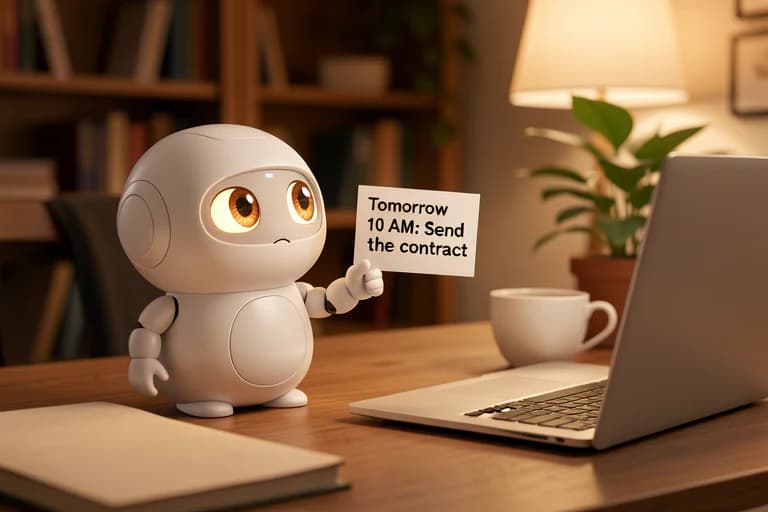
"Tomorrow morning, remind me to send the contract."
The robot says:
"Sure."
That is not enough.
Tomorrow morning it actually needs to remember.
And if I then say:
"I already sent it."
the robot should stop bothering me.
That's follow-through.
It sounds mundane.
But this is the kind of thing that makes an assistant genuinely useful.
The robot doesn't need to perform something spectacular.
It just needs to make sure the thing I handed it doesn't disappear.
The robot can become the place where unfinished thoughts go
I think this could be incredibly useful.
Throughout a normal day, people have dozens of tiny thoughts:
"I need to look into that."
"Remind me to send this."
"I should ask John about that."
"I don't want to forget this idea."
"Let's come back to this tomorrow."
Most of those thoughts don't belong in a giant project-management system.
They're just things floating around in your head.
A desktop robot could become a natural place to put them.
You say it out loud.
It understands.
You move on.
That sounds simple.
But that's exactly why it could be useful.
You don't need to stop what you're doing and organize your life.
You just tell the little robot sitting beside you.
This is where the physical robot actually helps
I could say these things to an app.
Of course.
And I already can.
But there is a difference.
The robot is physically there.
I'm already sitting at my desk.
I don't need to search for the right application.
I don't need to stare at another interface.
I can simply say:
"Remember this."
The robot acknowledges it.
Then I continue working.
That's a tiny improvement.
But you do that dozens of times over months.
The small improvement starts adding up.
That's when the robot starts earning its place on the desk.
It can also be the thing that remembers what you forgot
This is where the relationship becomes more interesting.
Suppose I tell my robot:
"I really need to call this person tomorrow."
Tomorrow arrives.
I forget.
The robot doesn't.
It says:
"You wanted to call Sarah today."
That sounds like a reminder.
But emotionally, it can feel more like:
"Oh right. You remembered."
That's a very different feeling from a notification saying:
Task overdue.
The machine is still doing the same basic job.
The physical presence changes how it feels.
And that matters if we're talking about a companion robot rather than another task-management app.
The robot doesn't need to become my manager
This is where I think things can easily go wrong.
A robot that remembers everything could become unbearable.
You said:
"I'll do this later."
It reminds you.
You ignore it.
It reminds you again.
You change plans.
It complains.
You go to lunch.
It gives you a report.
At some point you have created the worst possible coworker.
That's not what I want.
The robot needs to understand the difference between:
helping me
and:
managing me.
A good assistant gives you control.
It doesn't constantly demand that you obey it.
A good robot should know when to let something go
This is the other side of follow-through.
If I cancel something, the robot should stop.
If I change my mind, it should adapt.
If something isn't important anymore, it shouldn't keep bringing it back.
And if I've ignored the same reminder three times, perhaps the robot should eventually ask:
"Do you still want me to remind you about this?"
That's more intelligent than repeating the same notification forever.
Again, the user doesn't need to think about how this works.
The experience should simply be:
"It understands that this isn't important anymore."
This can become surprisingly useful for work
Now we're back to your desk.
You're working on something.
You suddenly remember:
"I need to ask the client about that tomorrow."
Instead of opening an application, you tell your robot:
"Remind me to ask the client about the delivery schedule tomorrow."
Done.
Later:
"What are the things I needed to follow up on?"
The robot knows.
You didn't have to maintain another list.
This is a small example.
But there are hundreds of variations.
Meeting follow-ups.
People you need to contact.
Questions you need to ask.
Ideas you don't want to lose.
Things you promised.
Things you need to check.
Small deadlines.
That's where a desktop robot could become useful without ever pretending to replace your actual computer.
It could also become a supervisor
This is one of the roles I think could become genuinely valuable.
Not a manager.
A supervisor for yourself.
Suppose you tell it:
"I want to finish this today."
Later, you are still procrastinating.
A robot that knows your habits might say:
"You said you wanted this done today."
That's different from a generic reminder.
It knows the commitment came from you.
It isn't imposing somebody else's goal.
It's helping you remember your own.
That's a subtle difference.
And it could be surprisingly powerful.
It can also be a coach
Suppose you're practicing something.
You tell the robot:
"I need to be ready for this interview next week."
It knows.
Over the next few days, you ask it questions.
Maybe it remembers what you struggled with yesterday.
Maybe it notices that you keep avoiding the same topic.
Maybe it asks again.
Not because somebody programmed:
"Interview mode."
Because the robot knows what you're trying to accomplish.
That's when the idea of a companion and a coach starts to overlap naturally.
Eventually, you could trust it with larger things
This is where I think the relationship could develop gradually.
You start with tiny things.
"Remind me about this."
Then:
"Keep track of this."
Then:
"Check this later."
Then:
"Make sure I don't forget this."
Then eventually:
"Take care of this for me."
That last sentence is a much bigger leap.
It requires trust.
Because now I'm not asking the robot to remember.
I'm asking it to act.
And I think that's where AI desktop robots will eventually face a very important question:
How much should I actually trust my robot to do without asking me every time?
I'm not sure the answer should be:
everything.
Probably the opposite.
Trust should grow gradually.
I would start with low-risk things
If I had an AI desktop robot, I'd probably trust it with things like:
reminders
keeping track of commitments
asking me about unfinished things
helping me prepare
checking information
practicing with me
organizing things I told it about
Those don't require huge amounts of trust.
They just require consistency.
If the robot handles those things well for months, I'd naturally start trusting it with more.
That's how relationships work.
You don't hand someone responsibility for your entire life the first day you meet them.
You start small.
The robot has to earn the right to become more useful
I think this is an important idea for the whole category.
People talk about how smart a robot is.
I'd rather ask:
Can I rely on it?
A robot that knows a lot but constantly forgets what I told it is frustrating.
A robot that talks beautifully but doesn't follow through isn't particularly helpful.
A robot that has fewer capabilities but reliably handles the things I care about could become much more valuable.
That's another reason why long-term software improvement matters.
The robot shouldn't just gain new tricks.
It should get better at keeping promises.
Better at understanding requests.
Better at remembering what matters.
Better at knowing when to act.
Better at knowing when not to.
That's the kind of improvement I'd actually notice.
This changes the meaning of "smart"
A robot can answer a difficult question.
That's impressive.
But imagine telling it something on Monday and getting the right follow-up on Thursday.
That's a different kind of intelligence.
It means the robot connected:
what you said
what happened later
what you expected
and:
what you need now.
I think that is much closer to the kind of intelligence people will value in a personal robot.
Not:
"It knows calculus."
But:
"It remembered what mattered to me."
And this is where being on the desk becomes important again
The robot doesn't have to follow you around your house.
It doesn't have to be everywhere.
Its physical presence can actually be an advantage precisely because it has a stable place.
It's where you work.
It's where you think.
It's where you make plans.
It's where you talk.
It's where unfinished ideas appear.
The robot becomes a persistent point in that environment.
You know where it is.
And it knows where it is in relation to you.
That stability could make it much easier to build a long-term relationship around it.
Imagine coming back to your desk
This is the kind of interaction I find much more interesting than another robot demo.
You sit down.
The robot says:
"You wanted to finish that proposal today."
You say:
"Right. I completely forgot."
It replies:
"You also wanted to ask Sarah about the numbers."
You look at it and say:
"Good catch."
That's it.
No dramatic movement.
No dancing.
No complicated interface.
It simply helped you remember the things you would otherwise have had to carry around in your head.
That's valuable.
And because it's a little robot sitting there, it can still make the interaction feel personal.
This doesn't mean the robot should always be working for you
I want to make this distinction very clear.
The robot should not become:
a productivity robot.
It should still be fun.
It should still have personality.
It should still talk to you about things that have nothing to do with work.
It should still be something you enjoy having around.
That's the entire reason the physical form matters.
The useful side shouldn't erase the companion side.
The best version is the same little robot that can joke with you at night and remind you about a commitment in the morning.
One relationship.
Different moments.
That may be the real meaning of a digital butler
A traditional butler isn't valuable because they can answer trivia questions.
They're valuable because they understand:
what matters
what needs to happen
what you prefer
what can wait
what you don't want to think about
and they handle small things without making you manage them.
An AI desktop robot obviously isn't going to become a Victorian butler.
But the underlying idea is useful.
Take something out of my head.
That is one of the most powerful forms of assistance.
And the same idea applies to a friend
A good friend also remembers things.
They might say:
"Didn't you say this was important?"
Or:
"You were worried about this last week. How did it go?"
They don't do this because they have a task-management system.
They do it because they know you.
That's why I think companionship and useful assistance don't have to compete.
The deeper the robot understands you, the more natural its help can become.
It doesn't feel like:
"I activated a productivity feature."
It feels like:
"My robot remembered."
This is why I'd rather see fewer impressive demos and more ordinary ones
Show me a robot that can:
remember that I need to call someone
remind me when it actually matters
understand when the task is done
stop reminding me when plans change
know that I prefer short reminders
remember why something matters
help me prepare
and keep track of things I would otherwise forget.
That is a much harder demo.
But it is also much closer to the product I think people might keep on their desk for years.
The robot doesn't need to do everything
It just needs to take the right things off your mind.
That's the distinction.
I'm not asking for a machine that runs my life.
I'm asking for something that gradually becomes reliable enough that I can say:
"I'll leave this with you."
And then actually leave it.
If it can do that, something important has happened.
The robot isn't just answering me.
It isn't just entertaining me.
It isn't just sitting there looking cute.
It's helping me carry a small part of my life.
And that is exactly where I think an AI desktop robot could become more than a gadget.
The body gives me a reason to want it around.
Its personality makes me enjoy having it there.
Its understanding makes it feel personal.
But the moment I can say:
"Take care of this for me."
and genuinely trust that it will,
the relationship changes again.
That's when the robot stops being merely something I talk to.
It starts becoming something I can rely on.