A robot can still turn on long after its software stops changing.
That is what makes this problem easy to underestimate.
The motors still move.
The lights still work.
The screen still shows something.
Maybe you can still talk to it.
So technically, the robot is still functional.
But something important may have already started to disappear.
It stops feeling like a product that is evolving.
It starts feeling like a finished object.
For a normal appliance, that might not matter very much.
For an AI desktop robot, I think it matters a lot.
Because the thing you're buying isn't just a collection of motors, cameras, speakers, and plastic.
You're buying a machine whose usefulness depends partly on software that can change.
And once that software stops changing, the robot's future becomes much easier to predict.
Usually, there isn't much of one.
A robot can become old without breaking
This is probably the easiest way to understand the problem.
Imagine buying a robot today.
It has a certain personality.
It can use a certain set of AI capabilities.
It supports some apps.
It connects to a few services.
The manufacturer keeps improving it.
New features appear.
Bugs get fixed.
Developers build new things around it.
That robot can feel very different after two years.
Now imagine another robot with almost identical hardware.
But after the first year, the software team mostly disappears.
No meaningful new features.
No compatibility improvements.
No new ecosystem activity.
No serious work on old problems.
The robot still works.
But the gap between the two products keeps getting larger.
That is a strange type of product aging.
The robot isn't broken.
It is simply being left behind.
Software updates are not just about fixing bugs
When people hear "software update", they often think about bug fixes.
That is only one part of it.
For an AI desktop robot, software updates can affect at least four different things.
1. The robot can become more reliable
This is the boring part, but it matters.
Robots are complicated combinations of software and hardware.
A camera might stop behaving correctly.
Audio might become unreliable.
A connection might fail.
An app might crash.
A behavior that worked six months ago might become inconsistent after another system changes.
Reachy Mini's current documentation explicitly tells users to keep the software and firmware updated, and its update flow is built directly into the robot's control software.
That sounds like maintenance.
And it is.
But maintenance is part of whether a robot remains pleasant to own.
2. The AI itself can improve
This is much more interesting.
A robot doesn't necessarily need new motors to become better.
Its software can change how it interprets speech, uses tools, behaves around people, or combines different capabilities.
That means an AI desktop robot can potentially improve without changing its physical body at all.
This is one reason I think software may eventually become more important than the hardware specification.
I've already written about why this matters when thinking about the robot's memory and continuity in Why Does an AI Desktop Robot Need Memory?.
The same idea applies here.
Memory can make a robot feel more continuous.
Updates can make the robot itself evolve.
Those are different things, but together they are what can make ownership last.
3. New software experiences can appear
This is where the difference between a product and a platform starts becoming obvious.
Reachy Mini already provides a useful real-world example.
Its official application ecosystem currently lists dozens of community and official applications, ranging from telepresence to games, productivity tools, vision experiments, music and voice experiences.
And Hugging Face has described a much larger Reachy Mini ecosystem with more than 200 community apps created by more than 150 creators.
That changes the ownership experience.
You are no longer asking only:
What did the manufacturer put inside the box?
You are asking:
What can this robot become over time?
That is a much more powerful question.
I explored the same issue from the discovery side in Do AI Desktop Robots Need an App Store?.
But there is another side to it.
An ecosystem only stays interesting if the underlying product keeps being maintained.
The biggest risk is not that the robot stops working
I think this is the part companies should be more careful about.
Most people wouldn't suddenly wake up one morning and find that their robot has become useless.
The decline would probably be gradual.
One service stops working.
Then one app becomes incompatible.
Then an AI provider changes something.
Then a feature stops receiving improvements.
Then newer community projects target newer versions.
Then the robot starts feeling strangely frozen.
Nothing dramatic happened.
The problem is that everything around it moved forward while your robot stayed where it was.
This is exactly how old smartphones, tablets, game consoles, smart speakers and other connected products become frustrating.
The hardware is still there.
The software world has moved on.
AI robots may age faster than ordinary appliances
I think AI desktop robots have a particular problem here.
A toaster does not become dramatically less useful because its software is three years old.
An AI robot can.
That's because some of its value comes from the software layer.
The models can improve.
The interfaces can improve.
The apps can improve.
The tools can change.
The integrations can change.
The way the robot uses those things can change.
That means the useful lifetime of an AI robot may not be determined only by how long its motors survive.
It may also depend on how long the software ecosystem remains alive.
And that creates a weird situation.
A robot could physically last for ten years while its useful software life is much shorter.
Or the opposite could happen.
A modest robot with a strong software ecosystem could remain interesting for much longer than a more impressive machine whose software is abandoned.
Look at what active software development tells you
One of the easiest ways to understand the difference is to look at what manufacturers are actually doing.
Reachy Mini's current roadmap doesn't treat the software layer as something finished at launch.
It includes continued work on the desktop application, device management, app discovery, remote control, and tools for building and sharing robot apps.
That's a useful signal.
It means the company is treating the robot as something that can evolve.
EMO provides another example from a different product direction.
Its July 2026 software update added new games, songs, animations, communication-related features, performance improvements and bug fixes.
You don't have to believe that every update is equally important.
The more interesting point is that the product is still changing.
That changes how I think about its lifespan.
What happens when those updates stop?
There are several possible outcomes.
The best-case scenario is that the robot becomes mature enough that it doesn't need much maintenance.
The hardware is stable.
The core software is stable.
The APIs remain compatible.
Third-party developers continue creating things.
In that situation, a manufacturer doesn't have to release exciting updates every month for the robot to remain useful.
That's important.
I don't think "constant updates" should become another marketing metric.
More updates do not automatically mean a better product.
A second outcome is more concerning.
The manufacturer stops improving the robot, but the existing features continue working.
This robot can remain usable for quite a while.
It just gradually stops becoming more interesting.
And then there is the worst case.
The manufacturer stops maintaining critical infrastructure.
Cloud services disappear.
APIs change.
Apps stop working.
New operating systems are no longer supported.
Third-party developers move on.
Now the robot may still physically function, but some of the experiences people actually bought it for are gone.
That's a much bigger problem.
This is why open source can change the equation
There is an important distinction here.
A manufacturer stopping active development does not necessarily mean an open robot has reached the end of its life.
The software may continue elsewhere.
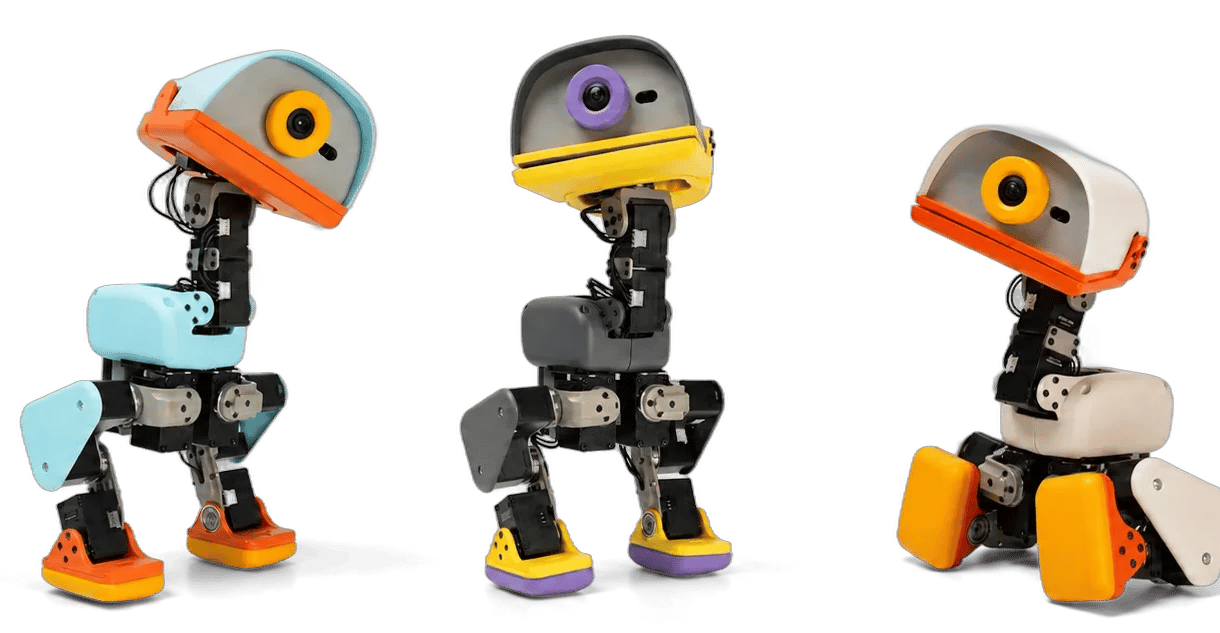
MicroDuck is an interesting example of this philosophy because its software stack is openly available rather than being defined entirely by a closed consumer application. Pollen Robotics provides the development stack, simulation environment and related resources publicly.
I would not automatically assume that this guarantees a long useful life.
It doesn't.
Open source has its own problems.
Someone still has to maintain things.
Dependencies still break.
Cloud APIs still disappear.
Hardware still ages.
But the possibility of someone else continuing the work is very different from a product whose software can only be changed by one company.
That distinction becomes more important as robots become more capable.
The robot company may matter more than the robot specification
This changes how I'd evaluate a future robot purchase.
I wouldn't just ask:
How many cameras does it have?
Or:
How many degrees of freedom?
I'd also want to know:
Who is going to keep this thing alive?
Not literally.
I mean the software.
Who maintains it?
Who updates it?
Who builds applications?
Who fixes compatibility?
Who runs the cloud services?
Who publishes new versions?
Who benefits from keeping the ecosystem healthy?
Those questions tell you something that a specification sheet usually can't.
A company can sell an impressive robot and still create a weak long-term product.
Another company can sell fairly modest hardware and create something that keeps getting better.
The community may become part of the product
This is another reason I think AI desktop robots are unusual.
For many electronics products, the community is mostly there to discuss the product.
For an open or semi-open robot, the community can become part of the product itself.
Someone builds a new behavior.
Someone publishes an application.
Someone creates a tool.
Someone figures out an integration.
Someone improves an existing project.
The manufacturer provides the base.
The community expands the possibilities.
This is already visible around Reachy Mini, where the official ecosystem actively surfaces community-built applications instead of treating third-party software as something completely separate from the product.
That creates a very different ownership model.
Your robot's future doesn't depend entirely on the roadmap inside the company.
But there is a limit to how much the community can save
I don't want to romanticize this.
Community software cannot magically fix everything.
If the base system becomes impossible to run, community developers may eventually stop supporting it.
If an important cloud API disappears, somebody has to replace it.
If the hardware uses proprietary components, an open repository doesn't solve the physical problem.
And if nobody is using the platform anymore, developers have little reason to keep building for it.
So "open" isn't the same thing as "future-proof."
The healthier way to think about it is:
More people should have a path to keep the robot useful.
That is different from:
The company promises to support it forever.
What I would want from an AI desktop robot
I don't think a manufacturer needs to promise ten years of feature updates.
That would probably be unrealistic for many products.
What I would want is something simpler.
I want the company to make the robot's long-term software position obvious.
Can the basic functions work without a company server?
Can applications be developed independently?
Are APIs documented?
Can users export important data?
Can the robot still be useful if one cloud service changes?
Is there an active developer community?
Does the company publish real updates?
Does it actually improve the product after launch?
Those answers tell me much more about the robot's future than a launch-day demo.
The most interesting robots may be the ones that improve after you buy them
This is probably the conclusion I keep coming back to.
The first version of an AI desktop robot is unlikely to be the final version of the experience.
The physical hardware may stay almost identical.
But the software around it can change dramatically.
New applications can appear.
New AI systems can become available.
The robot can gain new ways to interact.
The community can discover uses that the original manufacturer never expected.
That creates something unusual.
You are not only buying a machine.
You are buying into an ecosystem.
And ecosystems have lifecycles.
That's why I think the question:
"How good is this AI robot today?"
is only half of the question.
The other half is:
"What is likely to happen to it after the launch excitement is gone?"
A robot that gets one impressive demo and then remains frozen may be fun for a while.
A robot with a healthy software ecosystem can become more interesting over time.
And a robot with a strong community, accessible software and active development has something even more valuable:
a chance to outlive the original product roadmap.
That may eventually become one of the most important differences between AI desktop robots.
Not how impressive they look on the day you buy them.
But whether they are still becoming something new a year later.