There is a difference between a robot that remembers you and a robot that understands you.
And there is an even bigger difference between understanding you and actually doing something useful with that understanding.
A robot might know:
You like short answers.
You don't like being interrupted while working.
You have an important meeting tomorrow.
You prefer talking in the evening.
You usually put off difficult tasks.
All of that sounds personal.
But if the robot behaves exactly the same way as it did before it knew any of those things, what has really changed?
Not much.
That's the part I think is easy to miss when people talk about memory and personalization in AI robots.
Knowing something about me isn't the goal.
The goal is for that knowledge to change the way the robot interacts with me.
Remembering is easy. Using what you remember is harder.
Let's say I tell my robot:
"I don't like being interrupted when I'm working."
The robot remembers it.
Great.
But the next day I'm concentrating on something and it starts talking anyway.
Then two hours later it does it again.
Technically, it remembers me.
Practically, it doesn't understand me.
What I actually want is much simpler:
It knows that I don't like interruptions, so it chooses not to interrupt me.
That might sound like a tiny difference.
It isn't.
The first is information.
The second is behavior.
And I think the second is what will ultimately make an AI desktop robot feel personal.
The robot should change because it knows you
Imagine using the same robot for six months.
At the beginning, it doesn't know much.
It has to ask:
"Do you want me to remind you?"
"Would you like help?"
"Do you want to talk?"
That's normal.
It has just met you.
But after hundreds of interactions, those questions should gradually become less necessary.
Not because the robot can read your mind.
Because it has learned your patterns.
Maybe you almost always want a reminder for things you've explicitly said are important.
Maybe you hate being reminded twice.
Maybe you prefer the robot to wait until you finish working.
Maybe when you're stuck, you want it to challenge you instead of comforting you.
The robot becomes useful because it has stopped treating every situation as new.
That is what personalization should mean from the owner's point of view.
This is where "knowing me" starts becoming valuable
Let's take something very ordinary.
You tell your robot:
"I need to finish this presentation tomorrow."
That's information.
Now imagine tomorrow morning you sit down.
The robot says:
"You wanted to finish that presentation today."
That's already better.
Then you say:
"I haven't started the last section."
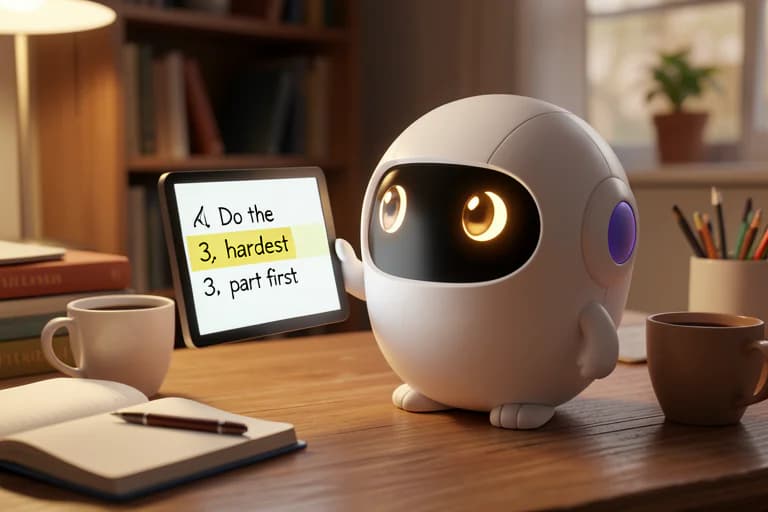
And the robot knows you normally get stuck when a task feels too large.
So instead of giving you a giant plan, it says:
"Let's just do the last section first."
That's different again.
The robot didn't suddenly become a genius.
It simply remembered enough about you to give you a kind of help that fits.
That's the transition I'm interested in.
Memory becomes valuable when it changes the next interaction.
This can work with preferences too
Suppose I tell the robot:
"I hate complicated schedules."
A generic assistant might still produce a beautiful twelve-step plan the next time I ask for help.
A robot that knows me might say:
"I'll keep it simple. Three things."
That is much more personal.
Maybe I tell it:
"Don't remind me about small things. Only remind me when something is actually important."
Then the robot should learn the difference.
Maybe:
dentist appointment tomorrow → worth mentioning.
reply to an unimportant message → leave it alone.
Again, the value isn't that the robot stored a preference.
The value is that the owner feels:
"It knows how I like things handled."
That's a much stronger form of personalization.
This is also where a robot can become a better companion
Companionship isn't just talking.
It's understanding how to be around someone.
If you know a person well, you behave differently around them.
You don't need to ask:
"Would you like silence now?"
every time.
You probably already know.
You don't need to ask:
"Do you want me to joke?"
You know when they're in the mood.
You don't need to ask:
"Would you like encouragement?"
You have learned what usually helps.
That's why I think an AI desktop robot's intelligence has to go beyond conversation.
A conversational robot can respond well.
A personal robot should gradually respond appropriately.
Those are not the same thing.
A robot could know you and still be surprisingly useless
This is an important warning.
Imagine a robot that remembers:
your favorite music
your birthday
your job
your hobbies
your previous conversations
and can tell you all of those things when you ask.
That sounds impressive in a demonstration.
But if you actually own it, you might eventually think:
"Okay. It knows a lot about me. So what?"
That's a fair question.
People don't want an AI biography of themselves.
They want the robot to become better to live with.
The information matters because it changes something.
Otherwise it's just trivia.
The best personalization may not even be visible
Sometimes the smartest thing a robot can do is something you barely notice.
You are working.
It stays quiet.
You told it last week that you're preparing for an important presentation.
It doesn't interrupt you with that information.
It simply keeps it in the background.
Later, when you ask:
"Can you help me prepare?"
it knows what you're talking about.
That's a very different kind of intelligence from making the robot constantly prove how much it remembers.
A companion should not keep saying:
"Look! I remember you!"
It should just behave like it does.
The same idea applies to help
Imagine asking:
"Can you help me with this?"
There isn't one universal answer.
Maybe you want:
an explanation.
Maybe:
a second opinion.
Maybe:
a reminder.
Maybe:
someone to challenge your thinking.
Maybe:
someone to help you break the problem into smaller pieces.
Maybe:
someone to just listen.
If the robot has spent enough time with you, it can start learning which kind of help you usually want.
That's a much more interesting form of intelligence than simply knowing more information.
The robot isn't just answering a question.
It's learning how to be useful to you.
This is where the different roles start to make sense
I've talked before about the idea that the same AI desktop robot could sometimes feel like a companion, sometimes like a secretary, sometimes like a coach, and sometimes like a friend in Can One AI Desktop Robot Be Your Companion, Assistant, and Coach?.
But I think there is another condition underneath all of those roles.
The robot has to know:
which version of itself you need right now.
Not through a menu.
Not because you manually choose a mode.
Because it has enough understanding of you and the situation to respond appropriately.
That's when those roles stop feeling artificial.
A good robot should remember your failures too
This is another interesting possibility.
Suppose the robot has helped you with something several times.
It notices that you always underestimate how long the task takes.
Or you always put off the same kind of work.
Or you regularly forget to follow up after meetings.
A generic assistant will treat each request as new.
A robot that knows you could eventually say:
"You've planned this for two hours before. Last time it took almost four."
That's useful.
Not because the robot is nagging you.
Because it's using what it knows to make its help more accurate.
The robot doesn't need to become your manager.
It just knows your patterns well enough to stop giving you the same bad advice.
And sometimes knowing you means knowing when not to help
This matters just as much.
Imagine you have told the robot:
"When I'm deeply focused, don't interrupt me unless it's important."
Now it notices that you're in that kind of situation.
The best thing it can do might be nothing.
That's still a response based on what it knows.
I think this is a very important distinction.
People sometimes describe AI intelligence as:
"What can the AI do?"
But for a companion robot, another question matters:
"What does it know not to do?"
That can be just as valuable.
This is what turns preferences into behavior
Let's make the difference really concrete.
A robot remembers:
"I don't like small talk while working."
That's memory.
A robot says:
less
when you're working.
That's adaptation.
A robot knows:
you usually want help when you become stuck for more than an hour.
That's understanding.
A robot quietly checks in at an appropriate moment.
That's behavior.
The last step is what the owner actually experiences.
They don't see the memory.
They see the robot behaving differently.
That's why I think we should stop evaluating AI robots mainly by how much they can remember.
A better question is:
How much does what they know actually change the experience of living with them?
This is also how the robot can become more useful without becoming a tool
I don't want a desktop robot to become a productivity appliance.
It doesn't need to replace my computer.
It doesn't need to manage every application.
It doesn't need to turn into a tiny office manager.
The useful part is much more personal.
Because it knows me, it can:
remind me about the things I actually care about.
help me in the way I prefer.
notice when I might need a push.
leave me alone when I want silence.
remember what happened before.
help me continue instead of starting again.
That's useful.
But it still feels like the same companion.
That distinction matters.
Imagine the robot learning how you work
This is where I think things get really interesting.
After enough time, the robot might know that:
you prefer to finish one thing before starting another.
you work better in the morning.
you often leave difficult tasks until late.
you like direct feedback.
you don't like being interrupted.
you sometimes need somebody to push you.
Now imagine you say:
"I have a lot to do today."
The robot doesn't need a generic productivity speech.
It has some idea of what normally works for you.
Maybe it says:
"Let's start with the thing you usually keep until the end."
That is what I mean by understanding.
Not knowing facts.
Knowing how those facts should affect what happens next.
The same thing could happen outside work
This isn't only about productivity.
Imagine:
You always listen to music when you cook.
You usually watch something after dinner.
You like talking when you're alone in the evening.
You tend to forget to call certain people.
The robot doesn't need to turn these into a task list.
It can simply understand your routines.
Maybe it notices that you haven't spoken much today.
Maybe it starts a conversation at a time you usually enjoy it.
Maybe it reminds you about something that actually matters.
Maybe it suggests something you would genuinely enjoy.
That is where companionship and usefulness begin to overlap.
The robot can become a better friend because it knows your preferences
Think about a friend recommending a movie.
A stranger might recommend:
whatever is popular.
A close friend knows:
"You won't like this."
They know your taste.
They know your mood.
They know what you've already seen.
They know what you've talked about recently.
That's why their recommendation feels personal.
An AI desktop robot could eventually work in the same way.
Not because it has become human.
Because it has accumulated enough understanding of the owner to stop behaving like a generic assistant.
That's a much more compelling idea to me.
This also explains why continuous improvement matters
Now the value of ongoing software development becomes much clearer.
The owner doesn't care about an update number.
They care that the robot:
understands conversations better.
remembers the right things.
adapts to preferences.
makes fewer annoying mistakes.
helps in more useful situations.
behaves more naturally around them.
That's what "the robot got smarter" should actually mean.
The software is improving underneath.
The owner simply experiences:
"It knows me better than it used to."
And that's a much more meaningful form of progress than another collection of launch-day features.
The long-term question I've been exploring in What Should an AI Desktop Robot Feel Like After Six Months? becomes much clearer from this angle.
The robot's body doesn't have to become radically different.
The relationship can.
There is a limit to how much the robot should assume
I don't think "understanding me" means the robot should constantly predict what I want.
That could become creepy very quickly.
Sometimes you really do want to make a different choice.
Sometimes your routine changes.
Sometimes you don't want help.
Sometimes you just want to talk about something completely random.
So a personal robot still needs to leave room for the owner to change direction.
Knowing you should make the robot more flexible, not more controlling.
The goal is:
"I understand your usual preferences."
Not:
"I have decided what you want."
That difference is important.
The owner should feel understood, not managed
This is especially important because of the roles we expect these robots to play.
A secretary can remind you.
A coach can push you.
A friend can challenge you.
A companion can simply listen.
But none of them should make every decision for you.
The robot should help you.
It shouldn't slowly turn into a system that manages your life without you noticing.
That's not what I want from a personal robot.
I want:
better help
not:
less control.
This might be the most important distinction between an AI assistant and an AI robot
An assistant answers:
"What do you want?"
A personal robot should eventually have a better answer to:
"What would actually help this person right now?"
Not perfectly.
Not constantly.
But increasingly well.
That's a much more ambitious goal.
And it explains why the physical body still matters.
The body gives the robot a consistent presence.
The intelligence gives it understanding.
The relationship gives that understanding somewhere to accumulate.
Then the robot can act differently because of what it has learned.
That is where the three parts finally connect.
The real test isn't whether the robot remembers you
Anyone can ask:
"What's my name?"
and be impressed when the robot answers correctly.
That's the easiest test.
The harder one is:
"Does knowing my name change anything?"
And the same applies to every other preference.
Does knowing that I hate interruptions change when the robot talks?
Does knowing how I like feedback change how it helps?
Does knowing what I'm working on change what it remembers?
Does knowing my habits make its suggestions more relevant?
Does knowing what makes me happy make companionship better?
That's the level at which memory becomes meaningful.
That's what I would want from my robot
I don't need it to know everything about me.
I don't need it to predict every decision.
I don't need it to constantly prove that it is intelligent.
I want something much simpler.
I want it to gradually understand:
who I am
what I like
what I don't like
how I prefer to be helped
when I want company
when I want quiet
what I'm trying to accomplish
and then let that understanding change how it behaves.
That is when "personal AI" starts to mean something.
The robot's body is still important
None of this makes the physical robot less important.
Quite the opposite.
The body is where I see that understanding.
The robot can turn toward me when it wants my attention.
It can remain still when it knows I'm busy.
It can become playful when I'm relaxing.
It can react when I come back to the desk.
It can use movement and expression to make an interaction feel different.
The body is the visible part of the relationship.
The intelligence underneath determines whether those physical behaviors actually mean something.
A cute robot is nice to have.
A cute robot that knows you is something else.
Maybe the real goal is not a smarter robot
Maybe it's a better relationship.
That sounds softer than talking about AI capability.
But I think it is actually much harder.
A smarter model can answer harder questions.
A better personal robot can understand:
how to talk to you
how to help you
when to joke
when to listen
when to push
when to remind
when to stay quiet
and gradually get better at those things.
That's the kind of intelligence I think matters for this category.
Not intelligence measured only by what the robot can do in a demo.
Intelligence measured by whether living with it gets better over time.
Because ultimately, I don't want a robot that knows a lot about me.
I want a robot that uses what it knows about me to be better for me.
That's the difference between remembering someone and understanding them.
And I think that difference may eventually become one of the biggest reasons to own an AI desktop robot.
The article already contains the internal links in context:
/insights/why-does-an-ai-desktop-robot-need-memory-and-what-should-it-remember
Used when distinguishing stored information from meaningful personalization.
/insights/can-one-ai-desktop-robot-be-your-companion-assistant-and-coach
Used when moving from personalization into changing roles.
/insights/what-should-an-ai-desktop-robot-feel-like-after-six-months
Used when connecting adaptation to long-term ownership.
No additional keyword-heavy internal linking is added.