The price of an AI desktop robot is easy to see.
The cost of owning one is less obvious.
A $140 robot, a $280 desk pet, and a $400 mobile or movement-focused robot are not necessarily competing for the same job. One may be a simple expressive character. Another may be built around conversation. A third may be attractive because it moves through the physical world.
The useful comparison is not just the price tag. It is the cost of getting the experience you actually want, and keeping that experience working for two years.
This is a research-based cost guide, not a claim that we have owned every product for two years. Prices below are snapshots from official product pages and brand price guides available as of October 28, 2026. Regional prices, taxes, shipping, bundles, and promotions can change.
The current entry prices are only the starting point
| Robot | Visible starting price from the sources checked | What to include in your comparison |
|---|---|---|
| Eilik | $139.99 | The base robot is the simple expressive experience. The optional Eilik AI Station is listed separately at $99. |
| EMO | $279 | Check whether you are buying the base EMO or a Go Home bundle, and whether any add-ons are already included. |
| LOOI | $259 listed price; $239 promotional price shown when checked | Your compatible smartphone is part of the experience. Do not count the robot as a fully independent device. |
| Loona | Around $399.90 in the brand's April 2026 US price guide | Bundles, accessories, regional pricing, shipping, and taxes can change the delivered cost. |
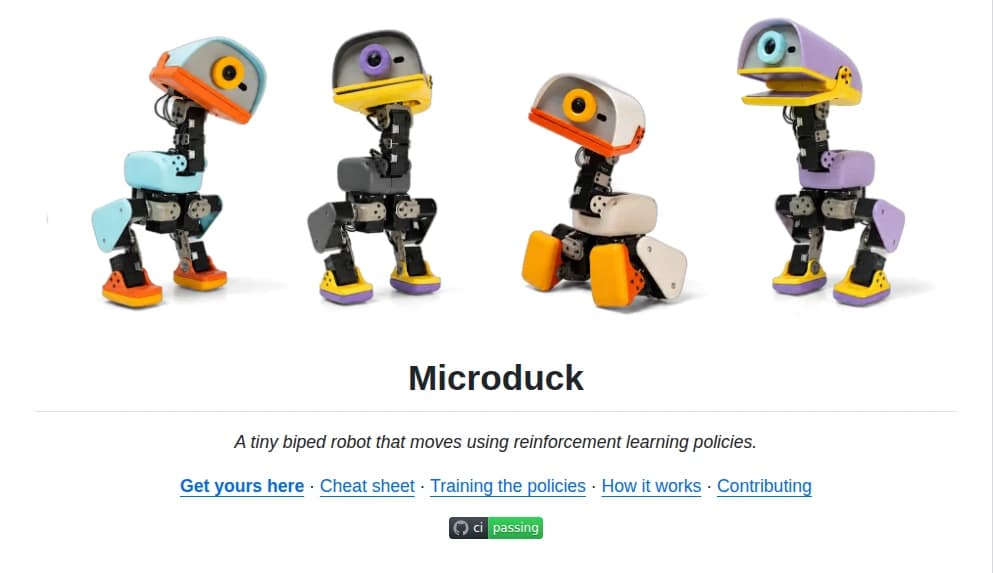
| MicroDuck | $399 pre-order price before taxes and shipping | It is an early product with optional accessory packs. First deliveries are targeted before Christmas 2026 in launch regions. |
These prices are not a direct value ranking. Eilik's base product, LOOI's phone-powered experience, Loona's mobile interaction, EMO's desk-pet behavior, and MicroDuck's physical movement are different propositions. The right choice depends on which experience you want to own.
The five costs buyers often overlook
1. Accessories that change the experience
Accessories are easy to dismiss as optional until they turn out to be the part you actually wanted.
Eilik is a clear example. The base unit is listed at $139.99, while the AI Station is listed separately at $99. If you specifically want the AI Station experience, your visible starting cost is about $238.99 before taxes and shipping, not $139.99. 1
Other products have their own bundle questions. With EMO, distinguish the base model from a Go Home bundle or separately listed accessories. With MicroDuck, Pollen Robotics lists optional packs, including a $39 accessory pack and a $119 developer pack. Those add-ons are not required for every buyer, but the purchase decision changes if the behavior or accessory you care about depends on one. 2 3
The rule is simple: price the configuration you intend to use, not the cheapest line on the store page.
2. A phone you already own, or a phone you need to dedicate
LOOI uses a smartphone as a central part of the experience. That can be a smart product design because it reuses a screen, cameras, microphones, connectivity, and processing already in your pocket. But it also creates a dependency.
If you already have a compatible phone and are happy to leave it attached to the robot when needed, you may not need to add hardware cost. If you planned to use an older phone that no longer meets the app's requirements, or buy a separate phone only for the robot, the real cost rises. The phone's value is not necessarily the full retail price, but the trade-off should be visible in your budget. 4
This is one reason that two robots with similar advertised AI features can have very different ownership costs. One includes more of the computing in the device; the other borrows it from a phone you must continue to support.
3. Recurring fees and service dependencies
Before buying, check whether the features you care about require a subscription, account, cloud service, or paid add-on.
Do not infer a lifetime cost from the absence of a subscription badge on a product page. A current app may be free to download while some capabilities depend on external services, and a product's future service terms may change. Conversely, do not assume every robot has a mandatory monthly fee if the manufacturer does not list one.
For the product pages reviewed here, there is no single subscription model shared across the category. The important questions are product-specific:
- Is a monthly or annual payment required for the core experience?
- Are advanced conversations, memory, voice services, or remote access included?
- Does the product depend on an online account or cloud service?
- What continues to work if an optional service changes or disappears?
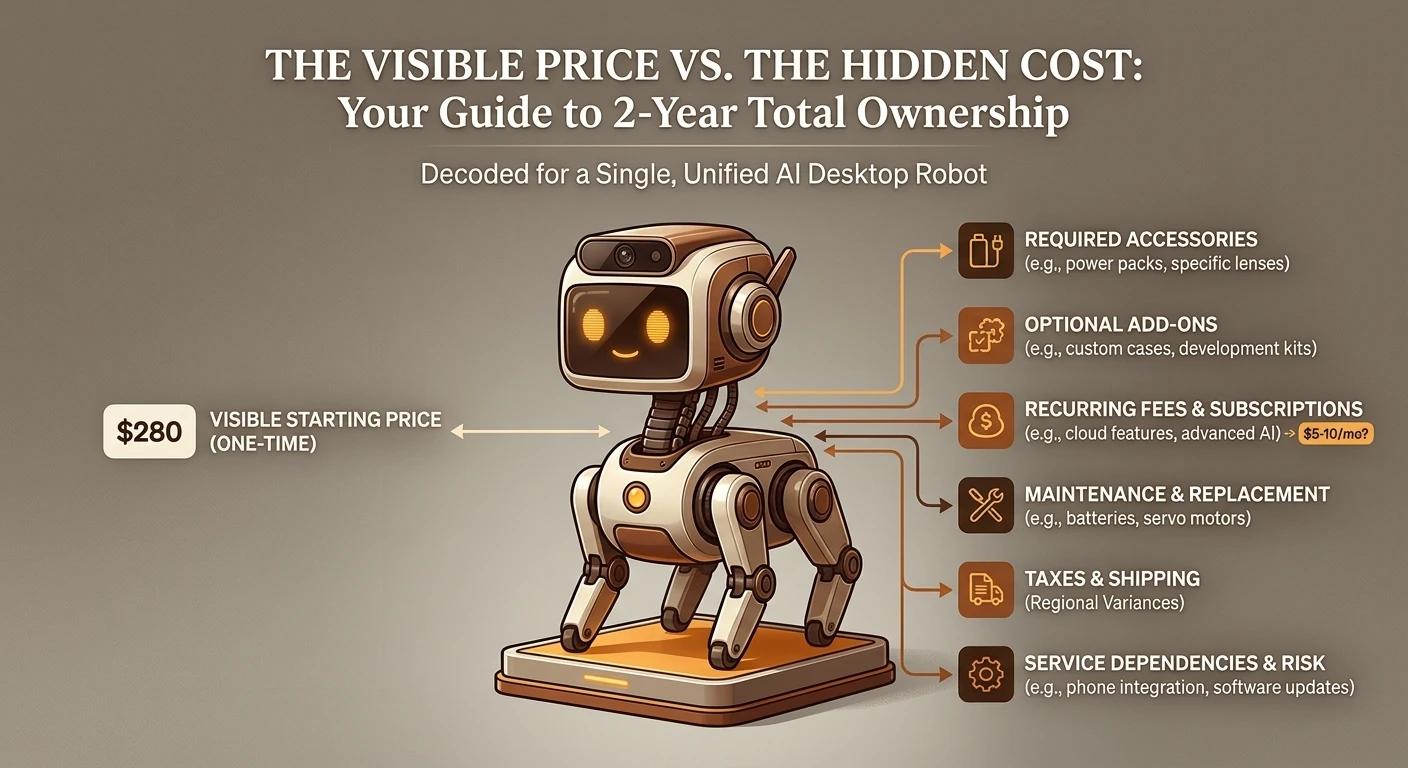
A hypothetical subscription helps show why this matters. At $5 per month, recurring fees add $120 over two years. At $10 per month, they add $240. These are examples of the arithmetic, not claims that any of the specific robots in this guide charge those amounts.
4. Time, attention, and friction
Time is not a line item on a checkout page, but it still affects whether a product feels worth its price.
Some people enjoy experimenting with settings, learning a robot's routines, troubleshooting an app, or following software updates. Others want a product to work without becoming a weekend project.
Neither preference is wrong. The problem is buying a product designed around experimentation when you actually want a low-effort companion, or buying a mostly finished desk pet when what excites you is customization.
Community discussions around EMO illustrate how different the experience can be. In one January 2026 thread, some owners reported that the novelty faded quickly, while others continued to enjoy it. That does not tell us the average usage curve, but it suggests that the attention you want to spend with the robot should be part of your decision. 5
5. The risk that the software experience changes
A robot can remain physically intact while some of its value changes. An app update may add a feature, alter a familiar behavior, introduce a bug, or change how you interact with the device. A cloud service or third-party integration may also become part of the experience you depend on.
The LOOI community's discussion of its August 2026 app update included both reports of improvement and complaints about regressions. That is not proof that the update was bad for every user. It is an example of why software maturity and update quality belong in a cost analysis. 6
For a longer discussion, see What Happens When an AI Desktop Robot Stops Getting Software Updates?.
A practical two-year ownership formula
Use this formula instead of comparing stickers:
Two-year cost = device price + required accessories + the accessories you actually want + taxes and shipping + recurring service fees + expected maintenance or replacement costs.
Not every owner will pay every item. The purpose is to make the assumptions explicit.
Here is how I would apply it to common purchase types.
| Buyer type | Example calculation | The question that changes the answer |
|---|---|---|
| Wants a simple expressive desk companion | Eilik at $139.99, or about $238.99 with the separately listed $99 AI Station | Do you want the base behavior, or do you specifically want the optional AI experience? |
| Wants a phone-powered AI character | LOOI at its current listed or promotional price | Do you already own a compatible phone, and are you comfortable keeping the phone and app involved? |
| Wants a desk pet with more developed personality and behavior | EMO at $279 for the base model | Are the bundle or optional accessories you want included in the price you are comparing? |
| Wants a mobile pet robot | Loona at around $399.90 in the cited US price guide | Does the mobility create value for you, and are you buying it for the right purpose? |
| Wants a small robot whose movement is the attraction | MicroDuck at $399 before taxes and shipping | Are the standard behaviors already worth the price, and do you need optional parts for the experience you want? |
I would avoid giving these products a single two-year total without knowing your location, tax rate, shipping cost, chosen bundle, phone situation, and service terms. A fabricated precision would be less helpful than a transparent calculation.
The most expensive mistake is buying the wrong experience
Imagine three buyers.
The first wants a little character on their desk. They rarely talk to it, but they enjoy the expressions and small reactions. A relatively simple robot may be all they need.
The second wants a conversational AI that remembers context and helps with tasks. If they buy a robot mainly because it has a cute body, they may pay hundreds of dollars for an experience that their phone already provides better.
The third wants to watch a small machine move and is excited by the possibility of new physical behaviors. They may be happy with an early product whose value is partly experimental. A buyer who wants a dependable, finished companion may find exactly the same product frustrating.
All three could reasonably spend different amounts. The mistake is comparing them only by the amount printed next to the Buy button.
Before you pay, check these seven things
- Core experience: Is the feature you want available today, or only described as a future possibility?
- Configuration: Are the accessories or add-ons needed for that feature included?
- Phone: Does the product need a compatible phone, and would a dedicated device add cost?
- Connectivity: Which features work offline, and which depend on an account or online service?
- Recurring fees: Are subscriptions or paid AI services required for the functions you care about?
- Support: Is there a stated warranty, update policy, and clear support channel?
- Long-term value: Would you still be happy with the current behavior if new features stopped arriving?
That last question is deliberately uncomfortable. It is also one of the most useful ways to avoid buying an imagined future product.
The MeraBots take
I would not judge a robot by whether it is cheap or expensive in isolation. I would judge it by how much of the experience you will actually use, how much effort it takes to access that experience, and how dependent it is on software that may change.
A $140 desk companion that you enjoy every day may be better value than a $400 robot that spends most of its time turned off. A $400 robot may be worth it if its physical behavior is exactly what you wanted. A phone-powered robot may be the smarter purchase if the convenience and interaction justify keeping your phone involved.
The goal is not to minimize the purchase price. It is to avoid paying for capabilities you do not need, accessories you did not realize were separate, or future software promises that have not arrived.
For the MicroDuck-specific cost breakdown, see The $399 MicroDuck Isn't the Whole Cost. For the broader question of long-term service costs, read Are AI Robot Subscriptions Becoming Normal?.
Sources and pricing notes
Prices are snapshots from the cited product pages or brand pricing guides, checked on October 28, 2026 where possible. The Loona figure comes from the brand's April 2026 US price guide, so verify the live listing before buying. Taxes, shipping, exchange rates, discounts, bundles, and availability can change. Reddit posts are individual owner reports and are not representative surveys.
- Eilik official store and optional AI Station (Source 1)
- LivingAI official store (Source 2)
- Pollen Robotics official MicroDuck page and accessory packs (Source 3)
- LOOI official product page and phone compatibility (Source 4)
- Community discussion: owner discussion on value and novelty, January 2026 (Source 5)
- Community discussion: August 2026 app update (Source 6)
- Loona price guide, April 2026 (Source 7)