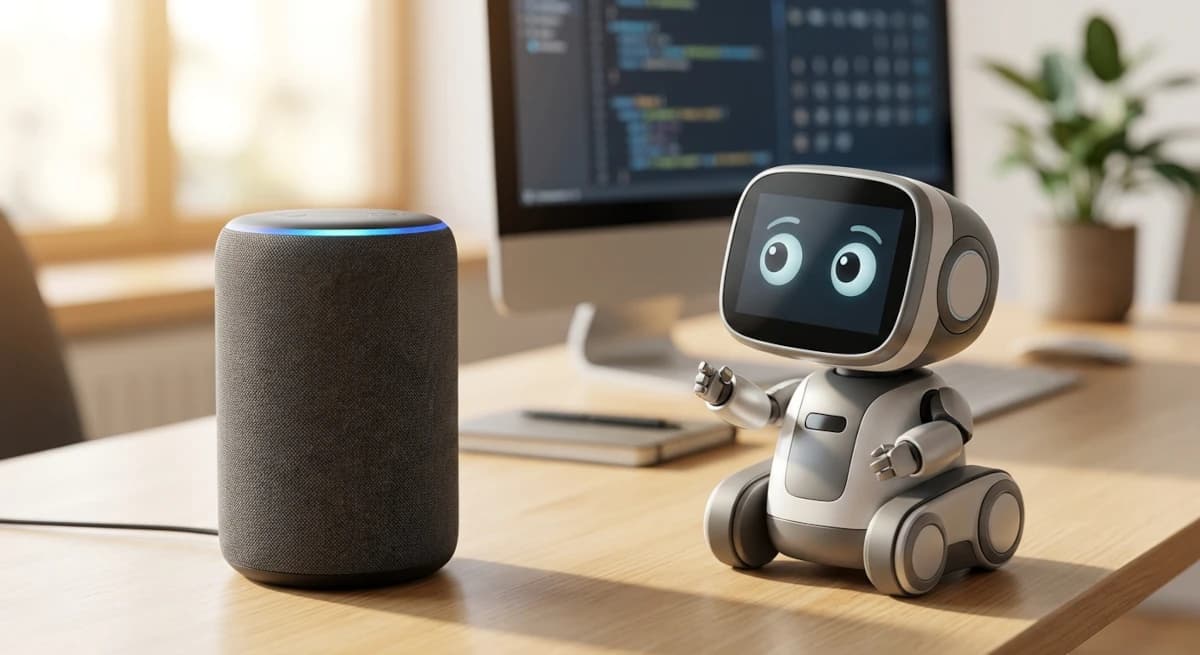
If you already own a smart speaker, should you spend more money on an AI desktop robot?
For most people who mainly want timers, music, quick answers, or smart-home controls, I would start with the speaker they already own. A robot is not automatically a better assistant just because it has a body or an AI model inside.
But that is not the whole comparison.
A smart speaker is designed to be useful with as little attention as possible. A desktop robot can be interesting because it is visible, expressive, and physically present. These are different product goals. The mistake is paying for a robot while judging it only by the jobs a speaker already does well.
The real difference is not the AI model
A smart speaker is generally a command interface: you say something, it responds, and you move on. A desktop robot can do that too, but its body adds another layer. It can turn toward you, move, make expressions, react to the surrounding space, or become a little character you notice between tasks.
That difference may be meaningful, or it may not matter to you at all.
If your primary need is to set a timer, control a light, or play a song, physical movement usually adds little. If you want a small companion on your desk, enjoy watching a robot react, or value an interaction that feels less like speaking to a disembodied service, the robot's body may be the point.
I would not assume that the robot provides better answers, more reliable automation, or stronger reasoning. Those capabilities depend on the product's software and integrations, not on the presence of motors.
Compare them by the job you want done
| What you want | Smart speaker | AI desktop robot |
|---|---|---|
| Timers, alarms, music, and simple commands | Usually the simpler starting point | Can offer these, but may be unnecessary for the job |
| Smart-home control | Often benefits from established integrations and room-wide placement | Depends on the robot's supported integrations; do not assume compatibility |
| A visible personality | Usually limited to voice and, on some models, a screen | Movement, gaze, expressions, and physical reactions can add character |
| A desk-side presence | Mostly waits for a command | Can be part of the visual environment even when you are not actively talking to it |
| Physical behavior | Not the product's main purpose | Can move, gesture, react, or interact with objects depending on the model |
| Setup effort | Often relatively low for common tasks | Varies from consumer-friendly to kit assembly and software setup |
| Cost | You may already own one | Adds a separate hardware purchase, space, charging, and upkeep |
| Long-term software value | Depends on service support and integrations | Depends on service support, integrations, and whether its physical behaviors remain enjoyable or useful |
The table is intentionally general. Smart speakers differ by ecosystem, and desktop robots are a varied category. Before buying, check the exact device rather than assuming every speaker can do every task or every robot has every AI feature.
Community discussions show what users actually value
Smart speakers have a practical advantage: people already know what they want them to do. A Pew Research Center survey published in June 2026 found that about 35% of U.S. adults reported having a smart speaker such as an Amazon Echo or Apple HomePod. That is a useful indicator that the category is familiar, although it does not measure satisfaction with every model. 1
But being familiar does not make the experience perfect. In a September 2026 r/alexa thread, one owner described basic commands, timers, and routines becoming unreliable, while other commenters in the same discussion said their devices continued to work well. Another thread about Alexa's evolution attracted owners who were frustrated by unwanted changes and others who preferred the newer experience. 2 3
I would not interpret those posts as proof that smart speakers are broadly failing. They show a more useful point: people judge assistants by whether familiar tasks keep working, not by how impressive the product announcement sounds.
Companion robots have a different kind of split. In a January 2026 discussion asking whether EMO was worth buying, some people said the novelty faded quickly, while another owner said they were still enjoying it after around 80 days. A longer-term owner said the robot remained cool but was not something they would buy again. 4
Put these discussions together and a pattern emerges. People get frustrated when a practical tool stops reliably saving time. They get disappointed when a companion fails to remain interesting. The evaluation criteria are different, even though both devices may be described as AI.
What a smart speaker can do better
It is built around utility
For a lot of homes, a smart speaker already occupies the right places: kitchen, living room, or bedroom. It can be positioned where a command is convenient, and it does not need to look at you or move around to do most of its jobs.
It may be easier to integrate into daily routines
If your routines depend on a particular smart-home ecosystem, check that ecosystem first. A robot may support some integrations, but you should not buy it assuming it can replace your speaker's established controls.
It can be the more sensible purchase
If you already own a speaker and use it successfully, a robot may duplicate the same voice interface at a much higher cost. The added value needs to come from something you cannot already get from the devices you use.
What a desktop robot can add that a speaker usually cannot
Physical expression
A small movement can communicate attention in a way a voice alone does not. A robot turning toward you, tilting its head, or reacting to an event creates a visible moment. That is not deeper intelligence by itself, but it can change how the interaction feels.
Presence between commands
A speaker is often invisible until you invoke it. A desktop robot can share your desk. It can be something you glance at, watch, or interact with briefly without opening an app. If this physical presence creates value for you, it may justify the extra cost even when the robot is not more useful at answering questions.
A different reason to return
A practical assistant earns repeated use by solving tasks well. A companion robot may earn repeated use through a mixture of movement, personality, curiosity, small surprises, or a familiar routine. This value is subjective, but subjective does not mean unreal. The question is whether you enjoy it enough to keep the robot switched on and in your space.
Not all desktop robots are substitutes for smart speakers
The category includes products with very different centers of gravity.
- LOOI is built around a smartphone-powered AI interaction. Its appeal is closer to giving an AI a physical, expressive place on your desk. Check phone compatibility and its current cloud and app requirements before buying. 5
- EMO is positioned as an AI desktop pet, emphasizing personality, movement, expressions, games, recognition, and small helper functions. It is better evaluated as a desk-side character than as a direct replacement for a whole-home assistant. 6
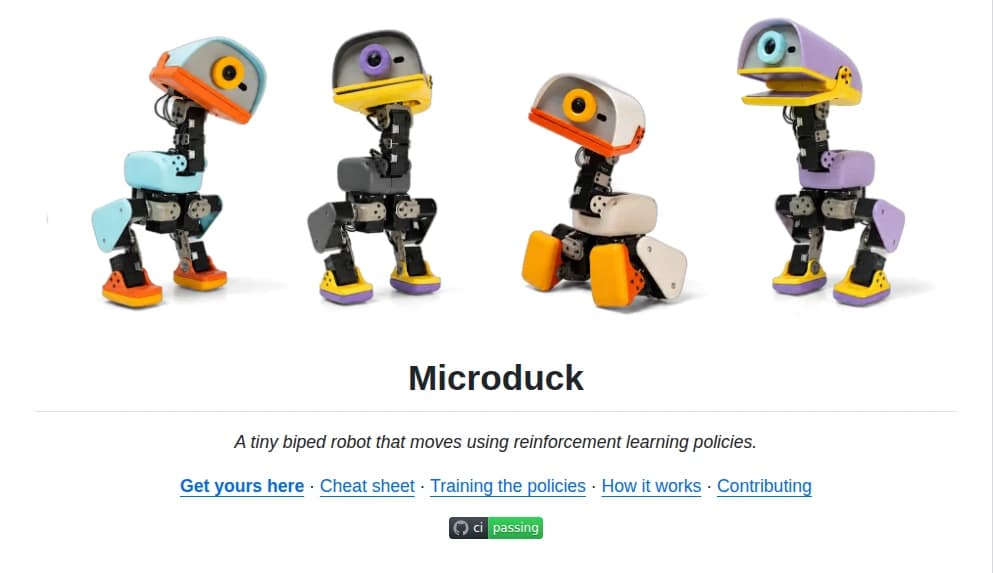
- MicroDuck emphasizes physical movement and trainable behaviors. Pollen lists a $399 preorder price, before tax and shipping, and describes an open software and training stack. It may appeal to someone who wants a little robot to move and explore, but that is not the same need as reliable voice control of household lights. 7
- Reachy Mini is an expressive robot and expandable interaction platform. Its current official pricing lists the Wireless version at $499 and the Lite at $399, with the Lite requiring an external computer and both versions sold as kits. That setup makes it a different proposition from dropping an inexpensive smart speaker into a room. 8
These products are not interchangeable, and no single ranking makes sense without knowing why you want the device. For a broader overview, see What Is an AI Desktop Robot? It's More Than a Tiny Chatbot and AI Desktop Robot vs AI Companion Robot: What's the Real Difference?.
What about privacy?
Both categories can use microphones and cloud services, and some devices add cameras or environmental sensing. The hardware label alone does not tell you which one is more private.
Amazon documents a physical microphone-off button on Echo devices, with a red light to indicate the microphones are disabled. LOOI's published privacy policy, updated August 5, 2026, says voice requests are sent to a contracted cloud AI provider, while its memory and conversation history are stored in its cloud environment. That is one example of why you should compare actual data handling rather than assume a robot is more private because it is smaller or a speaker is less private because it is common. 9 10
For either device, check sensor activation, cloud processing, memory retention, deletion controls, and what continues to work if you disable a feature. Our guide to AI Companion Robot Privacy: Cameras, Microphones, Cloud and Memory covers the questions in detail.
A simple way to decide
Ask yourself these four questions before spending money.
1. If the robot never spoke, would I still want it?
If the answer is yes because you enjoy its movement, look, and physical presence, you are buying more than a voice assistant. That can be a perfectly valid reason.
2. If it never moved, would I still want it?
If your answer is no, conversation alone may not justify the purchase. Look closely at the physical behaviors the robot actually performs today, not just what the product might do later.
3. What do I hope it does every week?
Write down two or three recurring moments. "Set a timer while cooking" points toward a speaker. "React to me while I work and make my desk feel more alive" points toward a robot. "Remember my plans and proactively help me follow through" requires much more specific evidence about memory and action capabilities.
4. Would I buy it if no new features were added?
This is the question I would use to protect myself from buying a future promise. A product may improve through updates, but the purchase should make sense based on the current experience. If future AI is the only reason the price feels reasonable, wait until that capability exists and can be evaluated.
The MeraBots take
A smart speaker is generally a tool you want to work quietly and reliably. A desktop robot is a physical experience you may want to spend time with. Some products can overlap, but the overlap is not the whole value proposition.
If you mainly want household utility, start with the speaker or phone you already own. If you want physical movement, expressiveness, or a companion that shares your desk, evaluate the robot on those terms. Do not pay a few hundred dollars to get a slightly different shell around the same command-response interaction.
The most interesting future devices may eventually combine both: practical assistance, memory, personality, and useful physical behavior. But buyers should not have to pretend that this combination is already complete in every product today.
The question is not "Which device has more AI?" It is "What kind of value do I want to experience often enough to justify another device in my life?"
Sources and notes
Product details and prices were checked on October 29, 2026 where available. Community posts are individual accounts, not representative market research. Product pages describe manufacturer-stated capabilities rather than independent hands-on test results.
- Pew Research Center: Americans and AI 2026 (Source 1)
- Community discussion: smart-assistant reliability, September 2026 (Source 2)
- Community discussion: Alexa experience and updates, September 2026 (Source 3)
- Community discussion: EMO value and novelty, January 2026 (Source 4)
- LOOI official product page (Source 5)
- EMO official product page (Source 6)
- MicroDuck official product page (Source 7)
- Reachy Mini official product page (Source 8)
- Amazon Alexa and Echo privacy FAQ (Source 9)
- LOOI Privacy Policy, updated August 5, 2026 (Source 10)