Should you worry about the camera and microphone on an AI companion robot?
Yes, but I would not stop at the simple question, "Does it have a camera?"
A camera can be used for local object recognition, cloud-based visual understanding, or a feature that is not active unless you turn it on. A microphone can listen for a wake word, process an interaction after you deliberately speak, or support a different kind of always-available experience. Those are not equivalent designs.
The useful question is what happens to information after the robot senses something.
For me, a trustworthy personal AI device needs to make three things understandable: when it senses, where the data goes, and what control the owner has afterward. Cute design and friendly conversation do not remove those responsibilities.
Privacy is a system, not a sensor
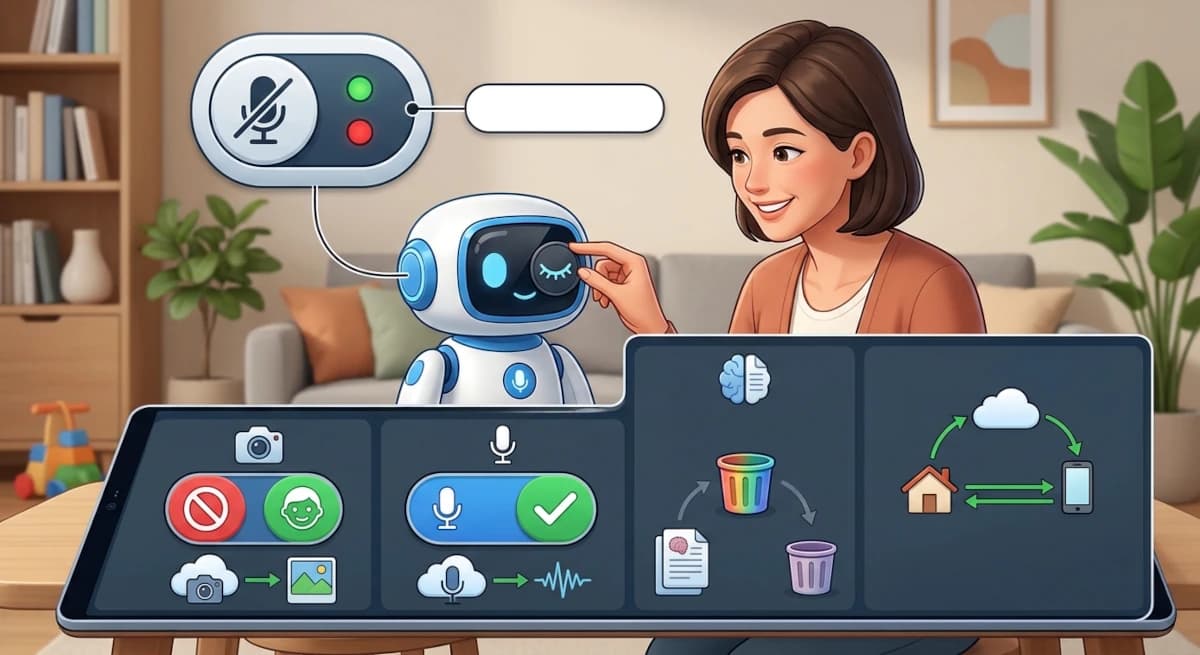
When comparing an AI companion robot, separate privacy into four layers.
1. What can the device sense?
Check whether it has a microphone, camera, depth sensor, face recognition, object recognition, or any form of presence detection. A sensor's existence does not tell you exactly how it is used, but it tells you which questions to ask.
For example, EMO's official product material describes sound tracking, recognition of people and objects, and independent movement around a desk. That gives it more environmental awareness than a robot that only plays pre-programmed animations. It also makes it worth checking the details of its sensing and data handling before you place it near conversations, family members, or sensitive work. 1
Do not assume every camera-equipped device uploads continuous video. Equally, do not assume that an on-device camera means every feature is processed locally. Look for the exact description of each feature.
2. What activates the sensor?
A robot that responds only after a button press has a different interaction model from one waiting for a wake word or observing its surroundings for activity.
Ask whether the microphone can be physically disabled, whether there is a visible indicator when the device is listening or sending data, whether the camera can be covered or disabled, and whether these settings persist after a restart or app update.
A control that exists only inside an app is still a control, but a physical switch can be easier to understand in the moment. Amazon, for example, documents a microphone-off button on Echo devices that disconnects microphone power and shows a red indicator. That is a useful design reference for what clear, observable control can look like. 2
3. Where is information processed?
This is where product descriptions often become vague. "AI-powered" does not tell you whether speech, images, or memories remain on the device, go to the manufacturer's servers, or are sent to a third-party AI provider.
LOOI's privacy policy, updated August 5, 2026, is unusually specific about several distinctions. It says voice input is transmitted to a contracted cloud AI provider for processing and is not stored afterward in a cloud database controlled by LOOI, while noting that the provider may temporarily process or retain limited information. The policy also says conversation history and LOOI Memory are stored in LOOI's cloud environment and relevant information may be sent to the provider with a new voice input. 3
That does not automatically make LOOI good or bad on privacy. It tells a buyer something concrete: the voice request and the persistent memory have different data paths. That is the level of detail worth looking for in any product's policy.
4. What stays stored, and how do you delete it?
Conversation memory is useful because it lets a robot maintain continuity across interactions. But memory is also a record about you.
Before buying, check whether you can inspect, edit, and delete stored memories; whether deleting a chat also deletes its derived memory; whether closing the account removes stored conversation data; and whether backup retention or third-party processing has separate rules.
LOOI's published policy says that its integrated conversation history and memory can be deleted through available app controls or by closing the account, subject to certain legal, security, and backup exceptions. It also describes its optional Deep Visual Understanding feature: when disabled, no image is uploaded for that feature; when enabled with consent, relevant single-frame images may be sent to its contracted cloud provider, while video files are not uploaded. The policy says those images are not stored in a LOOI-controlled cloud database after processing. These are the manufacturer's statements, not an independent security audit, but they are useful details to examine. 3
What community discussions tell us
Community posts do not establish how every device behaves. They are self-selected, and a worrying story can travel further than an ordinary day when nothing happens. Still, they tell us which failures destroy trust.
In a September 2026 discussion in r/alexa, an Echo Show owner described seeing the device transcribe a sensitive conversation and decided to disconnect their Echo devices. That is one user's account, not proof that all Echo devices are continuously recording or that the same issue applies to companion robots. What matters for a product designer is the trust consequence: when people cannot tell why a device activated or what it processed, an experience that once felt convenient can suddenly feel unacceptable. 4
Other discussions about smart assistants are more mundane but equally instructive. Users describe frustration when a familiar command stops working, changes after an update, or behaves inconsistently. Privacy and reliability are connected: the more a device listens and acts in the background, the more important it is that its state is understandable and predictable. 5
For a companion robot, this problem is more personal than it may be for a basic timer. The device may sit on a bedroom table or shared desk, build memories, and invite conversation that feels casual. People may disclose more when an interaction feels like a relationship rather than a command interface.
I think that makes privacy controls part of the product experience, not just a legal page.
A practical checklist before you buy
Use this checklist for any robot, not only LOOI or EMO.
| Question | What a useful answer looks like |
|---|---|
| Is the microphone always available? | The wake-word or activation behavior is explained clearly, and the controls are easy to find. |
| Can I disable the microphone physically? | The device has a switch or another clearly observable way to disable it, or the limitation is stated honestly. |
| What does the camera do? | The policy distinguishes local recognition from cloud visual features. |
| Does voice leave the device? | The manufacturer names the processing path and links to relevant third-party terms. |
| Is memory stored in the cloud? | Storage, deletion, and account-closure behavior are described. |
| Can I use the robot with visual or memory features off? | The product explains which functions stop working when you disable them. |
| Can I delete data? | The process, exceptions, and any backup-retention limits are documented. |
| What changes after an update? | There is a way to review permissions and privacy settings after major changes. |
If the answers are missing, that does not prove the company is doing something improper. It means there is an information gap, and you should decide whether that uncertainty is acceptable before purchasing.
Three privacy questions people often mix together
"Is it always recording?"
That phrase is often too imprecise to help. A device may use local processing to detect a wake word, send a short audio segment to the cloud after activation, or transmit data while a specific feature is running. Ask what is happening at each stage, rather than accepting a broad yes-or-no answer.
"Is cloud AI automatically unsafe?"
No. Cloud processing can enable useful capabilities, and a policy may describe controls designed to limit retention or training use. But cloud services introduce another organization and another set of conditions into the data path. Read what is actually disclosed, and do not mistake a privacy promise for an independent audit.
"If I can delete memory, does that solve everything?"
No. Deleting persistent memory is different from deleting every transient request, service log, diagnostic record, or backup copy. A good policy should distinguish those categories. Users should not have to infer the data lifecycle from a marketing page.
The MeraBots take
I do not think personal AI devices should have to avoid cameras, microphones, or memory to be trustworthy. Those capabilities may be exactly what makes a robot more useful and less repetitive.
But I do think the user should be able to understand and control them. A device that remembers you should make it clear what it remembers. A device that observes its surroundings should explain when that information leaves the hardware. A device that depends on a cloud model should not make the data path impossible to find.
For a product that lives in your physical space, a friendly personality is not a substitute for clear boundaries.
Before you buy, read the current product privacy policy and test the controls where possible. Policies and features can change, so the details below were checked on October 29, 2026 and should be rechecked before purchase.
For related context, see Why Does an AI Desktop Robot Need Memory, and What Should It Remember?, What Do You Actually Own When You Buy an AI Robot?, and Are AI Companion Robots Worth It?.
Sources and notes
This article distinguishes manufacturer disclosures from individual community reports. Privacy policies describe a company's stated practices; they are not independent verification. Community posts are illustrative examples, not representative surveys.
- LivingAI official EMO product information (Source 1)
- Amazon Alexa and Echo privacy FAQ (Source 2)
- LOOI Privacy Policy, updated August 5, 2026 (Source 3)
- Community discussion about an Echo Show privacy experience, September 2026 (Source 4)
- Community discussion of smart-assistant reliability, September 2026 (Source 5)