I think the easiest way to misunderstand an AI desktop robot is to start with the word AI.
You hear "AI robot" and immediately start thinking about the model.
What model does it use?
Can it see?
Can it talk?
Does it use ChatGPT?
Does it have memory?
Those things matter.
But they don't really explain what makes a desktop robot interesting.
A desktop robot is different because the AI has a body.
That sounds obvious.
It actually changes quite a lot.
So, what is an AI desktop robot?
In the simplest terms:
An AI desktop robot is a small physical robot designed to live and interact in the same space as you, with software that lets it perceive, respond, move, communicate, or perform behaviors.
The important part is not just that it has AI.
It is that the AI has somewhere to exist.
A chatbot lives behind a screen.
A smart speaker sits in one place and mainly waits for you to speak.
A desktop robot can look at you, turn toward you, move, make sounds, show expressions, react to something nearby, or physically do something.
That makes it a different kind of interface.
And I think that's the part people sometimes miss when they compare robots to ordinary AI products.
It isn't just a chatbot with legs
This is probably the easiest mental model.
Imagine putting your favorite chatbot inside a little plastic body.
You haven't automatically created a good robot.
You have just put software inside a machine.
The interesting part starts when the body changes what the software can do.
A robot can:
- move toward something;
- react to where you are;
- interact with physical objects;
- use movement as part of communication;
- notice things happening around it;
- exist in your room even when you aren't actively using it.
That last one is easy to underestimate.
You don't have to open an app.
You don't have to pick up your phone.
The robot is already there.
That physical presence is one of the biggest reasons I think desktop robots are worth paying attention to.
It gives software a physical place in your life.
But "AI desktop robot" can mean very different things
This is where the category gets confusing.
Not every desktop robot is trying to do the same thing.
Some are basically robot pets.
The main attraction is personality, reactions, little behaviors, and the feeling of having a character around.
Some are more like AI companions.
Conversation, memory, voice and interaction become the center of the experience.
Some are mainly physical robots.
The fun comes from watching them move, controlling them, playing with them, or seeing what they can physically do.
And some are really robot platforms.
The interesting thing isn't necessarily what the robot does on day one.
It's what you might build, install, retrain, or connect to it later.
That's one reason I don't think there is a single definition of what a desktop robot "should" be.
The category is still being figured out.
MicroDuck is a good example of the problem
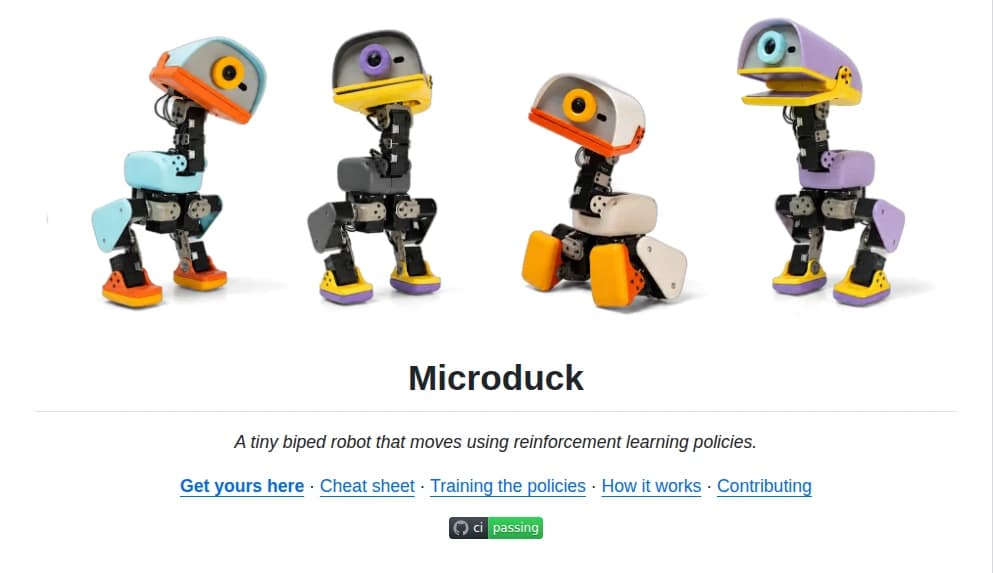
MicroDuck is probably one of the easiest robots to understand if you approach it from the physical side.
Pollen describes it as a 25 cm biped robot that can walk, sit, crouch, recover from falls, grasp objects and roller-skate. Its software, simulation environment and reinforcement-learning stack are open source, and the current product is available for preorder rather than general delivery.
That makes the robot interesting for more than one reason.
You might look at it and think:
"That's a cute robot."
Someone else sees:
"I can train this thing."
Another person sees:
"I want a little robot running around my desk."
And someone else immediately thinks:
"Can I connect an LLM to it?"
Those people are looking at the same robot.
They're actually looking for very different experiences.
That is why I think "desktop robot" is a useful category. It describes the physical product without pretending that every robot inside the category has the same purpose.
The community is already asking questions that go beyond the hardware
This is one of the things that makes the category interesting right now.
When MicroDuck launched, the community discussion wasn't limited to its walking ability.
People were asking about LLMs, voice interaction, smart-home integration, external compute, privacy, battery life, replacement parts, and what the robot could become beyond the behavior it ships with.
One commenter specifically asked whether MicroDuck's WebRTC connection could be used with an LLM to create autonomous behavior. A Pollen engineer confirmed that the technical pipe exists, but explained that things such as LLMs, SLAM and object recognition would require external compute and were not the team's immediate priority.
That conversation is interesting because it reveals something about the category itself.
People aren't just asking:
"What can this robot do?"
They're asking:
"What could this robot become?"
That's a much bigger question.
And I think we're going to see more of it.
A desktop robot can be a pet, an interface, or a platform
I find it helpful to think about three layers.
1. The robot as a character
This is the pet-like side.
You care about:
personality,
expressions,
reactions,
voice,
little habits,
and whether you actually enjoy having the robot around.
The robot doesn't need to solve a huge problem.
It just needs to give you a reason to care.
That's why I wrote about whether a desktop robot can actually become a companion before.
The interesting question isn't whether the robot can say nice things.
It's whether you eventually think:
"That's my robot."
2. The robot as a physical AI interface
This is where things become more interesting.
A normal AI interface is mostly screen, keyboard, microphone and speaker.
A robot adds:
movement,
location,
physical attention,
gestures,
objects,
space,
and time.
That changes how an AI system can interact with you.
Imagine telling an AI:
"Go over there."
Inside a chatbot, that sentence produces text.
Inside a robot, it could eventually mean:
understand where "over there" is → decide how to get there → move → check whether it arrived → continue.
That is a completely different problem.
The intelligence isn't just generating the sentence.
It has to connect the sentence to the physical world.
3. The robot as a platform
This is the part I think is going to matter a lot.
A robot can ship with a set of features.
But software can change what the robot becomes.
MicroDuck is already built around this idea at the behavior level. Pollen publishes the SDK, simulation and RL training stack, and its policy system is designed around retraining and publishing behaviors.
Reachy Mini takes another approach.
Its current ecosystem lets developers build apps, publish them through Hugging Face, and let robot owners install compatible apps from the robot's dashboard. The official documentation also includes LLM integrations, conversation apps, control loops and other software components.
That's an important shift.
The product is no longer just:
robot hardware.
It starts becoming:
robot + software + community + things you can add later.
And that could be much more important over time than a slightly better motor or a slightly better camera.
What makes a desktop robot different from a smart speaker?
A smart speaker is also physical.
So what's the difference?
For me, it comes down to behavior.
A speaker mostly waits for you.
You ask.
It answers.
You ask again.
It answers again.
A robot can potentially do more in between those moments.
It can look at you.
Move.
React.
Wait.
Do something.
Come back.
Change what it is doing based on what is happening around it.
That creates something closer to an interaction rather than a command-response interface.
The technology doesn't have to be incredibly sophisticated for this to matter.
Even a simple turn of the head can change the feeling of an interaction.
That's one reason I think why a robot feels different from ChatGPT is a more interesting question than simply asking which AI model the robot uses.
What makes an AI desktop robot "smart"?
This is where I think AI marketing creates unnecessary confusion.
A robot can use a very powerful language model and still feel surprisingly dumb.
It might understand your sentence perfectly.
But then what?
Can it remember what you told it yesterday?
Can it understand where you are?
Can it decide what to do without waiting for a command?
Can it use tools?
Can it turn a conversation into an action?
Can it notice that the physical situation has changed?
Can it recover when something goes wrong?
Those are different problems.
A good AI desktop robot therefore needs more than a model that can generate text.
It needs some way to connect:
perception → reasoning → memory → decision → action → feedback
And even that is only part of the story.
The robot also needs to make the interaction feel natural.
Timing matters.
Movement matters.
Expression matters.
Knowing when to stay quiet matters.
A robot that talks constantly can be annoying.
A robot that never reacts can feel dead.
The intelligence is only useful when it becomes a good experience.
This is why I wouldn't judge robots by their AI model alone
A big model is impressive.
It just isn't the whole product.
Imagine two robots using similar language models.
One can remember you.
It knows where it is.
It can react physically.
It can use tools.
It has a few useful behaviors.
It doesn't interrupt you every thirty seconds.
The other one can have a brilliant conversation but sits there doing nothing else.
Which one feels more like a robot?
That's not a benchmark question.
It's an experience question.
And I think this is one of the biggest areas where desktop robots still have a lot to figure out.
What a desktop robot is not
I think a few distinctions make the category much easier to understand.
It isn't necessarily a home robot
A desktop robot can be perfectly happy living on your desk.
It doesn't need to clean the house.
It doesn't need to carry groceries.
It doesn't need to become a humanoid assistant.
That's a completely different product.
It isn't necessarily a companion
A robot can be interesting without trying to become your friend.
MicroDuck is a good example.
Its current identity is heavily tied to physical behavior and experimentation rather than being a finished conversational companion.
It isn't necessarily a developer toy either
This is another mistake people make.
Because some desktop robots are open source or programmable, people assume they're only for developers.
I don't agree with that.
The real question is whether the software ecosystem eventually turns technical capabilities into things ordinary people can actually use.
That's why I think open source matters even if you don't code.
You don't need to care about the source code.
You can care about what other people build with it.
There is also a strange middle ground
This is probably my favorite thing about the category.
A desktop robot doesn't have to be useful in the traditional sense.
Your phone is better at email.
Your laptop is better at research.
Your smart speaker is probably better at answering a simple weather question.
A desktop robot can still be worth having.
Why?
Because it is there.
It moves.
It reacts.
It can become part of your environment.
Maybe it entertains you.
Maybe it keeps you company.
Maybe you enjoy experimenting with it.
Maybe you just like having a little machine on your desk that does something unexpected once in a while.
That's enough.
I don't think every consumer robot needs a productivity justification.
The way I think about a desktop robot
When I look at one, I find it useful to split the product into four questions:
The body
What can the robot physically do?
Can it move?
Can it see?
Can it hear?
Can it interact with objects?
The brain
How does it understand what is happening?
What kind of AI does it use?
Does it have memory?
Can it reason about goals?
The behavior
What does it actually do?
Not what the company says it could eventually do.
What does it do today?
The relationship
Why would you keep interacting with it?
What makes it feel personal?
What makes you want to see it again tomorrow?
This last part is easy to ignore because it is difficult to measure.
I actually think it may end up being the hardest part.
So, what is an AI desktop robot really?
At this point, I would define it pretty simply:
An AI desktop robot is a physical computer you can interact with, but the interesting part is that the computer has a body.
That body gives the AI a place.
A place to move.
A place to look from.
A place to react from.
A place to become familiar.
And eventually, maybe, a place to act.
That's why I don't think the future of desktop robots is simply:
"ChatGPT, but with arms."
The more interesting possibility is:
AI that can exist in your physical space.
We're still very early.
Some robots are mainly pets.
Some are mainly physical machines.
Some are platforms for developers.
Some are trying to combine all three.
MicroDuck is pushing the physical and open-source side.
Reachy Mini is pushing the interaction and software ecosystem side.
Other robots are exploring different combinations.
And I think that's exactly why the category is interesting right now.
We're still figuring out what people actually want these things to become.
That is probably a much more important question than:
"Which robot has the best AI?"
A few questions people usually have
Is an AI desktop robot the same as an AI companion robot?
Not necessarily.
An AI companion robot is usually defined more by the relationship and interaction experience.
A desktop robot is a broader physical category.
A desktop robot can be a companion, a pet, a physical toy, an experimental platform, or several of those at once.
Does a desktop robot need an LLM?
No.
A robot can have useful perception, behaviors, navigation, control or interaction without using a large language model.
An LLM can add another layer of intelligence, but it is not the definition of a desktop robot.
Do you need to be technical to use one?
Not necessarily.
Some robots are designed so that basic use does not require programming.
Others expose much deeper software capabilities for people who want to experiment.
The important question is not whether the robot is programmable.
It's whether you need to program it to get the experience you actually want.
Why not just use a chatbot?
Because a physical robot can do things a chatbot cannot.
It can move.
It can occupy physical space.
It can react through movement.
It can potentially interact with objects.
And you don't have to open an app every time you want to see it.
Whether those things matter to you is another question.
Are desktop robots actually useful?
Some are.
Some aren't.
And some are useful in a way that isn't traditional productivity.
The category is still young enough that I think "useful" is the wrong question to ask first.
A better question is:
What do I want having a robot around to add to my life?
That's where I would start.