I see these two terms used almost interchangeably:
AI desktop robot
and
AI companion robot.
I don't think they mean the same thing.
A robot can sit on your desk without trying to become your companion.
A robot can be designed as a companion without being limited to a desk.
And a robot can be both.
That last part is what makes this confusing.
The easiest way to understand the difference is this:
"Desktop robot" describes the physical product.
"Companion robot" describes the relationship.
That sounds like a small distinction.
It isn't.
Once you understand it, a lot of the current desktop robot market suddenly makes more sense.
What is an AI desktop robot?
Let's start with the easier one.
An AI desktop robot is basically a physical robot designed to live and operate around your desk.
It may:
- move around;
- see or hear;
- talk;
- react to you;
- show expressions;
- run AI software;
- play games;
- perform physical behaviors;
- run applications.
It can be simple or very sophisticated.
It can be a robot pet.
It can be an interactive AI interface.
It can be an experimental platform.
It can be a little physical machine you just enjoy watching.
So "desktop robot" tells you more about the form and environment than about the emotional relationship.
This is why I wrote What Is an AI Desktop Robot? It's More Than a Tiny Chatbot.
The body matters.
The robot has a physical place in your life.
But that doesn't automatically make it a companion.
Then what is an AI companion robot?
This one is more about the experience.
An AI companion robot is designed around some kind of continuing relationship with the user.
That can mean:
conversation
personality
memory
familiarity
emotional reactions
proactive interaction
recognizing you
remembering things about you
The exact combination varies a lot.
But there is usually one common idea:
The robot isn't only there to perform a task. It is there to interact with you over time.
That is a very different goal from:
"Here is a robot that can walk around your desk."
And that difference matters.
A robot can be physically impressive without being a companion.
It can also be a great companion without doing anything physically complicated.
Think about a normal pet
This is why I keep coming back to pets when talking about companion robots.
A dog doesn't need to solve a problem for you.
A cat doesn't need to answer questions.
You don't keep a pet because its feature list is impressive.
The value comes from the relationship.
You recognize it.
It recognizes you.
You develop routines.
You learn its little habits.
Sometimes you interact with it for no particular reason.
Sometimes you just like knowing it is there.
A companion robot is obviously not a real pet.
I'm not saying it is.
But the product idea borrows something from the same basic relationship:
continued interaction creates familiarity.
That's much more demanding than giving an AI a voice.
An AI voice does not automatically make a robot a companion
This is probably the easiest mistake to make right now.
Take a robot.
Add speech recognition.
Connect it to an LLM.
Add text-to-speech.
Now it can talk.
So:
AI robot = companion.
Not necessarily.
Imagine a robot that answers every question perfectly.
You ask:
"What's the weather?"
It answers.
You ask:
"What time is it?"
It answers.
You ask:
"Tell me a joke."
It tells you one.
That's an AI interface.
It can be useful.
It can be fun.
But it doesn't necessarily feel like a companion.
Now change one thing.
The robot remembers you.
Tomorrow, it knows that you were worried about an interview.
It notices you're back at your desk.
It asks how it went.
That's a different interaction.
The individual AI response isn't necessarily smarter.
The continuity is different.
And I think continuity may end up being one of the most important parts of companion robots.
This is where memory becomes important
Memory gets talked about a lot in AI products.
But I think the word is used too broadly.
There is a big difference between:
"The AI can remember the previous message."
and:
"The robot remembers something about you."
The second one is much more interesting for a companion.
Imagine a robot knowing:
your name
what you usually call it
who lives with you
what you like
what you don't like
the things you talked about last week
your normal routines
what happened the last time you interacted
That information changes the relationship.
Without memory, every conversation can feel like the first conversation.
With memory, the robot can begin to develop continuity.
That doesn't mean the robot actually understands you like a human does.
It means the software has context that persists between interactions.
And that can make a surprisingly large difference.
So is EMO an AI desktop robot or an AI companion robot?
Both.
LivingAI explicitly describes EMO as an AI desktop pet with personality and ideas. It can explore independently, track sounds, recognize people, interact with its environment, play games, dance, and respond to users.
That means EMO fits comfortably into both categories.
It is a desktop robot because of where and how it physically operates.
It is a companion-oriented robot because personality and ongoing interaction are central to the product.
This is why the two labels don't need to compete.
They are describing different layers.
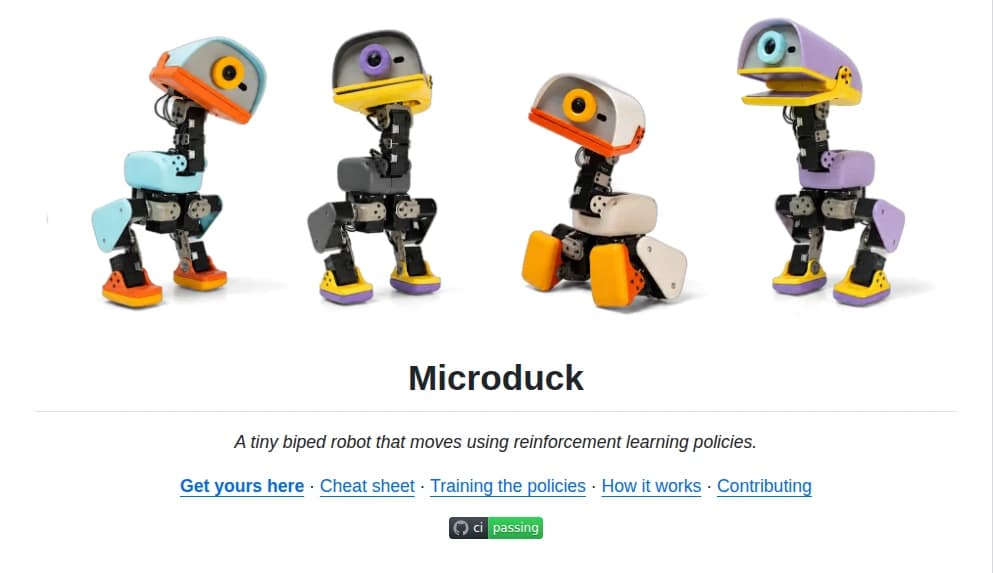
What about MicroDuck?
MicroDuck is an interesting example because its current product identity is much more physical.
Pollen describes MicroDuck as a small open-source biped built around movement and learned behaviors. Its current published behaviors include walking, sitting and standing, kicking, grabbing, roller skating, and getting back up after a fall.
So I would call it an:
AI desktop robot
very comfortably.
Would I automatically call it an:
AI companion robot?
I wouldn't.
Not yet.
Not because it couldn't eventually become one.
That's actually one of the interesting possibilities.
But a robot having a cute shape, a camera, a microphone, or an AI system doesn't automatically create companionship.
The companion layer needs to be built.
That's exactly why I still think Could a Desktop Robot Actually Become a Companion? is an important question.
The physical robot gives you presence.
The software has to give you a reason to keep coming back.
And this is where Reachy Mini gets interesting
Reachy Mini sits somewhere in the middle.
Pollen describes Reachy Mini around human-robot interaction, while its current software ecosystem includes applications for conversation, games, dance and other autonomous behaviors. Users can discover and install compatible apps, and developers can build their own applications through the SDK.
Its official documentation also includes a conversation example combining voice activity detection, LLMs and text-to-speech, along with custom vision and audio pipelines.
So Reachy Mini can be:
a desktop robot
and:
a conversational robot
and:
an experimental platform
and potentially:
a companion.
That's actually a good example of why I don't think the category should be divided too rigidly.
The same physical robot can support different experiences depending on its software.
LOOI shows another version of the same idea
LOOI approaches the problem from the AI side.
Its current product is built around a smartphone-powered design, with conversation, memory, personality, visual awareness, and expressive interaction forming a large part of the experience.
So LOOI feels much closer to:
AI companion with a physical body
than:
physical robot first.
That's a subtle difference.
With MicroDuck, you might start with:
"Look at what this robot can physically do."
With LOOI, you might start with:
"What would it be like to have this AI sitting next to me?"
Both are desktop robots.
But the reason you want them is different.
We've already gone deeper into that distinction in MicroDuck vs LOOI.
The easiest way to separate the two concepts
I think about it this way.
Desktop robot asks:
Where does the robot live, and what can its body do?
Companion robot asks:
What kind of relationship is the robot trying to create with me?
That's it.
Once you see this distinction, the category becomes much easier to understand.
A robot can be useful without being a companion
This is another thing that gets lost in the excitement around AI companions.
Suppose you have a robot that:
watches your desk
reminds you about something
moves around
controls smart-home devices
displays information
performs little physical tasks
It might be genuinely useful.
But you may not feel emotionally attached to it at all.
That's completely fine.
Not every robot needs to become your friend.
Some people may actually prefer a robot that stays out of the way and does something useful when needed.
Others may want exactly the opposite.
They want the robot to:
make noise
talk
react
surprise them
have a personality
The product category is broad enough for both.
A robot can also be a companion without being particularly useful
The opposite is also true.
A robot might spend most of its time:
sitting there
reacting to you
making expressions
talking
doing small movements
playing games
and providing no serious productivity benefit.
That doesn't necessarily mean the product failed.
A pet isn't a productivity tool.
Entertainment is a valid consumer use case.
Companionship is a valid consumer use case.
Presence is a valid consumer use case.
I think this is important because people sometimes judge companion robots using the wrong standard.
They ask:
"What problem does this solve?"
Maybe that's not the point.
Maybe the point is:
"Do I enjoy having it around?"
But companion robots have a much harder software problem
Here's where things get interesting.
A normal AI assistant can get away with being reactive.
You ask.
It responds.
Done.
A companion has to deal with time.
Yesterday matters.
Last week matters.
The last conversation matters.
Your habits matter.
Sometimes the robot should speak.
Sometimes it shouldn't.
Sometimes you want help.
Sometimes you don't.
Sometimes the robot should proactively do something.
Sometimes that would be extremely annoying.
That's a much harder software problem.
And it isn't solved simply by connecting an LLM.
You need a system that can handle:
memory
context
state
personality
goals
timing
perception
actions
boundaries
That's why I think the most interesting future work around companion robots is going to happen above the raw language-model layer.
The robot has to know when not to talk
This sounds trivial.
It's not.
Imagine sitting at your desk trying to concentrate.
Your robot keeps saying:
"Hey!"
"What are you doing?"
"Want to hear a joke?"
"Let's play a game."
Technically, the AI is being active.
From a human perspective, the robot is becoming annoying.
So a good companion isn't simply:
more proactive.
It needs to know when proactivity is useful.
That requires context.
And context requires more than a language model.
The system needs some understanding of:
what is happening
what happened before
what the user usually wants
what the robot is currently doing
what it is allowed to do
That is a very different engineering problem from simply building a chatbot.
Personality is also more than a prompt
You can give an LLM a system prompt:
"You are a funny and friendly robot."
That creates a certain voice.
But personality becomes much more convincing when it persists through behavior.
Imagine two robots saying the same sentence:
"You're back."
One turns toward you.
The other keeps facing the wall.
One remembers what you were talking about yesterday.
The other immediately starts a completely unrelated conversation.
One waits for you to finish.
The other interrupts.
Those differences have nothing to do with the sentence itself.
They are part of the robot's behavior.
That's why I think:
personality lives partly in software behavior, not just language.
And physical robots make that much more obvious.
Physical presence changes the relationship
This is probably the strongest connection between the two categories.
A chatbot can become familiar.
A companion robot can become familiar and physically present.
That's different.
The robot has a location.
It is part of the environment.
You can look at it without opening an application.
It can turn toward you.
It can move closer.
It can sit somewhere else.
It can react physically.
The interaction becomes spatial.
This is one reason I think desktop robots are interesting even when they aren't doing anything particularly useful.
They turn an invisible software relationship into something you can actually see.
This is also why movement can matter more than people expect
A tiny physical reaction can carry a surprising amount of meaning.
Imagine:
"Yes."
as text.
Now imagine a little robot:
looking at you,
moving its head,
making a sound,
then going back to what it was doing.
The information hasn't changed much.
The experience has.
That is the strange advantage of embodiment.
The robot can communicate through:
movement
position
timing
attention
expression
not just words.
MicroDuck is an interesting test case because its current identity is strongly centered on physical movement rather than conversation. Pollen's own introduction contrasts MicroDuck with Reachy Mini by describing MicroDuck as a robot designed to move through the world rather than primarily stay on a desk and interact with you.
That difference may become less important over time as the software around these robots develops.
What the community is already experimenting with
This isn't just a theoretical question.
People building companion robots are already running into the same problems.
In one recent robotics project, a developer described building a small companion robot around vision, lidar, hearing and local/cloud LLMs, while explicitly saying that personality was one of the central goals. The discussion then moved into questions around VLA models and how much intelligence was actually necessary for the robot's intended use.
I find that more interesting than another:
"Look, we connected ChatGPT to a robot!"
demo.
Because it shows where the real difficulty is.
You can connect an LLM relatively easily.
Making the whole system behave like a coherent thing is harder.
The interesting engineering question becomes:
What should happen between the moment the robot perceives something and the moment it responds?
That is where memory, planning, personality, tools and physical behavior start to meet.
This is why I don't think the future desktop robot will be defined by one AI model
I keep seeing people ask:
"Which LLM does this robot use?"
It's a useful question.
It's just not enough.
Imagine a robot with:
a great LLM
but:
no memory
no useful tools
no physical behavior
no persistent personality
no context
no ability to act
It may be a good conversational device.
It doesn't automatically make a great robot.
Now imagine a robot with a slightly less impressive model, but it can:
remember you
understand its environment
decide what to do
use tools
move naturally
maintain a consistent personality
learn your preferences
That could produce a much richer experience.
The model matters.
The system around the model may matter more.
So which one should a normal person look for?
Don't start by asking:
"Do I want an AI companion robot?"
Start with something simpler:
"What do I actually want this robot to add to my life?"
If you want:
physical movement
games
experimentation
a little machine doing unexpected things
then a desktop robot with strong physical behavior may be enough.
If you want:
conversation
familiarity
personality
memory
someone—or something—to interact with regularly
then you're looking more toward the companion side.
If you want both, you're looking for the part of the market that is still being figured out.
And honestly, I think that's where things get interesting.
The line between the two will probably disappear
I don't think "desktop robot" and "companion robot" will remain neatly separated.
The more capable the software becomes, the more a physical robot can develop a persistent identity.
And the more capable the hardware becomes, the more a companion can actually act in the physical world.
Eventually you could have:
a robot that remembers you,
understands your environment,
talks with you,
has a recognizable personality,
knows when to leave you alone,
moves naturally,
uses tools,
performs tasks,
and gains new skills over time.
At that point, what do you call it?
Desktop robot?
Companion robot?
Personal robot?
AI assistant?
Probably all of them.
And that's why I don't think the labels themselves are the important part.
The experience is.
The part I'm watching most closely
For me, the interesting question isn't:
"Which robot has the smartest AI?"
It's:
"What happens when the robot starts remembering, deciding, and acting instead of simply responding?"
That is where a desktop robot stops feeling like:
a chatbot with a body
and starts becoming:
a physical computing system with its own ongoing context.
We're not fully there yet.
Different products are approaching it from different directions.
MicroDuck starts from physical behavior and an open policy ecosystem.
EMO starts from personality and the idea of a robotic pet.
LOOI starts from the AI companion experience and gives it a physical form.
Reachy Mini is showing what happens when a robot becomes increasingly software-driven, with applications, LLM integrations and community-created behaviors.
None of them has to be the final answer.
They're different experiments.
And that's probably the most useful way to look at the category right now.
One simple distinction to remember
If you only remember one thing from this article, make it this:
A desktop robot describes the robot's place in the physical world.
A companion robot describes the robot's relationship with you.
A robot can be one.
It can be the other.
Or eventually, it can be both.
The really interesting products will probably be the ones where those two things stop feeling separate.
Because putting AI on your desk is easy to understand.
Making you care that it's there tomorrow is much harder.