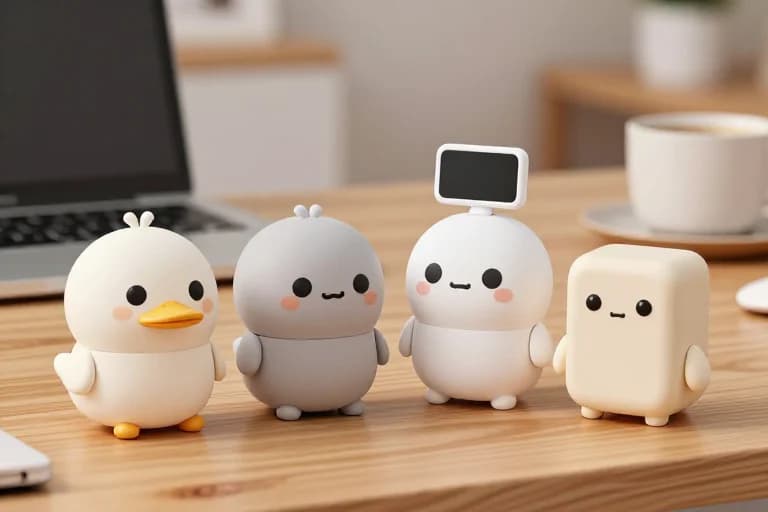
MicroDuck is getting a lot of attention right now, and I can understand why.
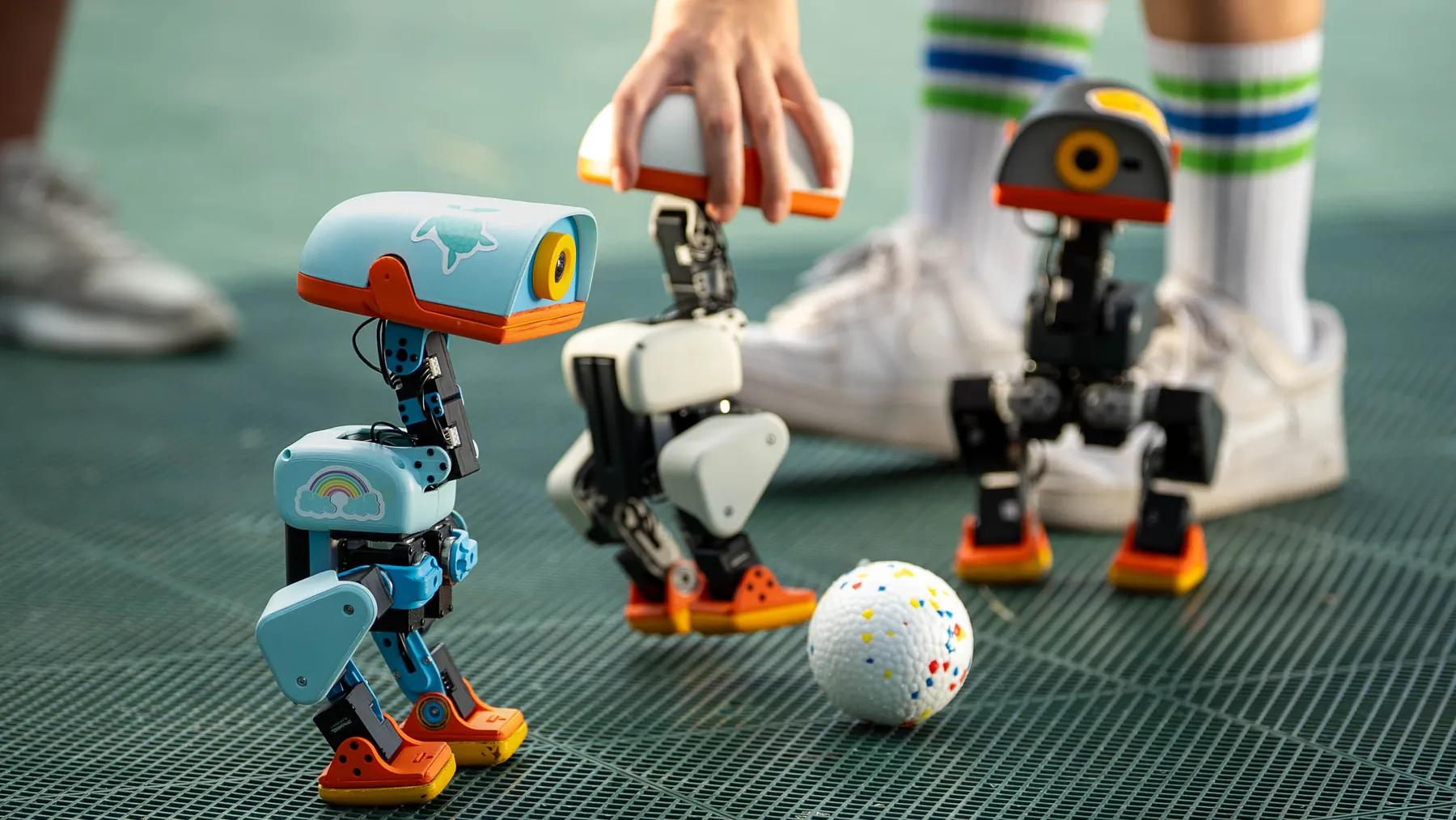
A small robot that can walk, crouch, grasp objects, recover from falls, and even roller-skate is not something you see every day.
But there is a problem that usually appears right after the initial excitement:
"Okay, but what else is out there?"
That is a reasonable question.
Because MicroDuck is not competing with just one other robot.
Depending on what attracted you to it in the first place, you might actually be looking for something quite different.
Maybe you want a robot that talks to you.
Maybe you want a little AI pet.
Maybe you want something that spends most of its time sitting on your desk and reacting to you.
Maybe you want an open platform that you can keep experimenting with.
Those are different reasons to want a robot.
And that is why I would not start with:
"Which MicroDuck alternative is the best?"
I'd start with:
"What part of MicroDuck made you want a robot in the first place?"
Once you answer that, the alternatives become much easier to understand.
MicroDuck is a little different from most desktop robots
Before looking at alternatives, it helps to understand what makes MicroDuck unusual.
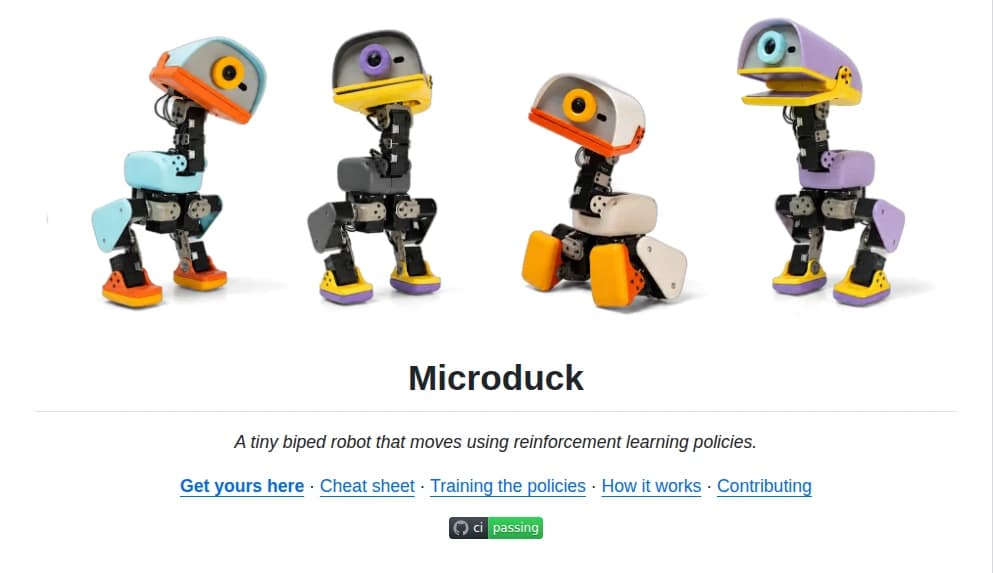
Pollen Robotics currently describes MicroDuck as a 25 cm open-source biped with 15 motors, a camera, LiDAR, two IMUs, an articulated beak, and a software stack built around simulation and reinforcement learning. It ships with seven trained behaviors and is currently available for preorder at $399 before taxes and shipping, with first deliveries targeted before Christmas 2026. ([Pollen Robotics][1])
That combination matters.
MicroDuck is not simply:
AI + cute body.
A lot of its appeal comes from the fact that the robot itself is doing something physical.
It walks.
It moves through space.
It falls and gets back up.
It can interact with objects.
And because the software stack is open, the interesting question is not only what it does now, but what other people might eventually teach it to do. ([Pollen Robotics][1])
That puts MicroDuck in a slightly unusual position.
It is part consumer robot, part physical AI platform, and part experiment.
So a good alternative doesn't have to copy all of that.
It just needs to solve the same underlying desire in a different way.
The first alternative: Reachy Mini
Reachy Mini makes more sense if what you really want is interaction
Reachy Mini is probably the most obvious robot to compare with MicroDuck because both come from Pollen Robotics and both sit inside the broader world of small, open, AI-oriented robots.
But they are built around different ideas.
Pollen describes Reachy Mini as a small desktop robot focused on human-robot interaction, while MicroDuck starts much more strongly from physical movement and learned behaviors. ([Pollen Robotics][2])
That difference is more important than the fact that both are "small robots."
Reachy Mini is designed to stay on your desk.
It can move its head and antennas, express different emotions, run apps, and interact through software that is specifically designed around the robot. Its current control software also lets users discover and install community applications. ([Hugging Face][3])
And this is where Reachy Mini gets particularly interesting.
It is starting to look less like:
"Here is a robot with some features."
and more like:
"Here is a robot that can run different things."
The current Reachy Mini ecosystem includes conversation apps, games, dances, AI integrations, and other community-created applications. Developers can also access the robot through its Python SDK. ([Hugging Face][3])
So if what attracts you to MicroDuck is:
"I want to see what people can build around an open robot."
Reachy Mini deserves a closer look.
If what attracted you was:
"I want to watch a tiny robot actually walk around."
then the two products are solving different problems.
We already looked at that difference in more detail in MicroDuck and Reachy Mini: What’s Actually Different, and Which One Fits You Better?.
The second alternative: EMO
EMO starts from the idea of a robot pet
EMO is a completely different direction.
LivingAI describes EMO as an AI desktop pet with its own personality. It can move around the desk, recognize people, react to sounds, play games, dance, answer questions, and interact with its environment. ([LivingAI][4])
That means the central question with EMO is less:
"What can this robot physically learn?"
and more:
"Do I enjoy having this little character around?"
That is a meaningful difference.
EMO's whole presentation is built around personality, expression, curiosity, and companionship. The company describes it as something that stays by your side and behaves more like a pet than a traditional machine. ([LivingAI][4])
And honestly, this is important because a desktop robot does not always need a complicated job.
A lot of people who become interested in these products are not thinking:
"I need a robotic assistant."
They're thinking:
"That thing is cute. I want one on my desk."
That's a legitimate reason.
The challenge is simply that EMO and MicroDuck satisfy that feeling in different ways.
MicroDuck is interesting because the physical robot is the attraction.
EMO is interesting because the robot's personality is part of the attraction.
We already explored that distinction in MicroDuck or EMO? Which One Fits the Kind of Companion You Want?.
The third alternative: LOOI
LOOI takes a very different shortcut: your phone becomes part of the robot
LOOI is probably the strangest comparison here.
It does not try to be a completely self-contained robot in the same way as MicroDuck.
Instead, it uses your smartphone as a major part of the experience.
The current LOOI product is built around a phone-mounted robot body, with the phone providing the display and much of the sensing and computing experience. Its official product page currently describes conversation, memory, visual awareness, emotional behavior, motion, games, reminders, and other interactive features. It supports both iOS and Android. ([LOOI Robot][5])
That changes the equation quite a bit.
You are not really choosing between:
robot A robot B
You are choosing between:
standalone physical robot
and:
robot body + smartphone as the brain/interface
And I think that makes LOOI worth considering for a very different type of buyer.
Someone who mainly wants:
conversation
personality
visual interaction
a little character on the desk
may find the LOOI approach much more interesting than a robot whose biggest appeal is walking.
There is also a nice consumer-product idea behind it.
Your phone already has:
- a screen
- cameras
- microphones
- processing power
- connectivity
LOOI uses those capabilities instead of trying to reproduce all of them inside the robot.
Whether that architecture is attractive to you depends largely on how you feel about having your phone remain part of the robot experience.
Our existing MicroDuck vs LOOI comparison goes deeper into that difference.
So which one is the closest MicroDuck alternative?
This is where I think most comparison articles get it wrong.
There isn't one.
At least not in a useful sense.
These robots are moving in different directions.
I would think about them like this:
| Robot | The main question it asks |
|---|---|
| MicroDuck | What can a small physical robot do? |
| Reachy Mini | What can a software-rich desktop robot become? |
| EMO | What if the robot feels more like a pet? |
| LOOI | What if your phone becomes part of the robot? |
That is a much better comparison than a spreadsheet full of specifications.
Because the specs don't explain why you would want one in the first place.
MicroDuck vs Reachy Mini vs EMO vs LOOI
There is a simple way to separate them.
If movement is the thing that caught your attention
Start with MicroDuck.
The robot's physical behavior is central to its identity.
Pollen currently highlights walking, sitting, crouching, grasping, falling recovery, roller-skating, and other learned behaviors. ([Pollen Robotics][1])
The most interesting part is not necessarily the number of behaviors.
It is that the robot itself becomes part of the entertainment.
You can see something happening in your physical space.
That's different from asking a chatbot a question.
If conversation and interaction are what you really want
Look more closely at Reachy Mini or LOOI.
Reachy Mini's current software ecosystem includes conversation apps and other interactive experiences, while LOOI is explicitly built around conversation, memory, visual awareness, personality, and expressive behavior. ([Hugging Face][3])
They take different technical approaches, but the user-facing goal is closer:
"I want something on my desk that interacts with me."
That's not quite the same thing as:
"I want to experiment with a robot."
If you mainly want a robot pet
EMO is the clearest example of that direction.
LivingAI doesn't hide what it is trying to create.
It calls EMO an AI desktop pet.
Personality is part of the product, not something that might appear later as an extra feature. ([LivingAI][4])
That makes EMO interesting even if you have no interest in robotics.
You don't need to care about reinforcement learning.
You don't need to care about open-source software.
You just need to like the idea of having a little robotic character around.
If the software side excites you
Then the comparison changes again.
Reachy Mini is particularly interesting here because its ecosystem treats applications as a first-class part of the robot.
The official documentation currently lets owners discover, install, start, and stop robot apps, while developers can build their own with the SDK. ([Hugging Face][3])
MicroDuck takes a somewhat different approach.
Its openness is strongly connected to policies, simulation, reinforcement learning, and the ability to create and retrain physical behaviors. ([Pollen Robotics][1])
For a normal consumer, the important distinction is simple:
Reachy Mini is showing what a robot software ecosystem can look like.
MicroDuck is showing what a robot behavior ecosystem can look like.
Those ideas may eventually start to overlap.
Right now, they're still different.
There are also robots outside these four
And this is where the desktop robot category gets more interesting.
The current market is not just:
MicroDuck vs EMO vs LOOI vs Reachy Mini.
There are also small robot pets, smartphone-based robots, educational robots, home robots, and experimental platforms.
Some are very productized.
Some are closer to toys.
Some are developer platforms.
Some are barely robots in the traditional sense but still compete for the same space on your desk.
That is why I would be careful with any article that gives you a giant list and calls every product an "alternative."
A robot doesn't become a meaningful alternative just because it has:
AI + wheels + a cute face.
The reason someone wants it matters more.
The desktop robot market is starting to split into different experiences
This is probably the most interesting thing happening right now.
For a long time, the idea of a small consumer robot was mostly:
a cute machine that reacts to you.
That is still a real category.
But now we're starting to see several directions emerge.
Robot as a pet
EMO is a good example.
The focus is personality, expression, presence and companionship. ([LivingAI][4])
Robot as a physical creature
MicroDuck is pushing strongly in this direction.
The robot moves through the physical world and its behaviors are a major part of the experience. ([Pollen Robotics][1])
Robot as an AI interface
LOOI shows this direction.
The body gives an AI system a physical form, while the smartphone supplies much of the underlying technology. ([LOOI Robot][6])
Robot as a software platform
Reachy Mini is increasingly interesting here.
The robot can run applications, connect to AI systems, and become something different depending on the software installed on it. ([Hugging Face][3])
And I suspect these categories will become less separate over time.
A robot could eventually be all four.
The question I would ask before choosing an alternative
Don't ask:
"Which robot has the most features?"
Ask:
"What do I want this robot to actually add to my desk?"
That sounds less technical.
That's exactly why I think it is more useful.
Maybe you want:
something that moves around.
Maybe:
something that talks to you.
Maybe:
something with a personality.
Maybe:
something you can keep experimenting with.
Maybe:
something that becomes more interesting as the software around it grows.
Those are completely different motivations.
And you don't need to force them into one ranking.
What MicroDuck alternatives tell us about the category
This is actually the part I find more interesting than the products themselves.
Look at the four approaches.
MicroDuck says:
Make the body interesting.
EMO says:
Make the personality interesting.
LOOI says:
Make the interaction interesting.
Reachy Mini says:
Make the software expandable.
None of these ideas are mutually exclusive.
In fact, I think the best consumer robots will eventually need all of them.
A body without good software becomes a gadget.
Software without physical presence is just another AI interface.
Personality without memory becomes repetitive.
An open platform without a useful ecosystem becomes interesting mostly to developers.
The hard part is putting everything together.
This is also why I wouldn't rush to buy an "alternative"
MicroDuck is still a new product.
Its preorder launched on August 27, 2026, and Pollen is targeting first deliveries before Christmas 2026. That means we are still very early in the product's consumer lifecycle. ([Pollen Robotics][1])
The same is true in a broader sense for consumer desktop robots.
We're still figuring out what people actually want from them.
And community discussion reflects that.
A recent discussion around desktop robots was not just about individual products. People were already experimenting with multiple robots, including Reachy Mini and MicroDuck, and talking about shared software or operating-system-level ideas across different physical robots. ([Reddit][7])
That's a much more interesting direction than another product with a few extra features.
Because it suggests a future where:
the robot is the hardware layer, and software determines much of what the robot becomes.
We're not there yet.
But you can see the beginning of it.
So, what should you look at instead of MicroDuck?
It depends on what made you interested in MicroDuck.
You saw the duck walking and thought, "I want a little robot that actually moves."
MicroDuck is still the most direct expression of that idea.
You thought, "I want something interactive on my desk."
Reachy Mini and LOOI are worth looking at.
You thought, "I want a little robotic pet."
EMO is clearly built around that experience.
You thought, "I want to keep experimenting with what this thing can become."
MicroDuck and Reachy Mini are probably the more interesting places to look, although they approach openness very differently. ([Pollen Robotics][1])
And that is why I don't think the right answer is:
"Here are the best MicroDuck alternatives."
The useful answer is:
"Here are the different directions desktop robots are taking."
Once you see that, choosing becomes much easier.
One more thing worth watching
The really interesting question may not be:
Which robot wins?
It may be:
Which robots develop the strongest software ecosystems?
That's a very different race.
Hardware eventually gets cheaper.
Sensors improve.
Processors get faster.
AI models improve.
But the software layer determines what a robot can actually become for a normal person.
Can new behaviors be added?
Can developers build things without fighting the hardware?
Can users install those things without learning how everything works?
Can the robot remember you?
Can it use tools?
Can it act instead of just talk?
Can different applications make the same robot feel completely different?
Those questions are starting to matter just as much as the physical hardware.
And they are probably going to matter even more as the category grows.
The bottom line
MicroDuck does not really have one direct replacement.
It has neighbors.
Reachy Mini is exploring the robot-as-platform direction.
EMO is exploring the robot-as-pet direction.
LOOI is exploring the robot-as-AI-interface direction.
MicroDuck is pushing the robot-as-physical-creature and open-behavior direction.
That is why I think comparing them only by specifications misses the interesting part.
The bigger story is that consumer desktop robots are starting to answer a very old question in different ways:
What would you actually want a little robot to be?
And we're still pretty early in finding out.
Related MeraBots guides
Before looking at alternatives, you may want to start with What Is an AI Desktop Robot? It’s More Than a Tiny Chatbot.
For a closer MicroDuck comparison, see MicroDuck and Reachy Mini: What’s Actually Different, and Which One Fits You Better?, MicroDuck or EMO? Which One Fits the Kind of Companion You Want?, and MicroDuck vs LOOI: Which One Feels More Like the Robot You Actually Want?.
And if the open-source side of MicroDuck is what caught your attention, Does Open Source Actually Matter If You Don't Code? is the next one I'd read.