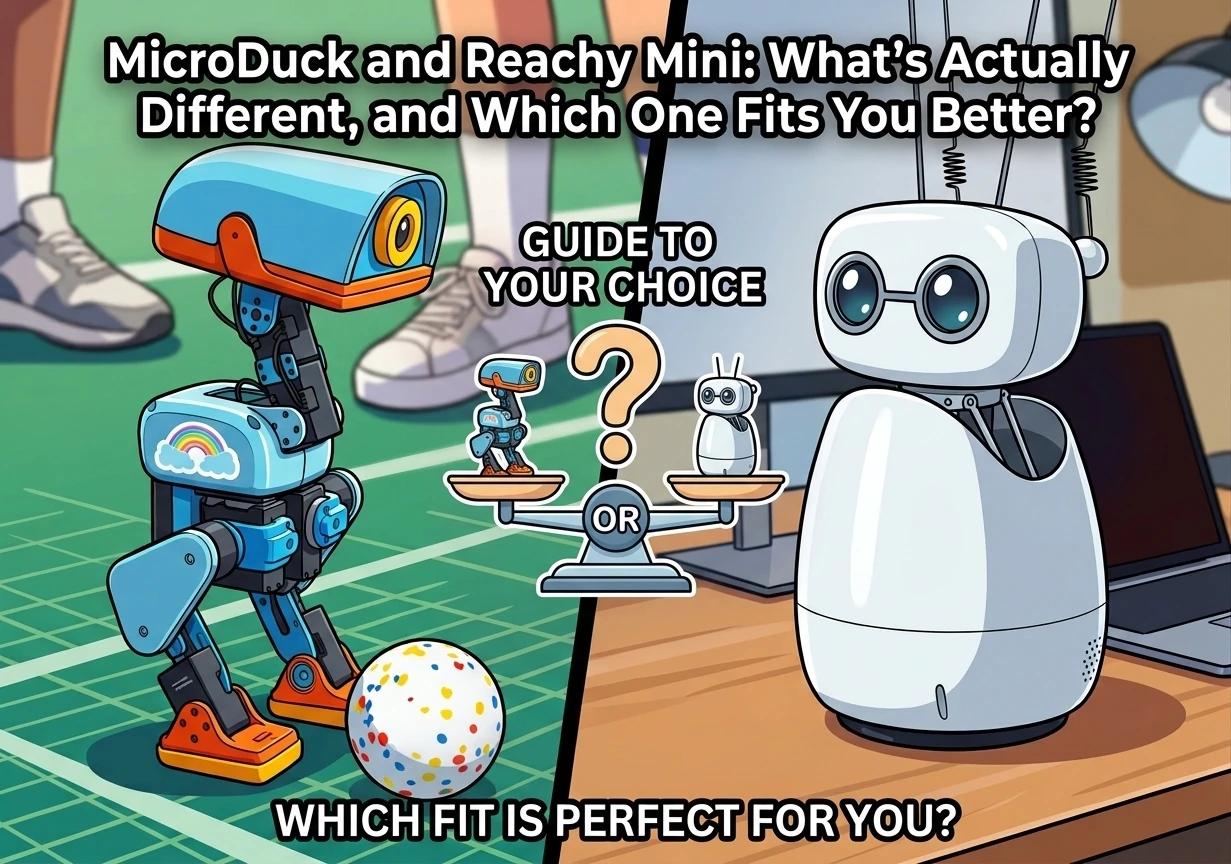
At first glance, MicroDuck and Reachy Mini look like competitors.
They are both small robots.
They are both made by Pollen Robotics.
They are both open source.
They are both designed to make AI and robotics more accessible.
And both can live on your desk.
But after looking more closely, I do not think they are really trying to be the same product.
Pollen itself describes MicroDuck as a different kind of small robot from Reachy Mini: Reachy Mini was designed around interaction, while MicroDuck was designed around moving through the world.
That difference is more important than the number of motors.
The Short Answer
The simplest way I would describe them is:
MicroDuck is a physical-action robot.
Reachy Mini is an interaction robot.
MicroDuck's core idea is:
Give a small robot a real body, train physical behaviors in simulation, and let developers create new things for that body to do.
Reachy Mini's core idea is:
Give AI a highly expressive physical interface that can see, hear, move, speak, and run applications built by its community.
Neither approach is inherently better.
They are optimized for different experiences.
And that is why the right choice depends much more on what you want the robot to become than on which specification looks better on a comparison table.
MicroDuck: Physical Movement Is the Product
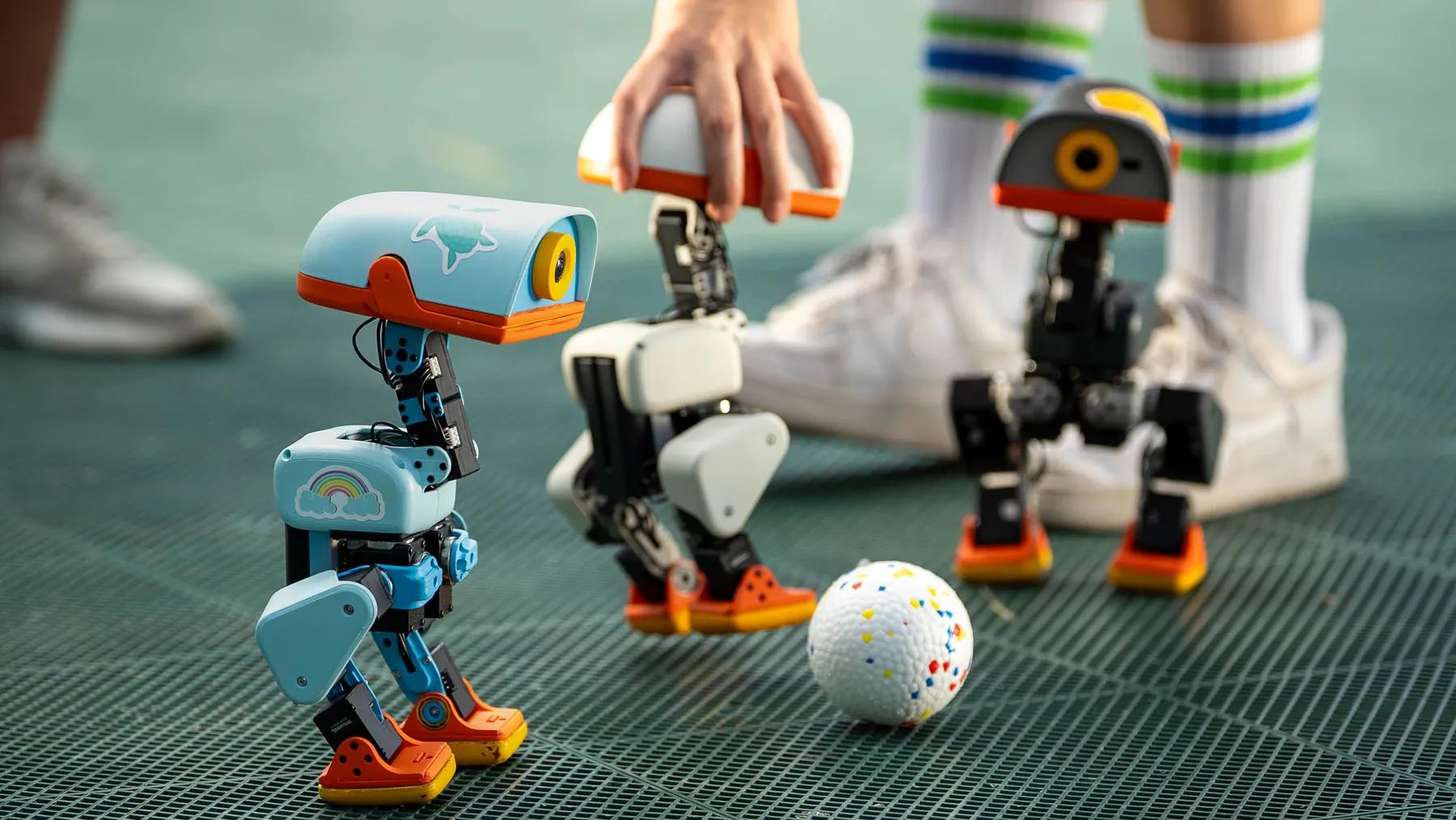
MicroDuck is a 25 cm biped weighing under 800 g.
It has 15 motors, a front camera, compact LiDAR, two IMUs, an articulated grasping beak, microphones and a speaker, NFC antennas, Wi-Fi and Bluetooth, and a Rockchip RK3566 with an AI accelerator.
Its current built-in behaviors include walking, sitting and standing, grasping, kicking, roller-skating, and recovering from falls. Pollen lists seven trained moves in the box.
The physical body is therefore a major part of the product.
MicroDuck is interesting because it can physically move through a space, maintain balance, interact with an object, and eventually be taught new physical behaviors.
That is a very different starting point from a robot whose main purpose is to face you and communicate with you.
Reachy Mini: Interaction Is the Product
Reachy Mini takes almost the opposite approach.
The current hardware has a six-degree-of-freedom expressive head, full body rotation, two animated antennas, a wide-angle camera, four microphones, and a speaker. The Wireless version adds onboard computing, Wi-Fi, battery operation, and an IMU.
The robot is designed to look at you.
Listen to you.
Move its head.
Move its body.
Animate its antennas.
Speak.
React.
And run AI-powered applications.
That makes Reachy Mini less about:
"Can the robot learn a new way to walk?"
and more about:
"What can an AI application do when it has a physical body that can express itself?"
That distinction changes almost everything.
They Solve Different Physical Problems
This is probably the cleanest way to compare them.
MicroDuck asks:
How can software control a physical robot that moves through the world?
The core challenges are:
- locomotion
- balance
- grasping
- perception
- physical interaction
- reinforcement learning
- sim-to-real transfer
Reachy Mini asks:
How can software make interaction with an AI feel physical?
The core challenges are:
- conversation
- visual interaction
- expressive motion
- voice input/output
- body language
- AI integrations
- application development
Both are physical AI.
But they emphasize different sides of it.
The Motor Count Tells the Story
MicroDuck has:
15 motors / degrees of freedom
across its body, legs, head, and neck.
Reachy Mini has:
5 servo motors, with a six-degree-of-freedom head, full body rotation, and two animated antennas.
That is not simply a case of:
15 is better than 5.
The motors are doing different jobs.
MicroDuck needs many actuators because its body has to physically move as a biped.
Reachy Mini spends its mechanical complexity on expression:
- head orientation
- body yaw
- antenna movement
- physical gestures
In other words:
MicroDuck spends more of its mechanical budget on locomotion.
Reachy Mini spends more of its mechanical budget on communication.
That is a much more useful comparison.
MicroDuck Has a Real Locomotion Problem
A biped has to deal with balance.
When MicroDuck walks, its software has to coordinate multiple joints while keeping the body stable.
That is why its software stack includes a reinforcement-learning training pipeline and a MuJoCo-based simulation environment.
Pollen describes MicroDuck's workflow as:
train in simulation → deploy on the robot → refine → retrain → publish.
Every shipped behavior is a policy that can be retrained.
That makes MicroDuck particularly interesting if you care about:
robot learning.
You are not just programming a collection of fixed motions.
You are working with learned policies that control a physical machine.
Reachy Mini Has a Different Kind of Complexity
Reachy Mini does not need to solve the same biped locomotion problem.
Instead, the expressive body becomes the interface for software.
The platform exposes robot control, camera, microphones, speaker, body movement, antennas, and application interfaces.
Its current API exposes endpoints for apps, robot state, movement, motors, kinematics, audio, and Hugging Face authentication.
That creates an entirely different development model.
A developer can write an application that:
- listens for something,
- interprets it with an AI model,
- decides what to do,
- moves the robot,
- speaks,
- and waits for the next interaction.
That is much closer to building an AI application with a physical interface.
The Software Ecosystems Are Also Different
This may ultimately matter more than the hardware.
MicroDuck's software philosophy
MicroDuck is built around:
simulation → reinforcement learning → physical deployment
The official stack includes:
- robot runtime
- simulator
- RL training stack
- retrainable policies
- deployment tooling
Pollen explicitly positions the complete software stack as open and says the shipped policies can be forked and retrained.
The ecosystem therefore revolves around:
new physical behaviors.
Reachy Mini's software philosophy
Reachy Mini is increasingly organized around:
robot → SDK → applications → AI integrations → community apps
Its documentation currently includes Python and JavaScript development, simulation, application publishing, AI integrations, and an app store powered by Hugging Face Spaces.
The ecosystem therefore revolves around:
new applications and interaction experiences.
That is a major difference.
MicroDuck Wants You to Teach the Body
Imagine you want to make MicroDuck do something new.
The natural path is:
create a behavior → train it → simulate it → deploy it → refine it.
This is a robotics problem.
The output is:
a new physical skill.
For example:
- a different locomotion behavior
- a new grasping behavior
- a new physical interaction
- a new learned movement
That is why MicroDuck is particularly interesting to people who want to explore reinforcement learning and embodied AI.
Reachy Mini Wants You to Build an Application
Now imagine you want to make Reachy Mini do something new.
The natural path is:
build an app → connect an AI model → control the robot → publish the app.
The output might be:
- a conversation experience
- a visual interaction
- an AI assistant
- a game
- an educational application
- an expressive character
- an AI-powered physical interface
This is closer to application development than robot training.
And the current ecosystem reflects that.
Hugging Face's documentation includes application development and publishing workflows, and an app store is already part of the Reachy Mini platform.
This Makes Reachy Mini Much More Interesting for AI App Developers
Suppose you are primarily an AI developer.
You already know how to work with:
- LLMs
- vision models
- speech
- agents
- APIs
- web applications
You want to put those things into a physical interface.
Reachy Mini is a very natural fit.
You can use the robot as the embodiment layer.
The AI remains the intelligence layer.
Your application connects the two.
That makes the transition from:
AI software
to:
AI product with a body
relatively straightforward.
MicroDuck Is More Interesting If You Want to Work on Embodied Intelligence
Now suppose your interest is different.
You want to understand:
How does an AI system learn to control a physical body?
That leads you toward:
- simulation
- reinforcement learning
- reward design
- policies
- motor control
- perception
- sim-to-real
MicroDuck is much more directly aligned with that problem.
The physical robot is not just a display for the AI.
The body itself is the research problem.
That makes it particularly interesting as an embodied-AI platform.
The Price Is Surprisingly Similar
MicroDuck currently starts at $399 before taxes and shipping.
Reachy Mini has been offered in two configurations, with the Lite and Wireless versions occupying different positions. Current Pollen/Hugging Face materials list the Wireless configuration at $499, while a current Pollen Robotics Reachy Mini purchase interface lists the Lite version at $299 and Wireless at $499.
So the comparison is not really:
expensive robot vs cheap robot.
The entry prices are close enough that the more important question is:
Which type of physical AI platform do you actually want?
That is a much better purchasing decision.
Reachy Mini Has an Important Advantage: It Is More Mature as an AI Application Platform
Reachy Mini came before MicroDuck.
Pollen says more than 10,000 Reachy Minis had already made their way to people around the world by the time MicroDuck was introduced in August 2026.
That gives Reachy Mini an ecosystem advantage.
More owners.
More applications.
More examples.
More documentation.
More community feedback.
And that matters enormously for a platform product.
Open source is valuable.
But an ecosystem is more valuable.
A repository tells you what you can build.
A community tells you what other people have already built.
Reachy Mini is further along on that curve.
Its current platform already includes an app store, and one 2026 community project reported more than 200 Reachy Mini apps created by 150+ creators.
That is an important distinction when evaluating the two products today.
MicroDuck Has a Different Advantage: It Is More Interesting as a Learning Robot
MicroDuck is newer.
Its ecosystem is therefore less mature.
But that is also why it is interesting.
Its design is closer to:
"Here is a small physical robot whose behavior you can train."
The product is making the sim-to-real workflow part of the consumer story.
That is unusual.
Most consumer robots hide the complexity.
MicroDuck exposes it.
For someone who wants to learn about embodied AI, that can be a feature rather than a drawback.
What About AI Companionship?
This is where Reachy Mini has a clear conceptual advantage.
Its body was designed around human-robot interaction.
It has:
- expressive head movement
- animated antennas
- camera
- four microphones
- speaker
- body rotation
That gives an AI application more ways to communicate nonverbally.
Reachy Mini can look toward you.
React through movement.
Use its antennas.
Speak.
Listen.
That makes the robot feel more like an embodied interface.
MicroDuck can also have microphones, a speaker, camera, and physical movement, but its defining physical problem is different.
Its body is primarily built around locomotion and manipulation.
So if your mental model is:
"I want an AI that feels like a little character living on my desk."
Reachy Mini makes more sense.
What About Physical Tasks?
Here MicroDuck becomes much more interesting.
It has:
- legs
- locomotion
- grasping
- physical recovery
- rolling
- object interaction
That means the robot can actually move its body through an environment.
Reachy Mini's mechanics are optimized for expressive desktop interaction rather than walking around like a small mobile robot.
So if your mental model is:
"I want software that can eventually teach a robot new physical skills."
MicroDuck makes more sense.
What About Developers?
This depends on what kind of developer you are.
AI application developer
Reachy Mini is probably the easier fit.
The current platform exposes SDKs, APIs, apps, AI integrations, simulation, and an app store.
You can spend more time thinking about the AI experience and less time thinking about locomotion.
Robotics / reinforcement-learning developer
MicroDuck is the more interesting fit.
Its core stack explicitly exposes simulation, reinforcement learning, policies, and sim-to-real deployment.
AI product builder
This becomes more interesting.
You should ask:
"Do I want to build the brain?"
or:
"Do I want to build applications around a body?"
Reachy Mini leans toward the second.
MicroDuck gives you more access to the first.
There Is an Even Bigger Difference
I think the comparison becomes much clearer if we stop thinking of the robots as products.
Think of them as platforms.
MicroDuck platform
Physical body
↓
Sensors + motors
↓
Open runtime
↓
Simulation
↓
RL training
↓
Policies
↓
Physical behavior
The platform gets more valuable when developers can create better physical skills.
Reachy Mini platform
Physical body
↓
Sensors + expressive movement
↓
SDK
↓
AI models
↓
Applications
↓
Apps / community
↓
Human interaction
The platform gets more valuable when developers can create better experiences.
Those are two different platform economics.
Which One Has the Bigger Long-Term Potential?
I would not answer that yet.
Because they are taking different bets.
MicroDuck is betting that:
physical AI becomes increasingly programmable at the behavior level.
Reachy Mini is betting that:
physical AI becomes increasingly programmable at the application level.
Both could become important.
And eventually they may converge.
A future robot could have:
- MicroDuck-like physical learning
- Reachy-like expression
- a strong AI model
- memory
- vision
- voice
- an app ecosystem
- community-created skills
That is probably where the broader category is going.
The interesting thing about today's products is that they are testing different pieces of that future.
Which One Should You Buy?
Choose MicroDuck if you want:
Physical movement
You want a robot that can actually walk and interact with the physical environment.
Embodied AI
You are interested in reinforcement learning, simulation, and sim-to-real.
Retrainable behavior
The idea of teaching a robot new physical skills interests you.
A younger platform
You are comfortable being early and watching the ecosystem develop.
Choose Reachy Mini if you want:
Human-robot interaction
You care about communication, expression, voice, and presence.
AI applications
You want to connect LLMs, vision, speech, and other AI systems.
A more mature ecosystem
You want an existing community and app ecosystem.
An expressive desk robot
You want something that feels more like an embodied AI character than a small mobile robot.
What If You Want Both?
That is actually a reasonable answer.
They represent two different experiments.
MicroDuck asks:
What happens when a small AI platform can learn physical skills?
Reachy Mini asks:
What happens when AI applications get a physical body that can express itself?
Those questions are different enough that owning or working with both could make sense for someone building in physical AI.
The Bigger Lesson
This is the part I think is more important than the buying decision.
The future of desktop robots may not be about one company designing a perfect robot.
It may be about separating:
body
from
brain
from
application.
The body provides:
- sensors
- motors
- physical presence
- constraints
The AI provides:
- perception
- reasoning
- language
- memory
The application decides:
- what the robot is actually for
- how it interacts
- what experience the user gets
And different physical forms can share increasingly similar AI infrastructure.
A duck-shaped robot.
An expressive desktop robot.
A robot toy.
A wearable device.
A future household robot.
They may look completely different.
But underneath, many of the same software capabilities can become reusable:
- speech
- vision
- memory
- agents
- planning
- personalization
- tool use
The body becomes the interface.
The software becomes the differentiator.
My Take
I would not ask:
"Is MicroDuck better than Reachy Mini?"
That is the wrong comparison.
I would ask:
"Do I want an AI that learns how to move, or an AI that learns how to interact?"
MicroDuck is more compelling if the physical world is the problem you want to solve.
Reachy Mini is more compelling if human interaction is the problem you want to solve.
And for the broader physical-AI market, this distinction is useful far beyond these two robots.
The interesting future may be less about choosing between "robot A" and "robot B" and more about figuring out which combination of body, AI brain, software platform, and application creates the experience people actually want.
That is why I think both robots are worth watching.
Not because either one has solved desktop robotics.
But because they are exploring two different pieces of what desktop robotics could become.