If you are shopping for an AI companion robot, a monthly subscription is one of the first things worth checking.
It is also easy to ask the wrong question.
"Does this robot have a subscription?" is useful, but incomplete. A product can have no mandatory monthly fee and still depend on an app, a cloud AI provider, an internet connection, or a phone that you must keep compatible. Another robot may offer a complete set of built-in behaviors but much less conversational intelligence.
Those are different kinds of ownership.
My preference is to separate three things: the fee you pay, the services the product depends on, and the experience you still have if those services change.
What "no subscription" should mean
Before comparing products, separate these terms.
No mandatory monthly fee
The manufacturer does not currently require a recurring payment to use the core experience you are buying. That does not guarantee every cloud feature, future service, or optional add-on will always be free.
No paid AI plan
The product may include access to an AI model without a separate consumer subscription. It may still depend on online services, and the model provider or manufacturer may change what is included. Verify the current terms rather than assuming that today's bundle is permanent.
Works offline
This is a different claim. A robot can have no monthly fee but still need an internet connection for conversation, recognition, account features, or updates. If offline use matters to you, look for a clear offline capability statement and a feature-by-feature explanation.
Open-source software
Open source can make it easier for a product's community to inspect or modify software. It does not automatically mean the robot is plug-and-play, that every cloud service is free, or that you will have the time and skill to maintain your own setup.
These four things are often treated as if they mean the same thing. They do not.
What current products tell us
The details below are a snapshot checked on October 29, 2026. Pricing, included services, and availability can change. Always review the current store page and terms before ordering.
| Product | What the current product information says | What to think about beyond the monthly fee |
|---|---|---|
| LOOI | The official product page currently lists a smartphone-powered robot with ChatGPT and Gemini integration. Its published support FAQ says LOOI currently requires no subscription, but that FAQ was published in November 2025. 1 2 | The phone, companion app, network connection, and cloud processing are part of the experience. Check current AI access terms in the app and at checkout, because the support FAQ may not reflect every later change. |
| EMO | LivingAI currently lists EMO at $279 and describes an AI desktop pet with personality, independent movement, recognition, games, and simple helper functions. The product page does not prominently list a mandatory monthly fee. 3 | A lack of an advertised monthly fee is not the same as a guarantee that every online capability is offline or permanent. Check the exact function you care about and current support information. |
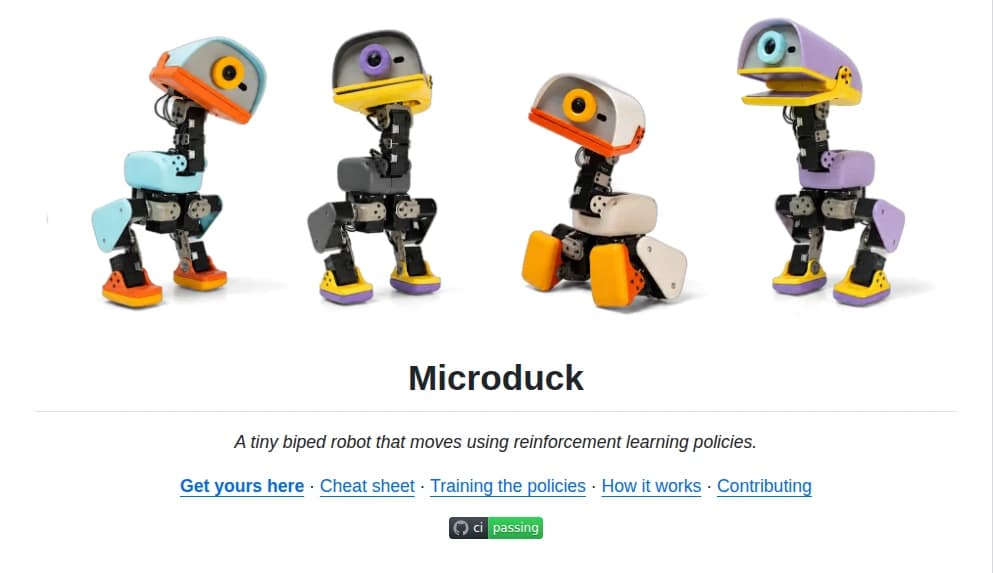
| MicroDuck | Pollen Robotics lists a $399 preorder price before taxes and shipping, with a battery, USB-C cable, game controller, and a software stack built around physical behaviors. Optional packs cost extra. 4 | It is more about movement and trainable behavior than a ready-made conversational companion. Its value comes partly from open software and experimentation, so your time and appetite for exploring matter. |
| Reachy Mini | Pollen lists Reachy Mini Wireless at $499 and Reachy Mini Lite at $399. The Lite uses a computer as its brain; both are sold as kits requiring about two hours of assembly. 5 | Hardware price is only one part of ownership. Setup, software integrations, the computer for Lite, and any external AI services you choose can affect cost and effort. |
This table does not rank the products by value because they are not trying to provide the same experience. LOOI is centered on an AI interaction with a phone-powered body. EMO leans toward a little robotic pet. MicroDuck emphasizes physical behaviors and open training. Reachy Mini is an expressive platform that can grow through software.
If your main goal is a conversational companion, a robot built around learned physical behaviors may not be the best substitute just because it has no subscription. If your main goal is movement and experimentation, paying for more advanced conversation may not add much value.
The hidden cost is often the service, not the subscription
A monthly fee is easy to notice. Dependencies are more subtle.
1. Cloud access
If the robot sends voice requests to a cloud model, that service has to remain available for the conversation experience to work as designed. The user may not pay a separate subscription today, but the product is still relying on external infrastructure and commercial terms.
LOOI's current privacy policy describes voice processing through a contracted cloud AI provider and says its memory and conversation history are stored in LOOI's cloud environment. That does not tell us the service will become paid; it does show that "no subscription" and "no cloud dependency" are not the same thing. 6
2. The phone you already own
A smartphone-powered design can be cost-effective if you already own a compatible phone and are happy to use it with the robot. It can be less convenient if you need to dedicate that phone, keep it charged, maintain app compatibility, or replace it sooner than planned.
Do not automatically add the full price of a new phone to the robot's cost. Instead, ask whether your existing phone can meet the requirements and whether using it this way creates a trade-off you care about.
3. Optional accessories
Some accessories improve convenience; others are required for a specific experience. MicroDuck's official page lists optional charger and accessory packs, including a $39 charger pack and a $39 accessory pack. These are not recurring fees, but they can increase the amount you spend to get the experience you imagined. 4
The same applies to add-on stations, spare batteries, charging docks, or other accessories across the category. Price the setup you actually plan to use.
4. Your time
This is the hidden cost most product pages cannot price for you.
Some users enjoy configuring devices, testing software, and following community projects. Others want to take the robot out of the box and interact with it without troubleshooting an app or learning a new workflow.
In a January 2026 r/emopet discussion, owners disagreed about whether EMO was worth the price. One person said the novelty ran out after a couple of days; another said they were still enjoying it after around 80 days; a longer-term owner said they had kept one for about two years but would not buy it again. This is not a representative sample, but the disagreement is useful: a product's cost cannot be separated from the kind of interaction the owner actually wants. 7
For open and programmable robots, that distinction matters even more. The ability to create new behavior is potential value. It becomes actual value only if you or the community turn that potential into something you want to use.
How to tell whether you will really save money
Use this simple checklist before buying any robot described as subscription-free.
- Check the current offer. Is there a mandatory recurring fee for the core use you want, or is the seller simply not advertising one on the product page?
- Check the feature boundary. Does "AI included" cover conversation, memory, visual understanding, voice, and future features, or only selected capabilities?
- Check the connection requirement. Which functions work offline? Which require an app, account, cloud model, or active internet connection?
- Check phone and computer requirements. Does a smartphone or PC provide part of the robot's processing? Is that device included?
- Check accessories. Are the charger, dock, controller, spare battery, or other items you need included?
- Check update history and support. Is there a clear place for release notes, known limitations, and support requests?
- Imagine the service disappearing. If cloud AI or the companion app became unavailable for a week, what could the robot still do?
The last question is not a prediction that a service will shut down. It is a useful way of understanding what you are purchasing: hardware with useful local behavior, or a physical access point to a service.
No subscription can still be the wrong deal
Imagine two robots.
Robot A has no monthly fee, but it mostly repeats a small set of animations. You like watching it move, and that is enough. It may be a good purchase for you.
Robot B offers richer conversation and memory, but its experience depends on a phone, an app, online AI, and a service policy that could change. It may still be the better choice if those capabilities are what you value. The important thing is knowing the dependency before you buy.
There is no universal winner. The decision depends on how much of the software experience you want, how reliably it works today, and how comfortable you are with the conditions that keep it running.
A note on AI model costs
I would be cautious with claims that a robot is "free forever" simply because its current plan has no subscription. AI services have operational costs, and product companies can make different choices about what they bundle, limit, or monetize. That does not mean a paid plan is inevitable for every robot. It means buyers should distinguish today's published terms from an open-ended promise about the future.
Equally, a subscription can be worth paying if it enables a capability you use frequently and the price is transparent. The goal is not to avoid every recurring fee. It is to avoid discovering after purchase that the feature you actually wanted sits behind a separate plan or relies on an unclear service dependency.
The MeraBots take
I would not choose a robot by subscription status alone. I would choose it by the relationship between four things:
- the experience it can reliably deliver today;
- the services or other devices needed to deliver it;
- the total setup and upkeep cost;
- the behavior that remains useful if the software stops improving.
The last point is important. A robot should not need an endless stream of promised future features to justify its current price. If its existing behavior already makes you smile, helps with a real task, or gives you something you value, new software can be a bonus. If the current experience is thin, a promise of future AI may not rescue the purchase.
For the wider cost picture, read How Much Does an AI Desktop Robot Really Cost Over Two Years?. For the more specific MicroDuck breakdown, see The $399 MicroDuck Isn't the Whole Cost. If you are comparing the value of the experience rather than its price, start with Are AI Companion Robots Worth It?.
Sources and pricing notes
Product prices and included features were checked on October 29, 2026 where possible. The LOOI no-subscription statement is from an official FAQ published November 13, 2025, so confirm the current terms in the app and at checkout. No subscription shown on a store page is not a guarantee that all future cloud features will remain free.
- LOOI official product page (Source 1)
- LOOI official AI access and subscription FAQ, November 2025 (Source 2)
- EMO official product page (Source 3)
- MicroDuck official page and accessory packs (Source 4)
- Reachy Mini official information (Source 5)
- LOOI Privacy Policy, updated August 5, 2026 (Source 6)
- Community discussion about EMO's value and novelty, January 2026 (Source 7)