The best AI desktop robot for an adult is not necessarily the one with the most impressive demo.
It is the one that gives you an experience you will still want after the first week.
That sounds obvious. It is also where many buying guides go wrong. They put a robot that walks, a robot that chats, a robot that reacts to touch, and a robot that turns your phone into a character into the same ranking. Then they decide one is the winner.
I would not compare them that way.
These products are trying to create different experiences. Before choosing a model, decide what you actually want to bring into your life: a little personality on your desk, an AI interface you can talk to, a mobile robot that moves around a room, or a small machine whose physical behavior is fun to watch and explore.
This is a research-based buying guide, not a claim that we have personally tested every device. I use manufacturers' current product information and public owner discussions, and distinguish those from conclusions drawn here. Prices were checked on October 26, 2026, and can change by region, bundle, and promotion.
The quick answer
| If you want... | Start by looking at... | The trade-off to understand |
|---|---|---|
| A character that behaves like a small desk pet | EMO | Personality and programmed behavior matter more than open-ended task ability. |
| A desk robot built around your smartphone | LOOI | Your phone and the companion app are part of the product, not optional extras. |
| A more mobile, pet-like robot | Loona | It is a playful mobile robot, not a replacement for a dedicated security camera or a guaranteed way to entertain a real pet. |
| An affordable expressive robot with simple interactions | Eilik | The basic Eilik is closer to an expressive desk companion than a general-purpose AI assistant. Its AI Station is sold separately. |
| Physical movement and room to experiment | MicroDuck | It is still early in its consumer lifecycle. Pre-order status and limited long-term owner evidence matter. |
If you are new to the category, read Before You Buy Your First AI Desktop Robot, Figure Out What You Actually Want before comparing specifications.
1. EMO: the clearest choice if you want a robot pet
EMO is built around personality, expression, and behavior in a small physical character. LivingAI describes it as an AI desktop pet that can explore the desk, react to sounds, recognize people, play games, dance, answer questions, and respond to its surroundings. The official store lists the base EMO at $279 at the time of research. 1 2
That makes EMO a better fit for someone who enjoys having a little character nearby than for someone who mainly wants a reliable task assistant.
The distinction is important. If you want the robot to entertain you through movement and reactions, the experience can be valuable even when it does not automate much of your day. But if you expect it to behave like a fully capable AI assistant that can follow a long conversation, remember everything, and reliably take actions, you may be judging it against the wrong product category.
Community discussions are mixed in a revealing way. In one 2026 thread asking whether EMO is worth buying, one owner said the novelty faded after a couple of days, while another reported still enjoying it after 80 days. A separate 2026 discussion included owners who said the novelty had worn off, alongside people who valued the character or the sense of companionship. These are individual reports, not a representative survey, but they show how strongly value depends on expectations and the way a person interacts with the robot. 3 4
Choose EMO if: you genuinely enjoy expressive, pet-like behavior and do not need the robot to justify itself through productivity.
Think twice if: you mainly want a conversational AI that can carry out useful tasks, or you tend to get tired of repeated animations and familiar routines.
2. LOOI: best for people who like the idea of a phone-powered robot
LOOI takes a different route. Instead of building every interface component into a self-contained robot, it uses your smartphone as a central part of the experience. Its official product page highlights AI conversation, memory, visual awareness, motion, reminders, games, and wireless phone charging. The app supports iOS and Android, subject to the phone requirements listed by the manufacturer. 5
The upside is easy to understand. Your phone already has a screen, cameras, microphones, connectivity, and substantial computing capability. A physical body can make that phone feel less like a slab on a desk and more like a small character that looks back at you.
The trade-off is just as important: you are buying a robot-and-phone system. Compatibility, the app, phone placement, charging, and software updates all affect the experience. If you want a completely independent robot that does not depend on your phone, LOOI may not be the right fit.
Community feedback also shows why a software-led product should be judged over time, not only from its launch video. The LOOI community discussed a major app update in August 2026, with some users reporting improvements and others describing regressions or loss of expected functions. A forum thread is not a controlled product test, and the experience can change after subsequent fixes. Still, it is a useful reminder to check current app behavior and release notes rather than assuming every review describes the current version. 6
Choose LOOI if: you want a conversational, expressive desk presence and are comfortable with your smartphone remaining central to the product.
Think twice if: you do not want another app-dependent device, or if you would rather use your phone directly for voice AI and reminders.
3. Loona: best if you want a mobile robot pet, not just a desk character
Loona moves around rather than staying in one desktop footprint. KEYi Tech presents it as a mobile pet robot for family interaction, games, and AI-enabled responses. Its US-facing price guide listed a standard bundle at around $399.90 in April 2026, with bundles and prices varying by market. Check the current official store before treating that figure as a quote. 7
The main appeal is physical presence. A robot that moves around a room creates a different kind of interaction from one that mainly reacts on a desk. For some people, that is exactly the point. For others, movement can create extra practical concerns: where it can roam, how it handles the space, when it needs charging, and whether its actions are actually useful rather than simply entertaining.
One expectation is worth correcting. Do not buy a consumer pet robot mainly to entertain your dog or cat, or as your primary home-security camera. In a September 2026 community discussion, owners specifically questioned those use cases and pointed out that a dedicated pet camera or security device may be better suited to the task. Those comments are anecdotes rather than a technical evaluation of every Loona feature, but the buying principle is sound: a robot being able to move or see does not automatically make it the best tool for surveillance or animal interaction. 8
Choose Loona if: you want a more mobile, playful robot and understand that its main value is interaction and entertainment.
Think twice if: you are trying to solve a specific monitoring task, or you expect a real pet to automatically bond with it.
4. Eilik: the budget-friendly option if you value expression over open-ended AI
Eilik is a smaller, simpler proposition. Energize Lab lists the base robot at $139.99 on its current store. It reacts to touch and handling with animated expressions and playful behaviors, and the manufacturer says it can operate without Wi-Fi or an internet connection. The separate Eilik AI Station is listed at $99, so a buyer who wants that add-on should compare the combined price, not just the base unit. 9
This distinction matters because the word AI can make products sound more similar than they really are. Basic Eilik is a small expressive companion. Adding the AI Station changes the experience, but it is still not sensible to assume it will work like a general-purpose assistant on your phone.
Eilik may be the better choice if you want an approachable desk character with low setup friction. It may also be a better gift than a more complex robot if the recipient wants simple, visible reactions rather than a device that needs regular conversation or configuration.
Choose Eilik if: price, simple interactions, and an expressive physical character are your priorities.
Think twice if: you specifically want strong open-ended conversation, long-term memory, or a robot that completes multi-step tasks. Confirm which capabilities are included in the base product and which require the AI Station or another accessory.
5. MicroDuck: the most interesting pick if movement is the attraction
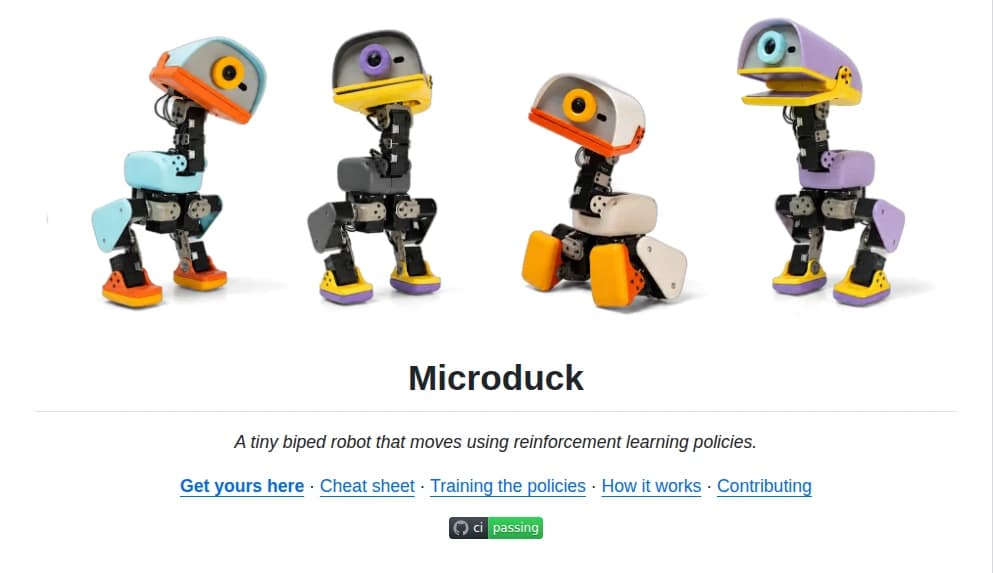
MicroDuck is different from most desk-pet products. Pollen Robotics describes it as a 25 cm biped with 15 motors, a camera, a depth sensor, two IMUs, an articulated beak, and an open software stack for training and deploying movement behaviors. Its introductory pre-order price is $399 before taxes and shipping, with first deliveries targeted before Christmas 2026 in North America, Europe, and the UK. 10
That is a compelling proposition for someone who wants to watch a small robot physically move, recover from falls, interact with objects, or eventually try new behaviors. The body is not just a display for an AI conversation. The movement is part of the experience.
But there is a consumer-evidence gap. As of October 28, 2026, MicroDuck is still in its pre-order period, so there is not yet a mature body of long-term household-owner experience to compare with established products. The public discussion around MicroDuck has included considerable interest in building, simulation, and robotics experiments. That tells us the platform attracts enthusiasts; it does not yet prove how often a typical non-technical buyer will use it after the novelty wears off. 10 11
I would not choose MicroDuck because I expect it to become a fully capable personal assistant. I would choose it because the physical robot itself looks interesting today, and because the open software creates room to explore what it could become.
Choose MicroDuck if: you are excited by movement and experimentation, and you are comfortable buying early in a product's lifecycle.
Think twice if: you want a proven, low-effort companion with years of ordinary household feedback behind it.
Which one is actually best for adults?
There is no useful universal winner, because these products offer different kinds of value.
| Your real priority | My starting point | Why |
|---|---|---|
| A little character that reacts to you | EMO or Eilik | Their expressive behavior is central to the product. |
| Conversation and an AI interface on your desk | LOOI | The smartphone-led design makes the interaction experience central. |
| A robot that moves around a room | Loona | Mobility changes the interaction more than another screen-based feature would. |
| A tiny robot whose physical behavior is the attraction | MicroDuck | Movement is the product's central strength, but it is still early for long-term consumer judgments. |
| A tool to solve a specific practical task | Start with the task, not a robot | A phone, speaker, timer, or dedicated home device may be more dependable and less expensive. |
Five questions to answer before buying
1. What do I want to happen on an ordinary Tuesday?
Not on launch day. Not in a highlight reel. On a normal day when you are busy, tired, or only half paying attention.
Do you want a few funny reactions while working? A conversation during breaks? A mobile robot to follow and play with? Or an actual task completed? Name the experience you want before comparing products.
2. How much interaction do I want to initiate?
Some buyers want a robot to react when they approach it. Others want it to remain quiet until invited. Some want proactive behavior. A robot that is lively to one person can feel intrusive to another, especially at night or while working.
3. What does it rely on?
Check the phone requirements, app, internet connection, account setup, charging arrangements, and which AI features require a service. A robot's body may last for years while the experience around it changes.
4. What is the current product, not the imagined future product?
Do not count a possible future app, a promised skill, or an open-source community project as a feature you already own. It is fine to be excited about future potential. Just price the product you can actually use today.
5. Would I still want it if the software never became more capable?
This is the question I would take most seriously. If the current behavior is already worth the money to you, future updates are a bonus. If the purchase only makes sense after imagining a much smarter robot, wait for evidence.
The MeraBots take
For most adults, the best first step is not choosing the robot with the longest feature list. It is deciding whether you want a desk pet, a phone-powered AI character, a mobile robot, or a small physical machine to explore.
These are not interchangeable experiences. The most expensive option may be wrong for you, and the least capable option on paper may be the one you are happiest to keep around.
I would also separate fun from utility. A robot does not have to improve your productivity to be worth owning. But if you are buying it for practical value, name the task and confirm that it can perform it today. Do not pay for usefulness you are only imagining.
For a closer look at how the products differ, see MicroDuck Alternatives: What Other Desktop Robots Should You Know About? and MicroDuck or EMO? Which One Fits You?.
Sources and community discussions
Product details and prices below are snapshots from the cited pages, checked or reviewed on October 28, 2026 where possible. Official descriptions show what a manufacturer claims, not independent verification of every capability. Reddit posts are individual experiences and should not be treated as a representative customer survey.
- EMO official product page (Source 1)
- LivingAI official store and listed EMO prices (Source 2)
- Community discussion: Is it really worth it? January 2026 (Source 3)
- Community discussion: Should I Let My Son Buy an EMO? July 2026 (Source 4)
- LOOI official product page (Source 5)
- Community discussion: August 2026 app update (Source 6)
- Loona price guide (Source 7)
- Community discussion: Expectations for Loona, September 2026 (Source 8)
- Eilik official store (Source 9)
- MicroDuck official product page (Source 10)
- Community member building a MicroDuck (Source 11)
- Discussion of MicroDuck's sim-to-real pipeline (Source 12)