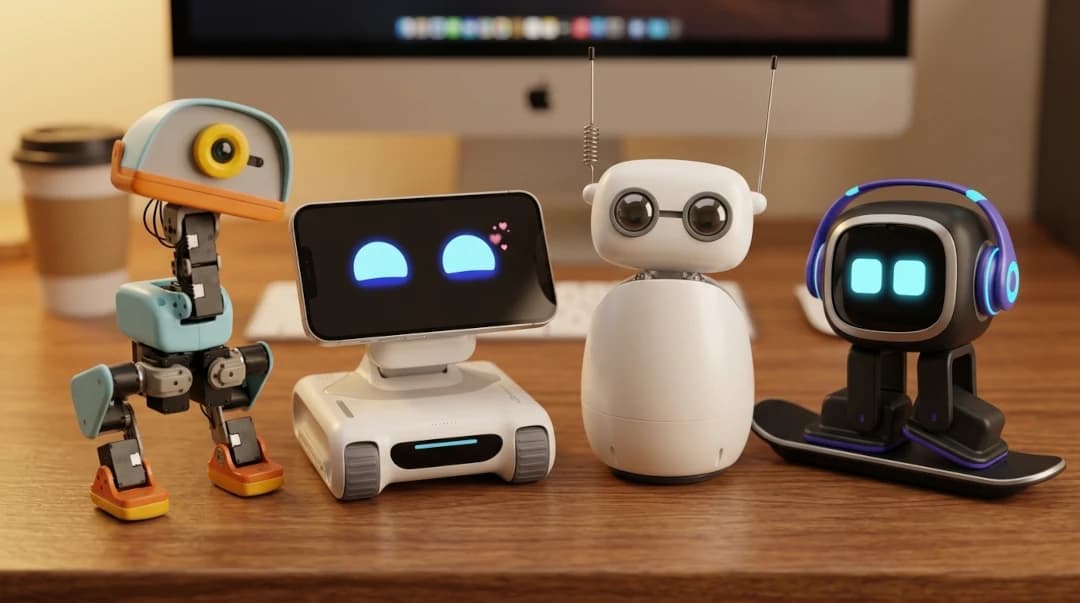
At first glance, this looks like a normal robot comparison.
Four small robots.
Four product pages.
A lot of specifications.
Then you start looking at what they are actually trying to do, and the comparison gets much more interesting.
MicroDuck wants to make the robot itself interesting.
EMO wants to feel like a little pet.
LOOI wants to turn an AI into something physical and expressive.
Reachy Mini wants to make the robot programmable, expandable, and increasingly useful through software.
So I don't think the right question is:
Which one is the best?
I think the better question is:
What kind of desktop robot are you actually looking for?
That difference matters more than another row in a spec table.
Four robots, four different ideas
Here is the simplest way I would describe them.
| Robot | The main idea |
|---|---|
| MicroDuck | Make the physical robot itself interesting |
| EMO | Make the robot feel like a pet |
| LOOI | Give an AI a physical body and personality |
| Reachy Mini | Make the robot a platform for interaction and software |
That is obviously a simplification.
Each robot does more than one thing.
But it is a useful place to start.
Because once you understand the basic idea behind each product, the rest of the comparison becomes much easier.
MicroDuck: What if the robot itself is the fun part?
MicroDuck is probably the easiest one to understand if you are drawn to the physical side of robotics.
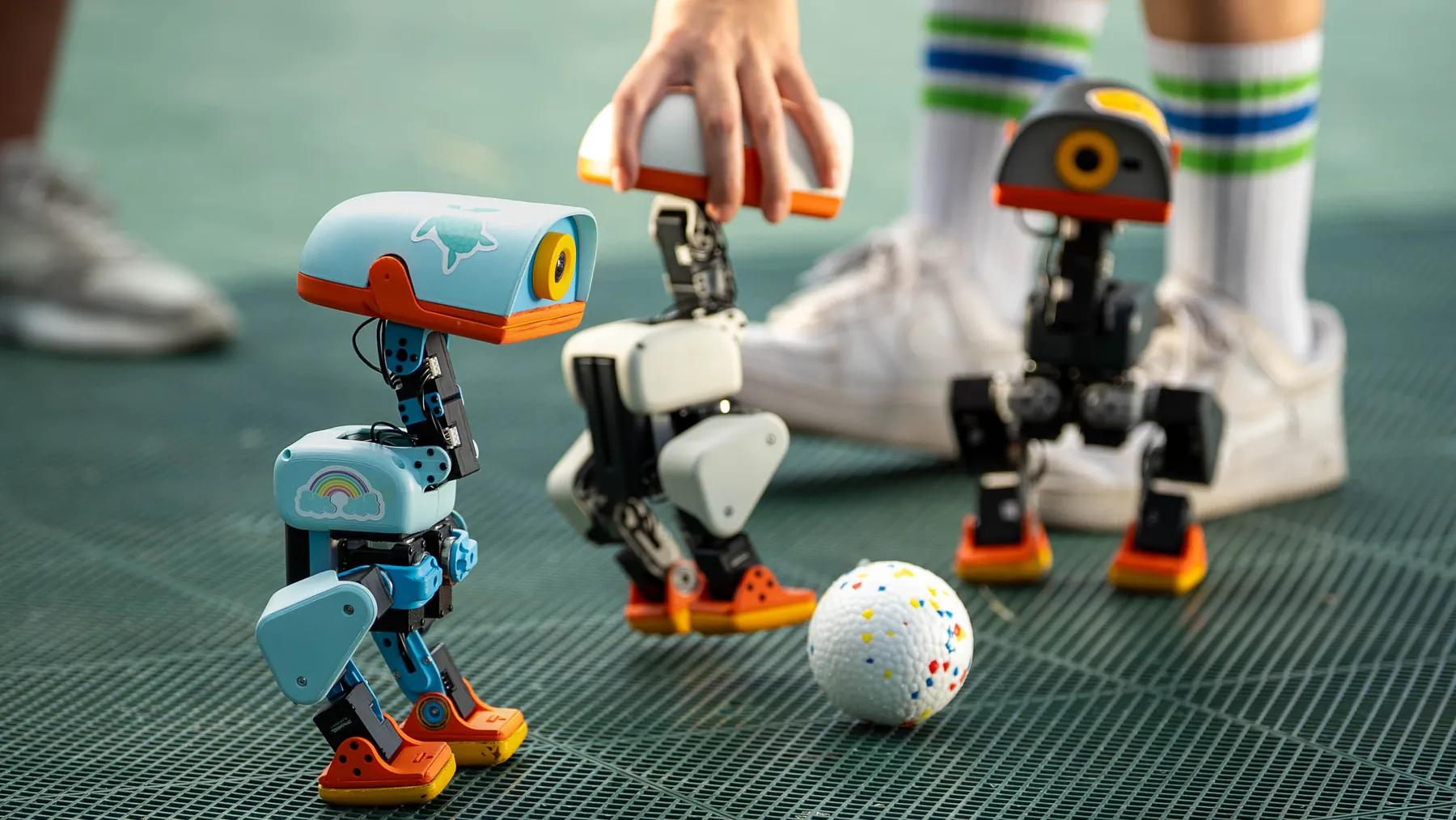
Pollen Robotics describes it as a 25 cm open-source biped with 15 motors, a camera, LiDAR, two IMUs, an articulated beak, and a software stack built around simulation and reinforcement learning. It can walk, sit, crouch, grasp objects, recover from many falls, and roller-skate. It currently ships as a preorder product rather than a generally delivered consumer robot.
That tells you something important.
MicroDuck is not really starting from:
"How can we make an AI assistant?"
It starts from:
"What can we make this little robot physically do?"
That's a different starting point.
And I think that explains why people react to it so quickly.
You don't have to understand reinforcement learning to look at a tiny duck walking across a room and think:
"Okay, that is actually pretty cool."
The physical behavior is the product.
The robot moving is the point.
The fact that the software is open source makes the idea bigger, because Pollen is publishing the SDK, simulation environment, and RL training stack rather than treating the robot's behavior as a completely closed box.
That openness also changes the kind of questions people ask.
In the MicroDuck launch discussion, people were already asking about adding large language models, voice recognition, autonomous behavior, and other interactive features before most people will even have the robot in their hands.
That's an interesting sign.
People are not only asking:
"What does MicroDuck do?"
They're asking:
"What could I make it do?"
If that's the part that gets you excited, MicroDuck is a very different proposition from a robot whose main purpose is companionship.
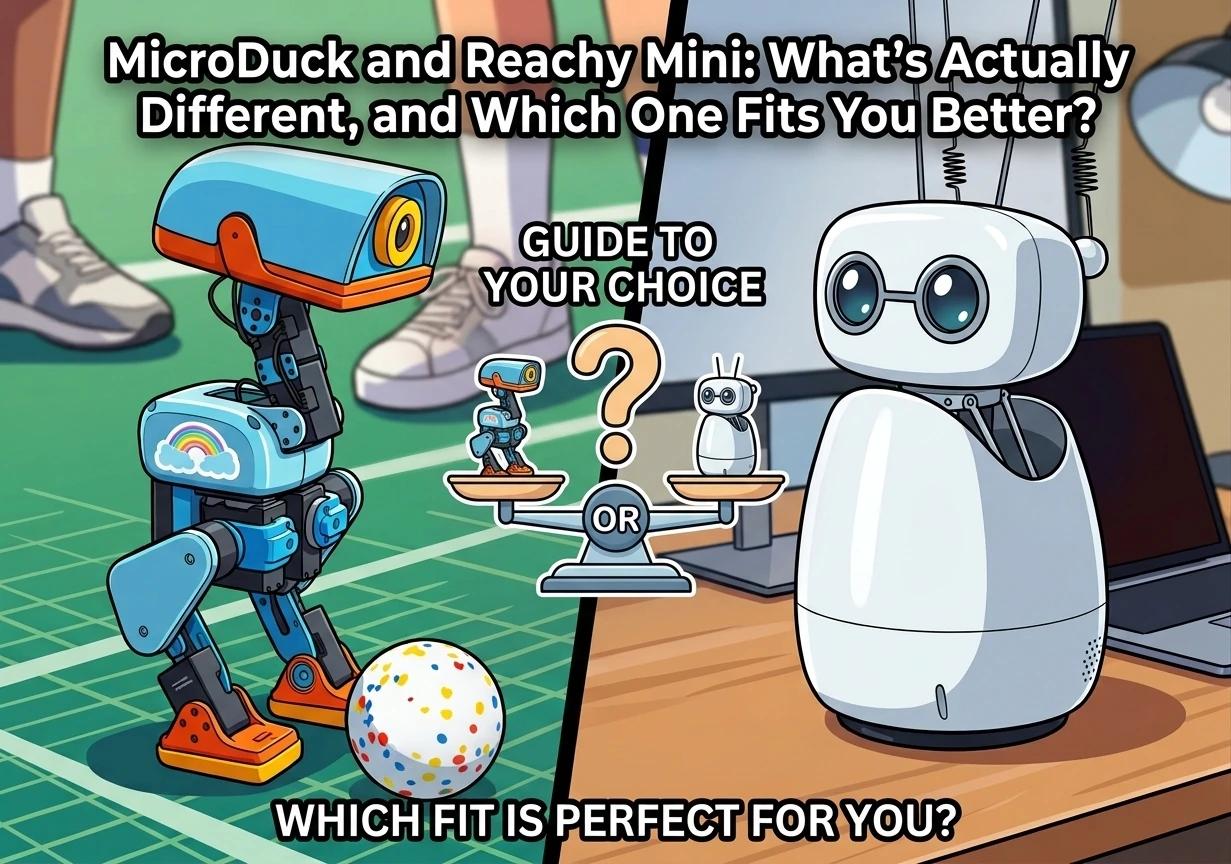
You can read our deeper MicroDuck and Reachy Mini comparison for the physical-vs-interaction difference.
EMO: What if the robot is more like a pet?
EMO starts from almost the opposite direction.
LivingAI calls EMO an AI desktop pet.
That isn't just marketing language around an otherwise generic robot. Personality is a major part of the product.
EMO is designed to move around the desk, explore independently, react to sounds, recognize people, play games, dance, answer questions, and behave like a little character that lives beside you.
The important thing here is that you don't necessarily need to invent a reason to use it.
You don't have to say:
"I bought this robot so it can increase my productivity by 8%."
That's not what EMO is trying to be.
The proposition is much simpler:
"I want a little robotic pet around."
And honestly, that makes sense.
A lot of people don't enter the desktop robot market because they have a problem to solve.
They see a robot doing something adorable and think:
"I want one."
That's actually how a lot of consumer products work.
The hard part comes later.
Will the robot remain interesting after the novelty wears off?
Does the personality feel varied?
Does it give you a reason to keep interacting with it?
Can it develop a sense of familiarity?
Those questions matter much more for a companion-oriented robot than the number of sensors it has.
That's why EMO belongs in this comparison even though its philosophy is quite different from MicroDuck.
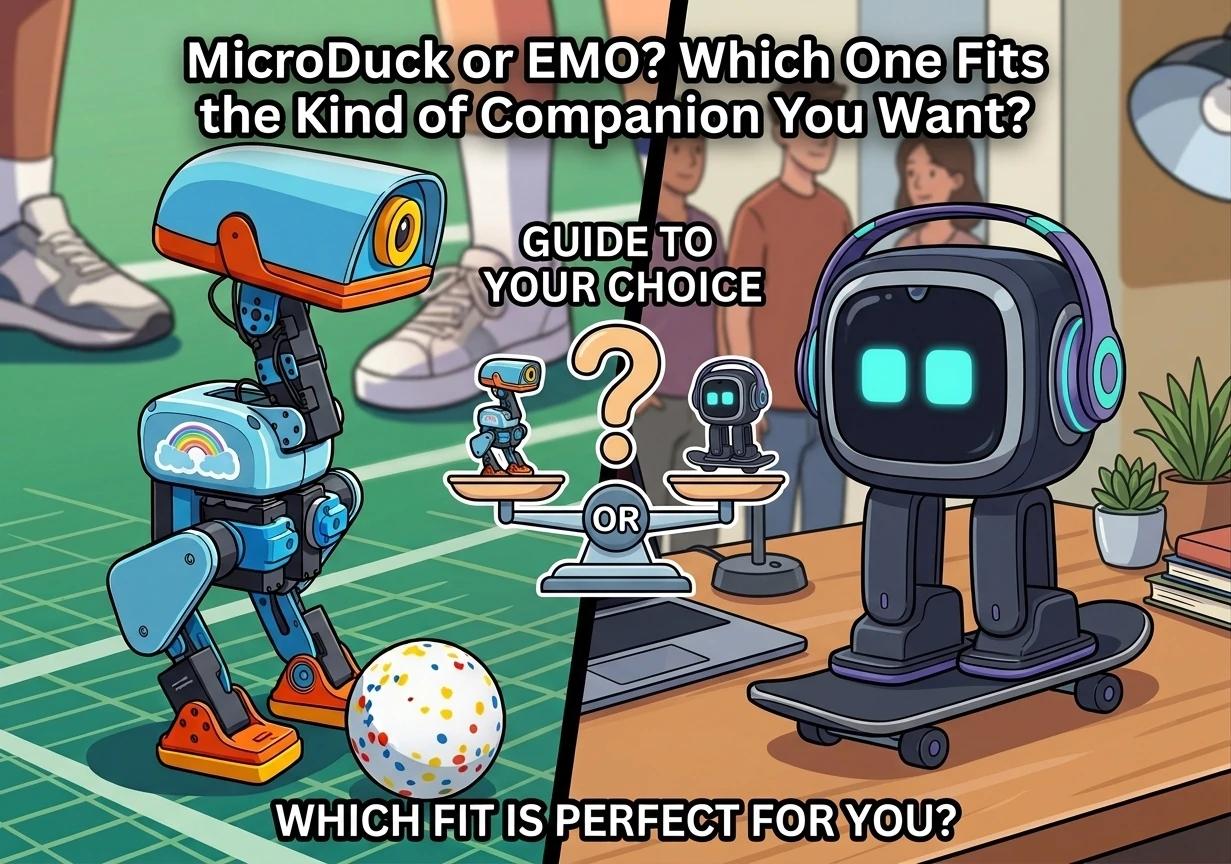
Our deeper MicroDuck vs EMO comparison looks more closely at that companion-vs-physical-robot distinction.
LOOI: What if your phone is part of the robot?
LOOI takes an approach that is easy to overlook because the product looks simple.
Your smartphone is part of the experience.
Instead of trying to put everything inside a standalone robot, LOOI uses the phone as a major part of the system and adds a physical body around it.
Its current product experience focuses heavily on natural conversation, memory, personality, visual awareness, gesture recognition, and expressive movement.
That creates a different kind of desktop robot.
LOOI is less about:
"Look what this machine can physically do."
and more about:
"What if the AI you already use could become a little character sitting next to you?"
I actually think that's a pretty clever idea.
Your phone already has:
- a good display;
- cameras;
- microphones;
- speakers;
- connectivity;
- significant computing resources.
Why rebuild all of that?
Use the phone.
Then let the robot body provide:
movement expression presence
So instead of building a robot around the hardware first, LOOI is using hardware to make an AI interaction feel more physical.
That's a very different product philosophy from MicroDuck.
MicroDuck asks:
"What can a physical robot do?"
LOOI asks:
"What happens when an AI has a physical presence?"
Those questions sound similar.
They are not.
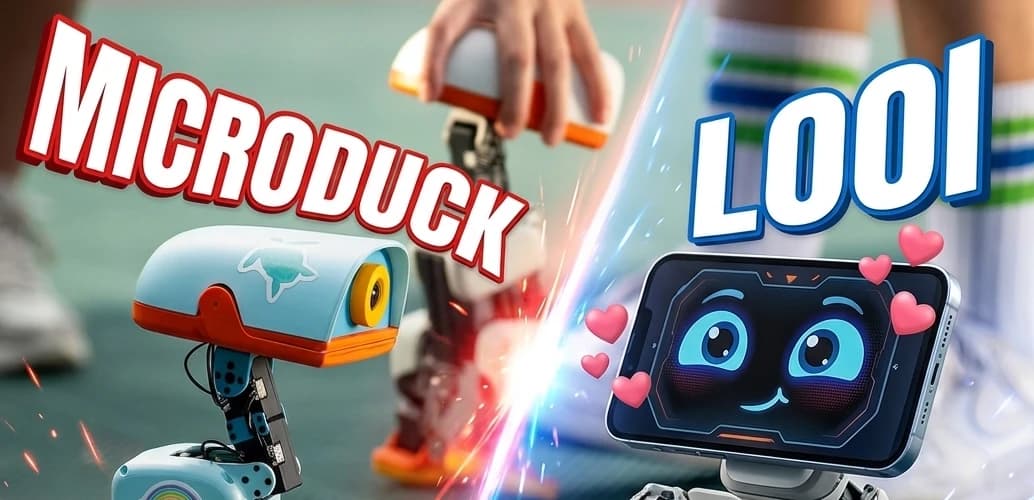
Our MicroDuck vs LOOI comparison goes deeper into this difference.
Reachy Mini: What if the robot itself is a platform?
Reachy Mini takes another route.
Pollen introduced Reachy Mini as an expressive, open-source robot designed around human-robot interaction, creative coding, and AI experimentation. The current ecosystem has gone further than simply giving owners a robot and an SDK: Reachy Mini supports apps that can be discovered and installed from its ecosystem, with official tooling for building and publishing new apps.
This is where the software side starts becoming really interesting.
An application can control the robot.
A conversation app can combine speech, LLMs and movement.
A browser-based app can interact with the robot through WebRTC.
Developers can publish applications so owners can install them.
And the official documentation explicitly describes AI-agent-assisted app creation as part of the workflow.
That changes the basic product model.
Instead of:
robot → fixed feature set
you start getting:
robot → software → applications → community
And that may turn out to be one of the most important directions in the entire desktop robot category.
Because hardware doesn't change very quickly after you buy it.
Software can.
A robot that gets new capabilities six months later feels like a very different product from one that ships exactly as it will remain forever.
So are these really competitors?
Yes.
But only at one level.
They are competing for some of the same people:
people who want something interesting on their desk.
That's real.
But underneath that, they're competing for different motivations.
Think about the question you might ask when you first see each one.
MicroDuck
"What can this little robot physically do?"
EMO
"What would it be like to have this little guy around every day?"
LOOI
"What would it be like if my AI actually lived on my desk?"
Reachy Mini
"What could I build or add to this robot?"
Those are four very different reasons to spend money.
And I think that is more useful than saying:
"Robot A has more features than Robot B."
The interesting comparison isn't really hardware
You can compare:
motors
cameras
microphones
battery
size
sensors
That's useful.
It just doesn't explain why you would choose one robot over another.
A more useful comparison is:
| Dimension | MicroDuck | EMO | LOOI | Reachy Mini |
|---|---|---|---|---|
| Physical behavior | Central | Important | Supporting | Important |
| Personality | Emerging | Central | Central | Important |
| Conversation | Not its main current focus | Present | Central | Strong software direction |
| Companion idea | Possible | Core | Core | Possible / expandable |
| Open software | Strong | More limited | More product-focused | Strong |
| Software ecosystem | Early | Product-driven | Product-driven | Strong community direction |
| Experimentation | Strong | More limited | Moderate | Strong |
This table is not meant to tell you which robot is "better."
It is meant to show you where the center of gravity is.
That's the part that matters.
There is a bigger story behind these four robots
This is where I think the category gets genuinely interesting.
For years, consumer robots were mostly divided between:
toys
and
useful machines.
Desktop robots are creating a stranger middle ground.
A robot can be entertaining without solving a serious problem.
It can be useful without looking like an appliance.
It can be programmable without requiring every user to become a developer.
And it can be intelligent without simply being a screen with a chatbot inside.
We're starting to see several different approaches at once.
MicroDuck is pushing the physical behavior side.
EMO is pushing the robot pet / personality side.
LOOI is pushing the AI companion with a physical body side.
Reachy Mini is pushing the software and app platform side.
And there is no reason these directions have to stay separate.
In fact, the obvious long-term question is:
What happens when one robot can do all four?
The software layer may become the real battleground
This is the part I would watch closely.
A better motor is nice.
A better camera is nice.
A better microphone is nice.
But software can completely change the experience.
A recent community discussion about desktop robots was already showing people thinking beyond individual products. One project demonstrated an autonomous software layer talking with a Reachy Mini and another physical robot, with MicroDuck being discussed as another possible robot in the same ecosystem.
That's a small discussion.
But I think it points toward a much bigger possibility.
Maybe the future isn't:
one company makes one robot with one fixed personality.
Maybe it becomes:
hardware layer + intelligence layer + apps + community
And then the hardware becomes one part of the product rather than the entire product.
That's a very different world.
This is also why "open source" means different things for different robots
MicroDuck's openness is strongly connected to its robot behavior stack: SDK, simulation, RL training, and the ability to work with the policies that control the robot.
Reachy Mini takes a broader software approach, with open tooling, apps, SDK access, AI integrations, and a mechanism for sharing applications with other owners.
Those are both called "open."
But they're not the same kind of openness.
This is why I wrote Does Open Source Actually Matter If You Don't Code?.
For a normal user, the important question is rarely:
"Can I read the source code?"
It is more like:
"Does somebody else being able to access the source code eventually give me a better robot?"
That is a much more interesting question.
What about AI?
Here's another thing I wouldn't use as the deciding factor.
People often ask:
"Does it use ChatGPT?"
or:
"Which one has the best AI?"
I understand why.
But I don't think the language model tells you enough.
A robot can use a great language model and still feel like a surprisingly bad robot.
Why?
Because a robot has to deal with more than conversation.
It needs:
perception
memory
timing
movement
state
tools
actions
recovery
physical context
A model can generate a very good answer.
That doesn't automatically make the robot know:
when to speak,
when to move,
what to remember,
what to do next,
or whether it should do anything at all.
This is one of the reasons I'm more interested in the idea of a robot brain than simply putting the newest LLM into a robot.
A robot with a body changes the problem.
And the software connecting the brain to the body may eventually matter more than the model name.
What if you're not technical?
This is probably the most important part for a normal buyer.
You don't need to become a robotics developer to understand the category.
You only need to figure out what actually attracts you.
If your reaction to MicroDuck is:
"I want to see a little robot running around."
Then you're interested in physical behavior.
If your reaction to EMO is:
"I want a little robotic pet."
You're interested in personality and companionship.
If your reaction to LOOI is:
"I want my AI to feel more like a little character."
You're interested in AI interaction.
If your reaction to Reachy Mini is:
"I wonder what people will build for this."
You're interested in software and experimentation.
None of those motivations is more legitimate than the others.
They're just different.
And knowing which one you actually care about can save you from buying a robot because the demo looked impressive, only to discover that it isn't the kind of robot you wanted.
That's also why our AI desktop robot guide starts from the experience rather than the specification sheet.
What I think is still missing
Looking at these products together, I don't think the category has figured out the final form yet.
We have pieces.
We have robots that move well.
We have robots with personality.
We have increasingly capable AI conversations.
We have open-source hardware and software.
We have growing app ecosystems.
But putting those things together is much harder.
Imagine a robot that:
knows who you are,
remembers previous conversations,
understands your environment,
decides when to interact,
moves naturally,
uses tools,
learns your preferences,
and gains new abilities through software.
That starts feeling very different from:
"a little robot that can talk."
It starts feeling like something closer to a personal physical AI.
We're not there yet.
But you can already see different pieces of it appearing in different products.
So which one should you look at?
I wouldn't start with a ranking.
I'd start with the thing that made you interested in desktop robots in the first place.
You want a robot that physically does things
Look closely at MicroDuck.
Its physical behavior is central to the product, and its open software stack makes experimentation part of the appeal.
You want a robot that feels like a pet
Look closely at EMO.
Its product identity is built around personality, exploration, reactions and companionship.
You want an AI companion with a physical form
Look closely at LOOI.
Its phone-based architecture and emphasis on conversation, memory and personality make it a very different kind of robot.
You want a robot that can keep changing through software
Look closely at Reachy Mini.
Its app ecosystem, SDK and AI integrations make the software side a major part of the product.
The question I'd keep asking
I don't think the interesting question is:
"Which desktop robot is the best?"
The more interesting question is:
"What do we actually want these robots to become?"
MicroDuck gives one answer.
EMO gives another.
LOOI gives another.
Reachy Mini gives another.
And because they are all still relatively early, I don't think we have the final answer yet.
That's exactly what makes this category fun to watch.
A few years from now, we may look back at these robots and realize they were all exploring different pieces of the same thing.
Not better chatbots.
Not smaller computers.
Not toys with faces.
But something much simpler:
A computer that can actually exist in your physical space.
And I think that is where desktop robots get really interesting.