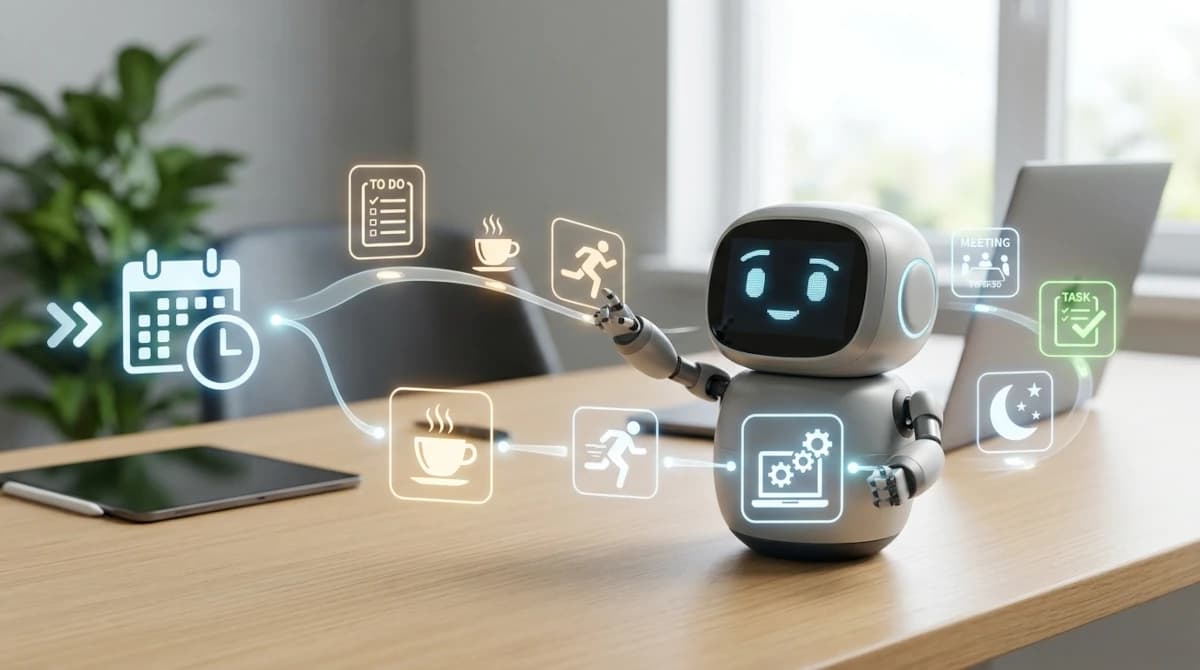
Can an AI desktop robot help you build a daily routine?
I think it could help with parts of one. But a robot following its own schedule is not the same as a robot helping you follow yours.
That distinction matters more than it first appears.
A robot may wake up, exercise, play, or go to sleep at set times. That can make it feel alive and give the device a rhythm. But your day is not a fixed animation sequence. Meetings move, plans change, you sleep in, and some days do not resemble the schedule you expected.
For a robot to become useful in your routine, it needs to respond to your life rather than simply perform a routine of its own.
A schedule is not the same as a useful routine
I would separate three things that product pages can make sound similar.
A character schedule gives the robot its own activities. It might appear to eat breakfast, exercise, read, or sleep at certain times. This adds personality and makes the robot feel less static.
A reminder schedule tells you about something you asked it to remember. That could be a meeting, a planned break, or a recurring household task. The value depends on whether the reminder is timely and easy to change.
A personal routine assistant understands how your activities relate to one another. It knows that a meeting has moved, that you already completed a task, or that a reminder is no longer relevant. It can adjust its behavior instead of repeating an outdated prompt.
The first is mostly entertainment. The second is a practical utility. The third requires a much deeper level of context and reliable software.
A consumer should not pay for the third while only receiving the first.
What current robot owners reveal about routines
EMO is a useful example because its daily schedule is an explicit part of the product experience. LivingAI announced a schedule feature in its June 2022 firmware update, describing timed activities such as eating, exercising, and playing. [1]
The feature gives EMO a sense of its own daily life. But owner discussions also show why a fixed schedule is not the same as a personalized routine. In July 2025, a LivingAI community moderator answered a question about changing EMO's wake-up time by explaining that users could not manually reschedule the activities. They could turn the schedule or its sound off instead. [2]
That may be perfectly fine for a digital pet. It is less useful if the buyer expects a personal assistant that adapts to their timetable.
A different kind of demand appeared in an October 2026 r/loona_robot discussion. A parent asked for ideas for custom interactions and daily routines for a family with a ten-year-old. Replies described the available Scratch-style programming as limited and expressed a desire for more flexibility. [3]
Again, this is one community discussion, not a full assessment of Loona's capabilities. What interests me is the question behind it: owners want to connect the robot's behavior to their own household patterns, not just watch a collection of preset tricks.
That is where routine value begins.
The routines a small AI device could realistically support
I would start with small, repeatable moments rather than expecting a robot to manage an entire day.
A start-of-day check-in
A useful morning interaction could ask what matters today, surface one or two upcoming commitments, and let you choose a priority. It should not deliver a long motivational speech or invent tasks you never agreed to.
The important part is context. If your calendar is empty, the robot should not pretend to know what you need to do. If your first meeting has moved, it should use the updated time rather than an old reminder.
A transition into focused work
A device could provide a simple cue when you choose to start a work block. The interaction might be a short sound, a visual expression, or a brief confirmation of the task you selected.
I would make this user-initiated. A robot should not decide that every time you sit down is an invitation to interrupt you. For more on that distinction, see AI desktop robots for working from home.
A follow-up after a commitment
This is more interesting than a generic reminder.
Suppose you tell an assistant, "I need to send that document after lunch." A basic reminder can repeat the sentence at a chosen time. A more useful system would preserve what "that document" refers to, ask whether the task is still relevant if plans change, and let you mark it done without rebuilding the context.
That requires memory, but memory alone is not enough. The system also needs to understand what action should happen next and whether the user has completed it.
An end-of-day reset
A short review can help you collect unfinished tasks, decide what should move to tomorrow, and stop carrying every open loop in your head.
The robot's physical presence could make this interaction feel more natural than opening another productivity app. But the software still needs to connect to the calendar and task list the person already uses. Otherwise, the robot becomes one more place where information has to be entered.
What makes a routine assistant helpful instead of annoying?
I would look for five behaviors.
It remembers the routine you actually chose
The user should define what matters. A morning review, an afternoon break, and an evening reminder are not universal needs. The device should not assume that everyone follows the same timetable.
It adapts when the day changes
A reminder that ignores a rescheduled meeting is not intelligent. A routine assistant should make it easy to postpone, skip, or adjust a cue without forcing the user to edit a complicated schedule.
It distinguishes a reminder from an action
Saying "You have an email to send" is not the same as preparing a draft, finding the relevant thread, or confirming that the message was sent. The system should be honest about what it can do and ask permission before taking consequential actions.
It knows when to stay quiet
A routine only helps when the interruption is worth it. The user needs quiet hours, a pause button, and control over how often the device initiates contact. We explore this in when a robot should talk first and when it should stay quiet.
It makes mistakes easy to correct
If the robot remembers the wrong time or misunderstands a task, correcting it should be easier than starting over. A personal assistant that confidently repeats bad information can create more work than it removes.
The software matters more than the animation
A robot can have a charming daily schedule and still do very little to support the owner's actual day.
For me, a better design starts with a simple loop:
- The user tells the system about a routine or commitment.
- The system records the time, context, and what should happen next.
- It gives a cue at the agreed moment.
- The user can confirm, postpone, or dismiss it naturally.
- The system updates the routine so it does not keep repeating stale information.
That loop is not flashy. It is also where repeated usefulness could come from.
The hardware can make the interaction more visible or more convenient. A desk robot can provide a glanceable cue; a wearable device could offer a subtle prompt while away from the desk. But neither form factor fixes weak memory, unreliable scheduling, or poor follow-through.
This is why I think the software should be designed around the user's routine first. The robot should be an interface for the experience, not the reason the experience exists.
Should you buy a desktop robot to improve your routine?
I would not buy one solely for that reason unless the specific product clearly supports the reminders and integrations you need today.
If you want a character with its own little schedule, a robot like EMO may offer an enjoyable experience. If you want a dependable system for managing appointments, tasks, and follow-ups, check whether it actually connects to those services and whether its behavior can be customized.
Before buying, ask:
- Can I create my own routines, or only watch preset activities?
- Can I move a reminder when my plans change?
- Can I silence or pause the robot immediately?
- Does it connect to the calendar or task app I already use?
- Does it remember whether I completed something, or will it repeat the same prompt?
The difference between a cute schedule and a useful routine assistant is the difference between a robot that has a day and a robot that helps you with yours.
I think the second is a much more interesting direction for personal AI. But it has to be earned through reliable software, not implied by a moving face and a clock.
Sources and community notes
Community posts below are qualitative examples, not a representative survey of robot owners.
- LivingAI: Firmware Update 1.5.0 and EMO's Daily Schedule — June 19, 2022 manufacturer forum announcement of timed character activities.
- LivingAI Community: EMO's Daily Schedule — July 2025 moderator response about the inability to manually reschedule the preset daily activities at that time.
- r/loona_robot: Custom programming ideas — October 2026 discussion from a parent seeking more flexible family interactions and routine ideas.